
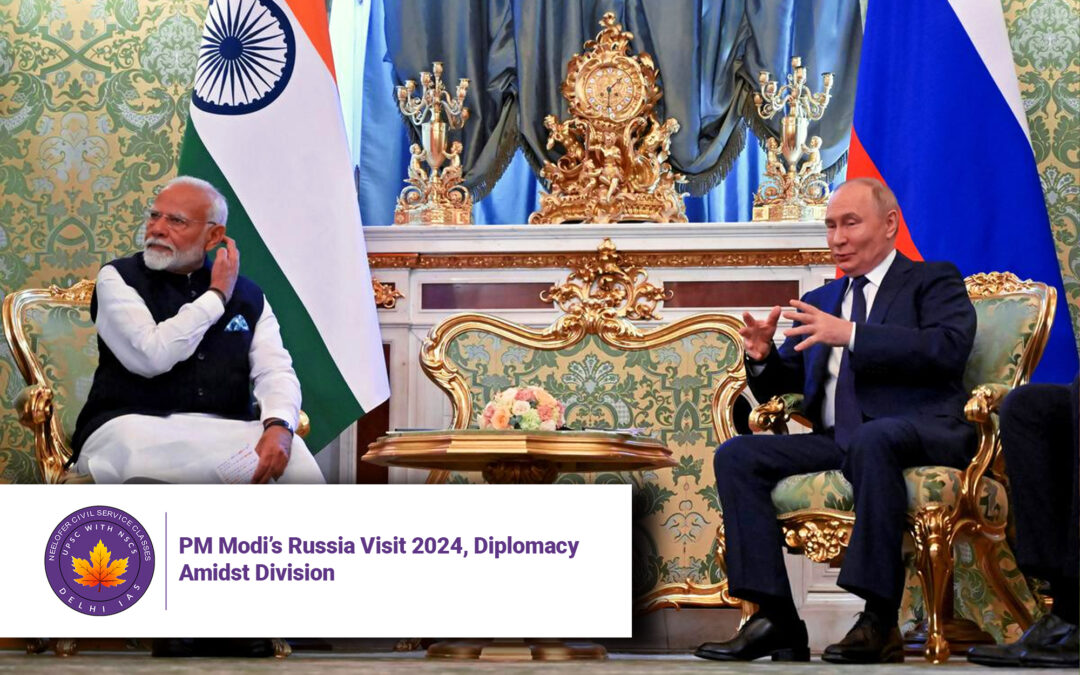
PM Modi’s Russia Visit 2024, Diplomacy Amidst Division
Why in News?
In July 2024, Prime Minister Narendra Modi visited Russia for the first time since the Russia-Ukraine war began in 2022. His meeting with President Vladimir Putin in Moscow marked a significant development in India’s foreign policy — balancing its deep historical ties with Russia amid increasing global polarization and pressure from Western allies. 
Introduction
India’s foreign policy has long been known for its strategic autonomy. PM Modi’s 2024 visit to Moscow reflects that principle in action. At a time when most Western leaders are isolating Russia, Modi’s presence at the Kremlin sent a strong signal — India will act in its national interest and engage all sides. The visit was a display of pragmatic diplomacy, with key focus areas like energy, defence, trade, and regional security.
This engagement not only reaffirmed India’s historical ties with Russia but also emphasized New Delhi’s role as a global bridge between the West and the East.
Key Issues and Background
1. India-Russia Relations: The Historical Context
-
The India-Russia (formerly USSR) partnership dates back to the Cold War era.
-
Russia has been India’s biggest defence supplier, and continues to support Indian interests at the UN Security Council.
-
Bilateral cooperation spans sectors including nuclear energy, space, pharmaceuticals, and crude oil.
2. Timing of the Visit and Global Optics
-
Modi’s Russia visit came just after his attendance at the G7 summit in Italy, where he met Western leaders.
-
His Moscow visit stood out globally because it came amid the ongoing Ukraine war, with the West maintaining a cold stance toward Russia.
-
Modi met Putin privately at his dacha, showcasing a personal rapport not often seen in diplomacy.
3. Balancing Ties: The Ukraine Factor
-
India has consistently avoided condemning Russia at the UN but has also called for peace and dialogue.
-
Modi reiterated that “this is not an era of war,” signaling concern over civilian suffering and global instability.
-
India continues to walk a fine line — importing discounted Russian oil while maintaining relations with Ukraine and the West.
4. Economic and Strategic Gains
-
India is the second-largest buyer of Russian crude, gaining from sanctions-induced discounts.
-
Discussions focused on expanding the India-Russia energy partnership, including nuclear cooperation and long-term oil agreements.
-
Talks also covered defence projects, local manufacturing under “Make in India,” and enhancing the INSTC trade corridor (International North-South Transport Corridor).
Specific Impacts or Effects
Strengthening Strategic Autonomy
-
The visit showcased India’s non-aligned and multi-aligned strategy, reinforcing its independent decision-making in foreign affairs.
Oil and Energy Security
-
With global oil prices volatile, India has benefited immensely from cheaper Russian crude, helping it curb domestic inflation.
Defence Continuity
-
Despite Western scrutiny, India reaffirmed its interest in Russian defence platforms, including spare parts for legacy systems.
Soft Power Diplomacy
-
Modi’s popularity among the Indian diaspora and friendly image in global media added to the symbolism of the visit.
Challenges and the Way Forward
Challenges
-
Western backlash: The U.S. and European Union may view deeper India-Russia engagement as contradictory to democratic partnerships.
-
China-Russia axis: Growing ties between Moscow and Beijing complicate India’s regional interests.
-
Dependency risks: Overreliance on Russian oil and defence tech poses long-term risks amid global instability.
Steps Forward
-
Diversify energy sources while using Russian deals as leverage.
-
Increase domestic defence production to reduce import dependency.
-
Use diplomatic goodwill to push for peace in Ukraine, enhancing India’s global image as a peace broker.
-
Strengthen regional cooperation through BRICS, SCO, and INSTC to hedge against unpredictable geopolitics.
Conclusion
PM Modi’s 2024 Russia visit was more than a bilateral engagement — it was a geopolitical statement. By visiting Moscow amid global tensions, India reasserted its strategic autonomy and commitment to multi-alignment. This is not a tilt toward any bloc but a firm step in protecting India’s national interest. In an increasingly divided world, India’s ability to talk to all sides — East, West, and Global South — gives it unique diplomatic currency.
As the world grapples with energy crises, regional conflicts, and a shifting world order, India’s voice of balance is not just important — it’s necessary.
5 Questions and Answers
Q1: Why was PM Modi’s visit to Russia in 2024 significant?
A: It marked India’s strategic decision to maintain relations with Russia despite Western pressure, showing its commitment to multi-aligned diplomacy.
Q2: What were the key issues discussed during Modi’s visit?
A: Energy cooperation, defence ties, trade routes, regional security, and the global fallout of the Ukraine war.
Q3: How did India balance its relations with the West and Russia?
A: By attending the G7 summit just before visiting Moscow, India signaled it values partnerships with both camps and will act independently.
Q4: What were the economic benefits of the visit for India?
A: Continued access to discounted Russian oil, reaffirmation of defence deals, and new opportunities in energy and infrastructure cooperation.
Q5: What are the concerns arising from deeper India-Russia ties?
A: Potential diplomatic friction with Western allies, dependency on Russian resources, and navigating the growing Russia-China partnership.

