
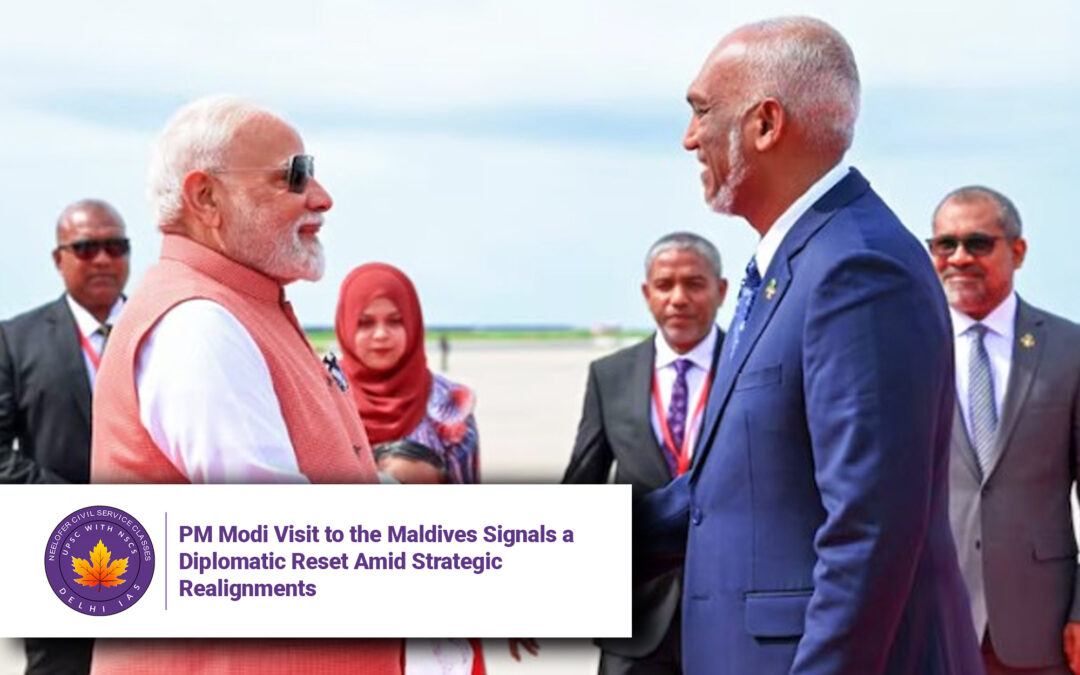
PM Modi Visit to the Maldives Signals a Diplomatic Reset Amid Strategic Realignments
Introduction
In the rapidly evolving dynamics of the Indian Ocean region, the relationship between India and the Maldives has always held strategic weight. This bilateral connection, rooted in historical, cultural, economic, and maritime links, has witnessed both periods of close cooperation and episodes of tension. The recent visit by Indian Prime Minister Narendra Modi to the Maldives, at the invitation of President Mohamed Muizzu, comes at a critical juncture—marking a potential reset in strained bilateral ties. 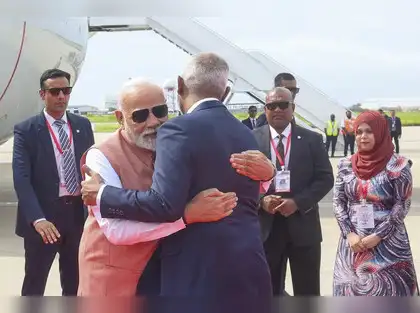
This diplomatic engagement was not just symbolic but substantive, with several economic agreements signed and development projects inaugurated. It reflects India’s efforts to reaffirm its presence in the Maldives amid rising Chinese influence and to restore the trajectory of a time-tested partnership that had faltered since the political change in Malé in 2023.
Backdrop: The India-Maldives Diplomatic Strain
The strain in India-Maldives relations began with the rise of Mohamed Muizzu to the presidency in September 2023. Backed by the “India Out” campaign—a political movement aimed at reducing Indian military presence and influence in the Maldives—Muizzu’s administration quickly signaled its intent to shift foreign policy orientation. His visit to China in January 2024 and subsequent call for the withdrawal of Indian troops from Maldivian territory were perceived as assertive steps to distance the island nation from New Delhi.
India, long a strategic partner and neighbor with deep-rooted historical and cultural ties to the Maldives, found its influence receding. At a time when China’s economic engagement with the Maldives was gaining momentum, India’s diplomatic and strategic presence seemed under threat.
The current visit by PM Modi, therefore, is not merely ceremonial—it is aimed at rebuilding trust, reaffirming India’s commitment to its ‘Neighbourhood First’ policy, and countering growing Chinese engagement in India’s maritime periphery.
Significance of the Visit: Economic and Strategic Turnaround
1. A Diplomatic Reset
PM Modi’s visit was centered around the celebration of Maldivian Independence Day, but its deeper message was the intent to normalize and revitalize diplomatic ties that had been under strain for nearly a year. During his visit, PM Modi met senior government officials and also leaders from the Maldivian Opposition, demonstrating India’s effort to engage across the political spectrum and build enduring institutional relationships.
This approach signifies India’s desire to insulate its bilateral ties from domestic political fluctuations in the Maldives. By ensuring engagement with both ruling and opposition factions, India is reinforcing a non-partisan diplomatic approach, a move that provides stability to the relationship even amidst regime changes.
2. Renewed Economic Engagement
During the visit, several economic agreements were signed, and important projects were inaugurated. India reiterated its commitment to support the Maldives in sectors such as infrastructure, healthcare, tourism, and disaster relief. These agreements underscore India’s proactive approach to assist the Maldives in tangible and impactful ways, which in turn helps restore goodwill among Maldivian citizens.
India has historically provided lines of credit, grants, and technical assistance to the Maldives. PM Modi’s visit brought renewed momentum to these programs, strengthening bilateral economic ties and increasing India’s visibility in the region.
3. Maritime and Strategic Importance
The Maldives, situated in the heart of the Indian Ocean, is critical to India’s maritime strategy. It lies along key sea lanes of communication through which a significant percentage of India’s and global trade and energy supplies pass. Ensuring friendly relations with the Maldives is essential for India’s maritime security, naval outreach, and regional influence.
India’s ‘Neighbourhood First’ policy and SAGAR (Security and Growth for All in the Region) doctrine both place the Maldives at the core of its Indo-Pacific strategy. PM Modi’s visit is a reaffirmation of this strategic priority and India’s continued commitment to being a reliable partner.
Tourism and People-to-People Ties: A Cultural Connector
Tourism has always been a central link between India and the Maldives. Indian tourists were the largest group visiting the Maldives for several consecutive years until 2023. However, this trend reversed sharply in 2024 following derogatory remarks made by three Maldivian junior ministers about Indian tourists. The comments triggered a diplomatic row and a significant decline in Indian tourist arrivals.
In a bid to reverse the fallout and rebuild trust, President Muizzu acknowledged India’s vital contribution to Maldivian tourism. Speaking after PM Modi’s visit, Muizzu stated that “India is one of the major countries that helps the Maldives with tourism. With PM Modi’s visit, it is going to increase a lot.”
Tourism contributes nearly one-third of the Maldivian economy. Rebuilding Indian tourist flows is essential for Malé’s post-pandemic economic recovery. India, for its part, also benefits through cultural exchanges, connectivity, and diaspora engagement.
China Factor: Strategic Competition and Policy Dilemmas
India’s reset in relations with the Maldives comes against the backdrop of increasing Chinese economic and political engagement in the region. China, through its Belt and Road Initiative (BRI), has made large-scale investments in the Maldives, including in infrastructure, housing, and port development.
President Muizzu’s visit to China in January 2024 was closely watched in New Delhi, particularly as discussions were held on loan restructuring and new investment flows. However, little progress has been made on debt relief, with Chinese lending practices now being viewed by some Maldivians as a burden rather than a boon.
The Maldives’ external debt situation—significantly tilted towards Chinese lenders—has become a pressing issue. India, as a responsible regional power, is offering viable alternatives through transparent development aid and low-interest financing. This provides Malé with room to maneuver, reducing over-dependence on Beijing.
India’s challenge lies in balancing its influence without being seen as coercive, while also protecting its security interests in the Indian Ocean. The visit by PM Modi aims to position India as a partner that respects sovereignty, delivers results, and shares long-term regional objectives.
Political Engagement: Reaching Across the Aisle
Another critical takeaway from PM Modi’s visit was his effort to engage not just with the ruling establishment, but also with opposition parties and political stakeholders. This engagement sends a strong signal that India values long-term relationships with Maldivian institutions, not just individual leaders or parties.
In countries with frequent leadership changes, such as the Maldives, such bipartisan engagement is essential. It ensures continuity in foreign relations and insulates them from domestic political turbulence.
India’s approach reflects lessons from past experiences where political shifts in neighboring countries have impacted bilateral ties. By fostering wider engagement, India aims to strengthen institutional bonds and ensure that ties remain resilient irrespective of electoral outcomes.
Conclusion: A Path Forward
PM Modi’s visit to the Maldives is a strategic masterstroke that seeks to recalibrate relations after a challenging period. By focusing on infrastructure, people-to-people ties, tourism, and security cooperation, India is aiming to rebuild trust and strengthen its foothold in a region that is becoming increasingly contested.
At the same time, India is careful not to demand exclusivity. It recognizes that the Maldives, like other sovereign nations, will engage with multiple partners, including China. The key lies in offering better terms, deeper cultural and historical resonance, and long-term partnership—values that India is uniquely positioned to deliver.
Going forward, the real test of this diplomatic outreach will be in the implementation of projects, timely financial support, and the sustained building of mutual trust. With this visit, India has taken a bold step to restore its place as the Maldives’ most reliable and enduring partner.
5 Questions & Answers
Q1: Why was PM Modi’s visit to the Maldives significant?
A1: PM Modi’s visit marked a crucial diplomatic reset following strained ties caused by President Mohamed Muizzu’s pro-“India Out” stance and warming relations with China. His presence at the Maldivian Independence Day, along with the signing of economic agreements and project inaugurations, helped reaffirm India’s commitment and stabilize bilateral relations.
Q2: What caused the recent dip in India-Maldives relations?
A2: Relations soured after Mohamed Muizzu, who led the “India Out” campaign, assumed power in 2023. His calls for Indian troop withdrawal and early visits to China signaled a shift away from India. Diplomatic tensions were further fueled by derogatory remarks from Maldivian ministers toward Indian tourists, leading to a decline in tourism and bilateral warmth.
Q3: How important is the Maldives to India’s strategic interests?
A3: The Maldives lies at a strategic location in the Indian Ocean along vital sea lanes. It is critical to India’s maritime security, trade routes, and energy imports. As part of India’s ‘Neighbourhood First’ and SAGAR policies, the Maldives is a key player in India’s Indo-Pacific vision, making strong bilateral ties a strategic necessity.
Q4: What role does China play in the Maldives’ foreign policy?
A4: China has been increasing its footprint in the Maldives through infrastructure investments and development loans. However, its aggressive lending practices have contributed to Maldives’ debt burden. While China remains a significant economic player, India is countering this influence by offering transparent aid, capacity building, and long-term support.
Q5: What steps did India take to broaden its diplomatic outreach in the Maldives?
A5: During the visit, PM Modi met not only government officials but also opposition leaders and members from across the Maldivian political spectrum. This strategy aims to insulate India’s relations from political changes and ensure continuity. India also signed multiple economic agreements and reemphasized its support for Maldives’ development and tourism.

