
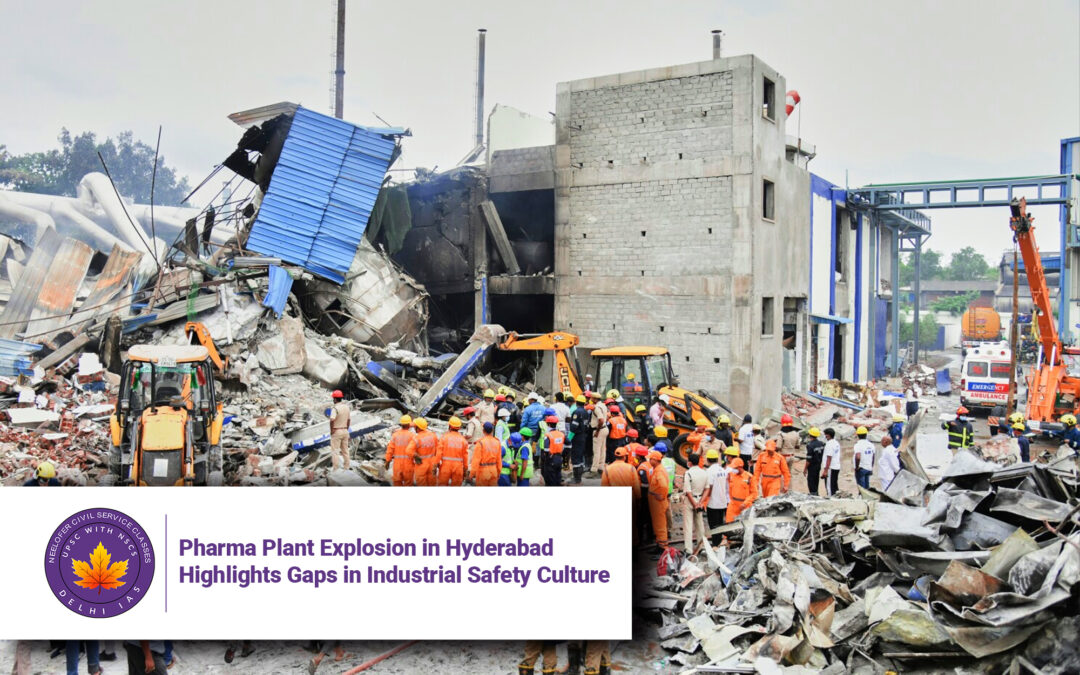
Pharma Plant Explosion in Hyderabad Highlights Gaps in Industrial Safety Culture
Why in News
A tragic industrial accident at the Sigachi Industries pharma unit in Hyderabad has resulted in the death of 36 workers, drawing national attention to the safety protocols in India’s pharmaceutical manufacturing sector. The explosion, which occurred despite the plant dealing with a relatively inert chemical, has once again exposed serious flaws in industrial hazard management.
Introduction
The recent blast at a pharma plant producing Microcrystalline Cellulose (MCC) — a chemically inert and commonly used substance in drug manufacturing — highlights the urgent need for robust safety protocols. Though MCC itself is harmless to touch or ingest, its manufacturing process involves hazardous conditions that require high levels of technical precision and operational discipline.
Key Issues and Background
-
What is MCC?
MCC (Microcrystalline Cellulose) is a widely used ingredient in pharmaceuticals, food, and cosmetics, often acting as a binder or texturizer. While not toxic or reactive, its production process involves conditions that, if mishandled, can turn deadly. -
The Hyderabad Tragedy:
The incident occurred at Sigachi Industries, where an explosion during the manufacturing process led to the deaths of 36 workers, many of whom were young, poor, migrant laborers from northern and eastern India. Initial findings suggest a malfunction in equipment or poor maintenance as possible causes. -
Recurring Incidents:
This is not an isolated event. In the past year, multiple pharma unit accidents have occurred:-
August 2024: Major accident at a unit in Anakapalli, Visakhapatnam
-
April 2024: Another accident in Hyderabad
-
Specific Impacts or Effects
-
Loss of Lives and Livelihoods:
The majority of the deceased were migrant workers with limited social protection. The Telangana government has announced an ex-gratia of ₹1 crore, but there is concern over whether relief will reach affected families efficiently. -
Global Reputation at Stake:
India’s pharmaceutical industry is a key foreign exchange earner. Repeated accidents like these can tarnish its global image, affecting exports and investor confidence. -
Need for Safety Culture:
Experts emphasize the need for a “high level of safety culture” at such manufacturing sites. This means:-
Rigorous training for workers
-
Regular HAZOP (Hazard and Operability Analysis)
-
Constant monitoring and data integration to detect abnormalities
-
Competent operational staff
-
-
Failure of Preventive Mechanisms:
Preventive maintenance and early detection of hazards were likely ignored. This allowed an abnormal rise in temperature, suspected to be the cause of the explosion.
Challenges and the Way Forward
-
Strengthening Regulations:
India’s industrial safety regulations need stricter enforcement. Safety audits must be regular, transparent, and followed by corrective actions. -
Training and Accountability:
Operators and managers must be trained not only in SOPs (Standard Operating Procedures) but also in risk awareness. Companies must be held accountable for negligence. -
Technology and Monitoring:
Integration of real-time data monitoring systems can flag anomalies early. Safety indicators should be tracked continuously by trained staff. -
Welfare of Migrant Workers:
The dependence on unprotected, poor migrant laborers must be addressed. This includes social security, healthcare coverage, and compensation mechanisms.
Conclusion
The Hyderabad pharma plant explosion is a grim reminder that even seemingly safe manufacturing processes can turn fatal without stringent safety protocols and trained personnel. As India aspires to be a global pharma hub, it must uphold international safety standards. A single lapse can not only cost lives but also damage the country’s economic credibility in global markets. Manufacturing units must embrace a safety-first culture — where every worker, manager, and stakeholder treats risk mitigation as a core operational value, not an afterthought.
5 Questions and Answers
1. What caused the blast at the Hyderabad pharma plant?
Initial investigations point to equipment malfunction or poor maintenance, leading to a build-up of abnormal temperature and a resulting explosion.
2. Why is the incident alarming despite MCC being safe?
Though MCC is chemically inert, the production process involves risky mechanical operations that, if not handled properly, can become dangerous.
3. What support has the government provided?
The Telangana government announced an ex-gratia of ₹1 crore, with efforts underway to ensure timely compensation to victims’ families.
4. How does this affect India’s pharma exports?
Such industrial accidents tarnish India’s image as a trusted pharma exporter, potentially affecting trade partnerships and compliance with global safety norms.
5. What is the key takeaway from this incident?
The need for a high level of safety culture — encompassing trained staff, operational oversight, and preventive maintenance — is paramount in industrial units.

