
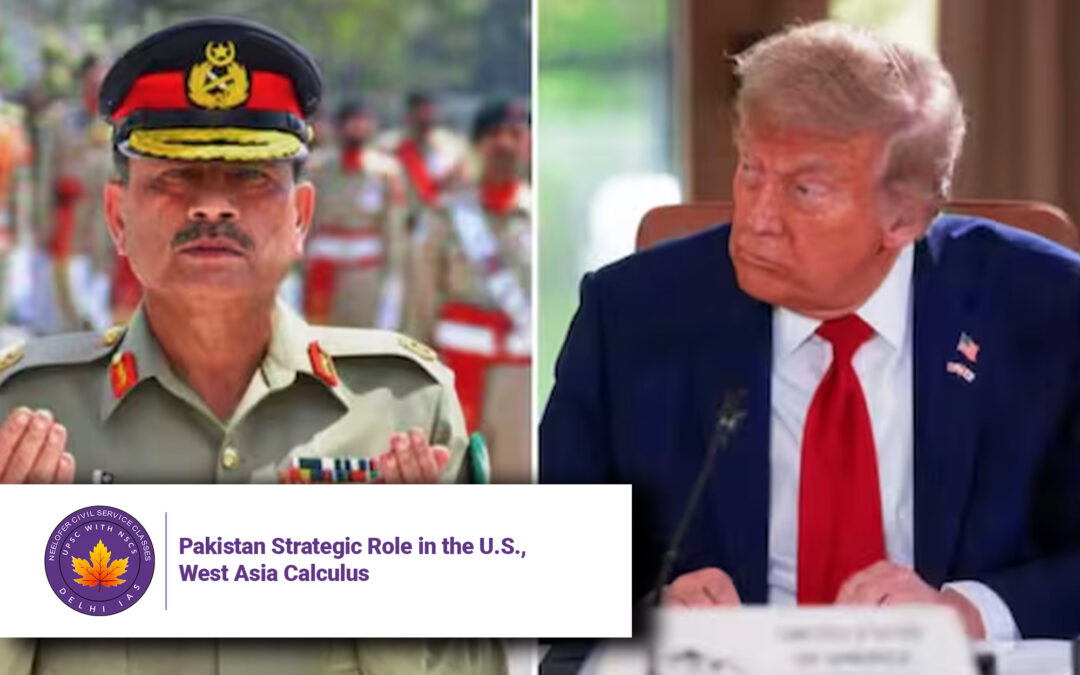
Pakistan Strategic Role in the U.S., West Asia Calculus
Why in News?
On June 22, 2025, U.S. President Donald Trump confirmed American military strikes on Iranian nuclear assets. As global tensions rise, Pakistan’s complex geopolitical position has gained renewed significance in U.S.–West Asia policy, especially given its proximity to Iran, ties with Afghanistan, and historical military alignment with the U.S. 
Introduction
The current U.S.–Iran tensions, reminiscent of past conflicts like those in 1992, 2003, and 2011, have once again thrown global geopolitics into turmoil. In this context, Pakistan emerges as a key player in the shifting dynamics of West Asia, especially for the U.S., which may see Islamabad as a counterbalance to Tehran in case of further escalation.
Key Highlights
-
Strategic Repositioning: During a White House meeting on June 18, President Trump promoted Gen. Asim Munir’s visit to Washington. He praised Munir and underscored Pakistan’s strategic value, particularly as the U.S. looks to deepen military cooperation in the region.
-
Pakistan-Iran Dynamics: While Pakistan shares a border with Iran, its ties with Tehran are competitive, particularly in Afghanistan and over regional trade routes. Iran depends on imports that pass through Pakistani land and air space, especially via the China-Pakistan Economic Corridor (CPEC).
-
Pakistan-U.S. Security Alignment: Pakistan has long-standing defense agreements with the U.S. and remains heavily reliant on American military aid and technology. U.S. troops formerly stationed in Afghanistan relied on Pakistan’s logistical support.
Economic and Budgetary Considerations
-
Increased Defense Allocation: Pakistan’s FY 2025–26 defense budget rose by 17%, reaching ₹2.57 trillion, or 54.7% of total federal revenue. The increase suggests enhanced readiness in light of regional tensions and support for potential U.S. military logistics.
-
Saudi and U.S. Aid Influence: The recent Saudi support and a potential $25 billion bailout package may play a critical role in aligning Pakistan’s military posture with broader Western interests.
Regional Geopolitics
-
Baluchistan and Gwadar: Pakistan’s Balochistan province, especially Gwadar Port, is of strategic importance. It serves as a trade and supply link to Iran and is emerging as a focal point in the U.S. interest matrix due to its proximity to both Iran and the Arabian Sea.
-
Border Militancy: Iran and Pakistan have previously clashed over militant activities across their border. The trust deficit was most recently visible during Iran’s retaliatory missile strikes earlier this year following attacks on its soil.
Religious and Ideological Tensions
-
Anti-Israel Protests: In reaction to American strikes, Pakistan witnessed large-scale protests condemning U.S. and Israeli actions. This highlights the public’s opposition even while the state apparatus aligns itself more with Western strategies.
Conclusion
Pakistan’s role in the U.S.–West Asia geopolitical calculus is multifaceted. As the U.S. seeks regional stability while countering Iranian nuclear ambitions, Islamabad’s dual capacity as a logistical hub and a strategic counterweight makes it indispensable. However, the internal contradictions between public sentiment and state actions could complicate Pakistan’s long-term balancing act between Iran, the West, and its own national interests.

