
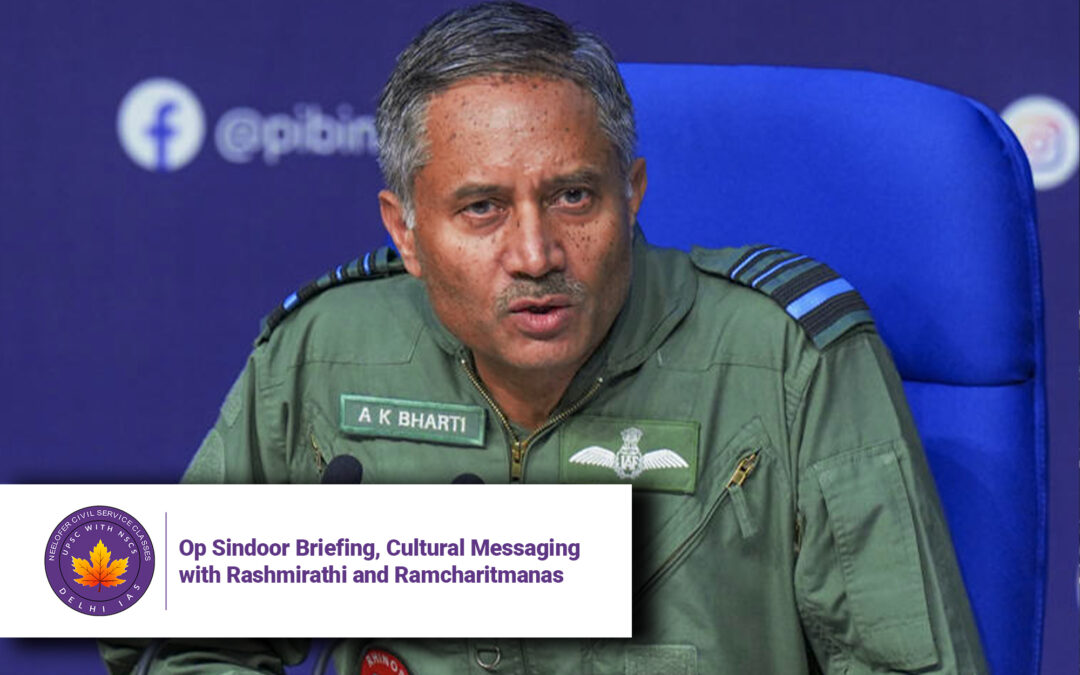
Op Sindoor Briefing, Cultural Messaging with Rashmirathi and Ramcharitmanas
Why in News?
During a high-level media briefing on Operation Sindoor, the Indian Armed Forces took an innovative approach by integrating poetry and classical literature to convey deep strategic and cultural messages. Senior Air Force officers quoted lines from iconic Indian texts — Ramcharitmanas by Tulsidas and Rashmirathi by Ramdhari Singh Dinkar — sparking reflection on India’s resolve, philosophy, and moral compass in the face of threats from Pakistan.

Introduction
Cultural and literary references are not common in military briefings. However, in a rare move, senior officers of the Indian Air Force (IAF), during Operation Sindoor, used iconic lines from Indian epics and literature to underscore the gravity of the situation and India’s preparedness. Quoting from Rashmirathi and Ramcharitmanas, they connected the historical past with present-day military challenges.
Key Messages from Operation Sindoor Briefing
1. Dinkar’s Rashmirathi — A Message of Duty Over Fear
The IAF presentation included lines from the poem Rashmirathi, which tells the story of Karna, a warrior from the Mahabharata, who stood for dharma (duty) despite knowing he was on the losing side.
-
Quote:
“Jab naash manuj par chaata hai, pehle vivek mar jaata hai”
(When destruction awaits, wisdom is the first to die)
This line emphasized that those who choose the path of destruction often abandon wisdom and rationality — a subtle critique possibly aimed at Pakistan’s recent military misadventures.
Another line referenced:
“Honi hokar rahegi, bhale tu talwar utha le ya dhanush chadha le”
suggested the inevitability of justice and destiny.
2. Ramcharitmanas — The Divine Stance on Justice and Forgiveness
Air Marshal A.K. Bharti quoted Tulsidas from Ramcharitmanas:
“Manahu janam sabu karma ke, jehi bidhi rakhe Ram, tehi bidhi rahiye”
(“A man’s life is governed by karma; remain as Lord Ram keeps you.”)
This message reflected a deep philosophical outlook — accepting one’s dharma, maintaining patience, and acting only when necessary. The officers also referred to Lord Ram’s restrained use of power, contrasting it with forced aggression.
3. Cultural Symbolism in Military Context
These literary references were not just poetic—they were symbolic. They subtly conveyed:
-
The high moral ground held by India in the face of provocation.
-
The refusal to act with blind aggression.
-
India’s willingness to act decisively, but only when the path of tolerance is exhausted.
Challenges and the Way Forward
-
Communication Strategy: India is increasingly using soft power — including cultural references — in strategic communications. While effective domestically, international audiences might need clearer policy articulation.
-
Avoiding Misinterpretation: Mixing cultural texts with military strategy must be done carefully to avoid misreading or political misuse.
-
Public Engagement: Such strategies can connect with the public emotionally and foster patriotic unity if used responsibly.
Conclusion
The Operation Sindoor briefing was not just a military update — it was a cultural assertion. Quoting from Rashmirathi and Ramcharitmanas, the Indian Armed Forces conveyed that India seeks peace but is prepared for war. It reaffirmed the ethos that India, like Lord Ram or Karna, values dharma, justice, and wisdom above blind power.
Five Questions and Answers
Q1. What was Operation Sindoor?
A: Operation Sindoor was a military readiness operation by the Indian Armed Forces to respond to aerial threats, during which senior officers also invoked cultural and literary references to highlight India’s strategic stance.
Q2. Which two Indian literary works were quoted during the briefing?
A: Rashmirathi by Ramdhari Singh Dinkar and Ramcharitmanas by the 16th-century saint poet Tulsidas.
Q3. What message did the line “Jab naash manuj par chaata hai, pehle vivek mar jaata hai” convey?
A: It implied that wisdom is the first casualty when a person or nation chooses the path of destruction — possibly a veiled reference to Pakistan’s actions.
Q4. Why was Lord Ram’s restraint emphasized during the briefing?
A: It reflected the idea that India, like Lord Ram, has the power to act but prefers peace and justice unless provoked beyond limits.
Q5. What was the overall purpose of quoting these epics in a defence briefing?
A: To culturally and morally justify India’s defensive stance, emphasize wisdom over aggression, and align military decisions with dharma and national values.

