
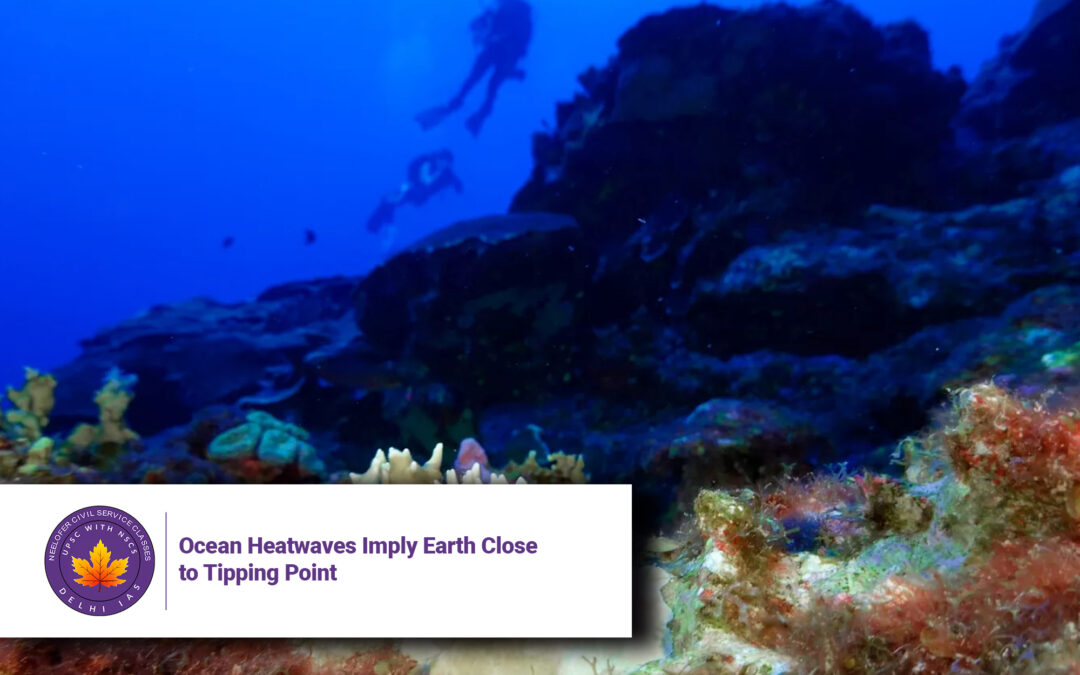
Ocean Heatwaves Imply Earth Close to Tipping Point
Why in News?
Scientists have sounded an urgent alarm after analyzing data from 2023, revealing that ocean heatwaves recorded last year were the most extreme in modern history. The implications of this trend point to the Earth potentially nearing a dangerous environmental tipping point. With over 96% of the ocean experiencing prolonged heat stress, experts believe that irreversible changes in marine ecosystems and global climate patterns could be on the horizon. 
Introduction
The year 2023 marked an alarming milestone in the history of Earth’s climate patterns—marine heatwaves, which are prolonged periods of abnormally high sea-surface temperatures, reached record extremes. These events were not isolated incidents but widespread occurrences affecting nearly the entirety of the global ocean. This escalation in ocean temperatures raises profound concerns, as oceans play a critical role in climate regulation, carbon absorption, and sustaining life.
The data suggests that the oceans were subjected to unusually high levels of thermal stress, with sea-surface temperatures staying above the 90th percentile for extended durations. Scientists have calculated the cumulative thermal stress to be a staggering 53.6 billion degrees Celsius-days (C-days). The situation is so severe that researchers are now warning that the Earth may be dangerously close to passing a climate tipping point—one from which there may be no return.
Key Issues and Scientific Observations
-
Extent of Ocean Heatwaves in 2023
The year 2023 saw sea-surface temperatures remaining above the 90th percentile for up to 120 days across more than 96% of the ocean surface. This is unprecedented in terms of both geographical reach and duration. -
Thermal Stress Measurement
Scientists use the metric of degree Celsius-days (C-days) to measure the intensity and impact of ocean heatwaves. The 2023 heatwaves produced an enormous 53.6 billion C-days of thermal stress. This means that marine organisms were exposed to temperatures far above their normal thresholds for prolonged periods, causing stress, mortality, and migration. -
Triggering Factors Identified
The heatwaves were found to have been intensified due to a combination of climatic factors:-
Extra sunshine and a shallow mixed layer in the North Atlantic: The upper ocean became warmer due to increased sunlight and reduced mixing with cooler, deeper waters.
-
Fewer clouds and stronger ocean currents in the Southwest Pacific: These conditions enhanced heat retention and distribution.
-
Sustained heat gain in the North Pacific: Heat accumulated over time, particularly in regions already experiencing warming trends.
-
El Niño-driven ocean flows in the equatorial east Pacific: The El Niño phenomenon, which naturally warms the Pacific Ocean, played a significant role in amplifying the effect.
-
-
Ecosystem Impact
Marine heatwaves can lead to coral bleaching, massive fish die-offs, habitat loss for marine mammals, and disruption of food chains. The scale and intensity of 2023’s heatwaves are likely to have caused long-term damage to global marine biodiversity. -
Global Climate Feedback
Oceans absorb more than 90% of the excess heat from greenhouse gas emissions. As they heat up, their ability to act as a heat sink diminishes. Warmer oceans also release more carbon dioxide into the atmosphere, creating a feedback loop that further accelerates global warming.
Five Key Observations / Takeaways
-
Ocean temperatures remained unusually high for unusually long durations across almost the entire planet.
-
This highlights a disturbing trend of global oceanic warming that cannot be ignored.
-
-
Thermal stress from ocean heatwaves reached historic levels.
-
53.6 billion degree C-days is an indicator of unprecedented environmental pressure on marine life.
-
-
Multiple climatic and atmospheric anomalies contributed to the crisis.
-
Factors ranged from El Niño to reduced cloud cover and altered ocean currents, indicating the complex interplay between weather systems and ocean temperatures.
-
-
The Earth’s climate system is showing signs of nearing a tipping point.
-
A tipping point refers to a threshold beyond which significant, irreversible changes may occur.
-
-
Urgent climate action is needed at the global level.
-
Mitigation efforts must focus on reducing greenhouse gas emissions, protecting marine biodiversity, and enhancing ocean observation systems.
-
Challenges and the Way Forward
Challenges
-
Lack of Preparedness: Most coastal communities and nations lack the infrastructure and response systems to handle rapid changes in ocean temperatures.
-
Marine Ecosystem Collapse: Long-term heatwaves can destroy habitats like coral reefs, affecting fisheries and food security.
-
Scientific Gaps: While data is improving, scientists still lack full knowledge of all tipping points and how they interact.
-
Global Emissions: Continued fossil fuel use is pushing Earth closer to crossing environmental thresholds.
-
International Coordination: Marine issues often fall into the gray area of international law, complicating enforcement and cooperation.
Way Forward
-
Strengthen Ocean Monitoring: Expand the use of satellites, buoys, and ocean sensors to monitor temperature anomalies in real time.
-
Climate-Resilient Policies: Coastal nations should develop adaptive policies that can address marine heatwaves and their cascading effects.
-
Promote Marine Conservation: Establishing more Marine Protected Areas (MPAs) can offer sanctuaries for affected species and ecosystems.
-
Cut Greenhouse Gas Emissions: Governments must commit to rapid decarbonization through clean energy transitions and enforcing emissions standards.
-
Global Climate Agreements: Reinforce multilateral agreements like the Paris Accord and ensure countries stay accountable to their climate goals.
Conclusion
The findings from 2023 represent a stark warning: the Earth is on the edge of a climate precipice. Marine heatwaves are not just rare events anymore—they are becoming the norm. The record-breaking figures from last year highlight how fast oceanic systems are changing, and how close we might be to triggering a series of irreversible environmental events.
The oceans, once a buffer absorbing much of the impact from global warming, are now beginning to show signs of saturation. If current trends continue, we could witness accelerated sea-level rise, mass extinction of marine species, and large-scale disruptions to weather patterns, agriculture, and human settlements.
The situation demands immediate, unified global action—not just to prevent further damage, but to restore and adapt marine ecosystems for the future. Without such intervention, the consequences could be beyond our control.
Q&A Section
1. What are marine heatwaves, and why are they significant?
Marine heatwaves are extended periods of abnormally high sea-surface temperatures. They are significant because they stress marine organisms, disrupt ecosystems, affect weather patterns, and signal broader climate disturbances.
2. How widespread were the ocean heatwaves in 2023?
In 2023, sea-surface temperatures stayed above the 90th percentile for up to 120 days over more than 96% of the global ocean. This level of coverage is unprecedented and marks a critical turning point in climate observations.
3. What factors triggered these heatwaves?
Multiple factors were responsible:
-
Extra sunshine and a shallow mixed layer in the North Atlantic
-
Fewer clouds and strong ocean currents in the Southwest Pacific
-
Sustained heat gain in the North Pacific
-
El Niño-driven flows in the equatorial east Pacific
4. What is meant by “53.6 billion degree C-days” of thermal stress?
This is a cumulative measure of heat exposure. It means the oceans experienced 53.6 billion degrees of excess heat, sustained for one day, or equivalently distributed over time and space. It’s a stark indicator of how much thermal pressure marine systems endured.
5. Why are these trends considered signs of an approaching “tipping point”?
A climate tipping point refers to a critical threshold where small changes can lead to drastic, irreversible impacts. If the oceans continue to absorb heat at this scale, we may witness massive ecological collapses, permanent changes to Earth’s climate systems, and feedback loops that worsen global warming.

