
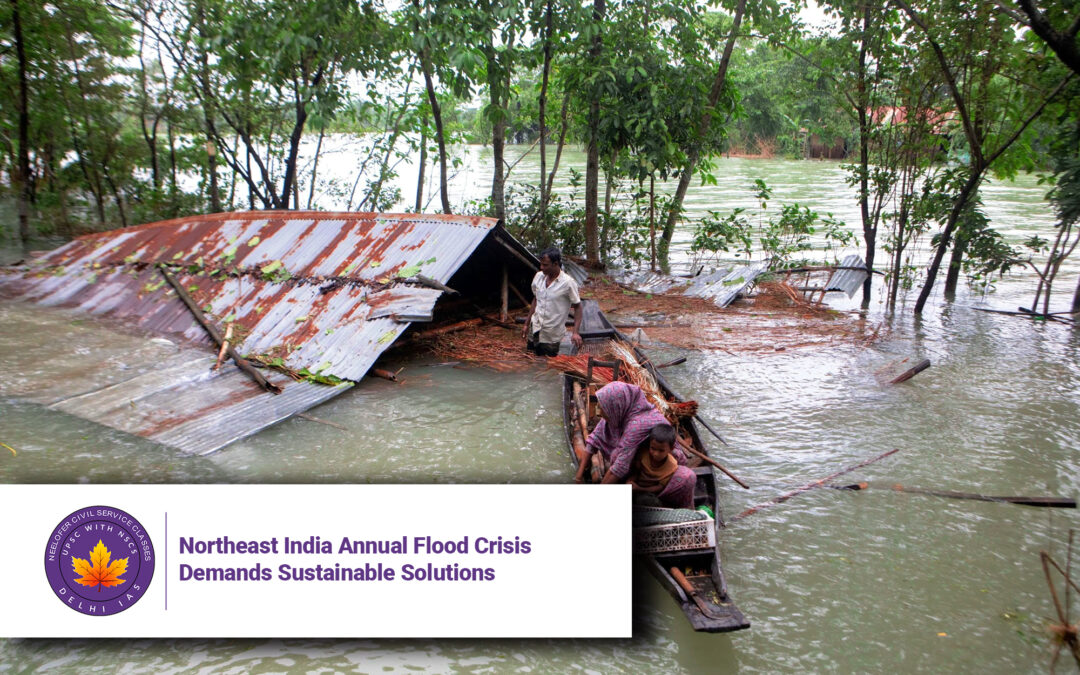
Northeast India Annual Flood Crisis Demands Sustainable Solutions
Why in News?
The 2024 monsoon has unleashed devastating floods across Northeast India, with Assam, Tripura, and Sikkim bearing the brunt—30+ deaths, 3 lakh displaced, and 1,500 tourists stranded in Sikkim. Despite IMD predicting “below-normal” rains, the region’s inherent vulnerability highlights the urgent need for long-term flood mitigation strategies.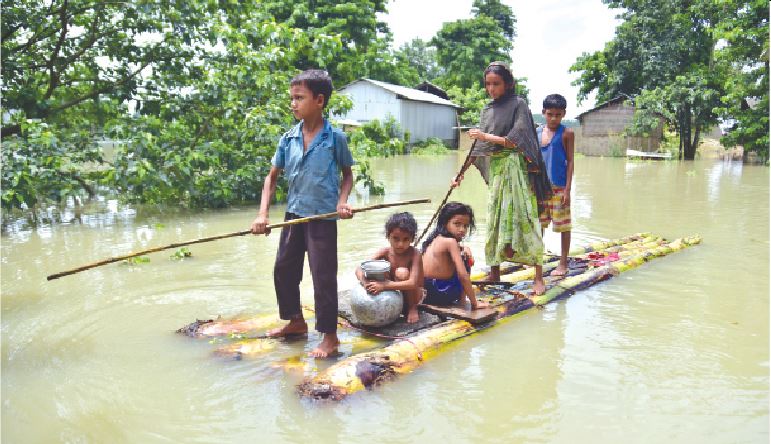
Key Developments
-
Current Impact (June 2024):
-
Assam: 10 rivers above danger mark; 19 districts affected.
-
Tripura: Extreme rainfall triggering landslides.
-
Sikkim: Teesta River overflow swept away a bus (2 dead, passengers missing); 1,500 tourists stranded.
-
-
Structural Challenges:
-
Geographical Vulnerability: Steep terrain + high baseline rainfall (even “deficit” years see destructive downpours).
-
Infrastructure Gaps: Poor road connectivity and flood-resistant housing exacerbate crises.
-
-
Climate Context:
-
Dual Monsoon System: Bay of Bengal branch hits Northeast first, often violently.
-
October–December Mini-Monsoon: Prolongs flood risks beyond the June–September season.
-
Why Short-Term Measures Fail
-
Band-Aid Solutions: Annual relief packages focus on immediate rescue (boats, shelters) but neglect prevention.
-
Data Gaps: No unified floodplain mapping or early-warning systems for cross-state rivers like Brahmaputra.
-
Tourism Pressure: Sikkim’s fragile ecology strained by unregulated tourism infrastructure.
5-Point Long-Term Plan
-
Eco-Engineering:
-
Restore wetlands and mangroves as natural buffers.
-
Implement Japan-style “super levees” in urban areas (e.g., Guwahati).
-
-
Climate-Resilient Infrastructure:
-
Elevate highways (like Bangladesh’s flood-proof roads).
-
Enforce strict building codes in landslide-prone zones.
-
-
Regional Cooperation:
-
NE States + Centre + Bhutan/China (upstream) for transboundary water management.
-
-
Tech-Driven Early Warnings:
-
AI-based flood prediction models (successfully piloted in Kerala).
-
-
Tourism Regulation:
-
Cap visitor numbers in ecologically sensitive areas (e.g., North Sikkim).
-
5 Critical Questions Answered
Q1: Why is Northeast India flood-prone?
A: High baseline rainfall + steep Himalayan slopes + poor drainage infrastructure.
Q2: How does climate change worsen floods?
A: Increased rainfall intensity (+20% in Assam since 2000) and erratic mini-monsoons.
Q3: What’s the economic cost?
A: Annual losses exceed ₹1,000 crore; Assam’s tea industry suffers 30% production drops.
Q4: Why are tourists at risk?
A: Narrow roads + unstable slopes (e.g., Sikkim’s Nathu La) lack safety measures.
Q5: What’s the policy roadmap?
A: Merge flood control with climate adaptation under the National Disaster Management Plan.
Conclusion
The Northeast’s floods are not just “annual disasters” but symptoms of systemic neglect. As Assam’s Water Resources Minister recently admitted, “We’ve been rebuilding the same breached embankments for 50 years.” A paradigm shift—from reactive relief to proactive resilience—is overdue. The 2024 monsoon must be the last wake-up call.
— With inputs from IMD, NDMA, and regional disaster response teams

