
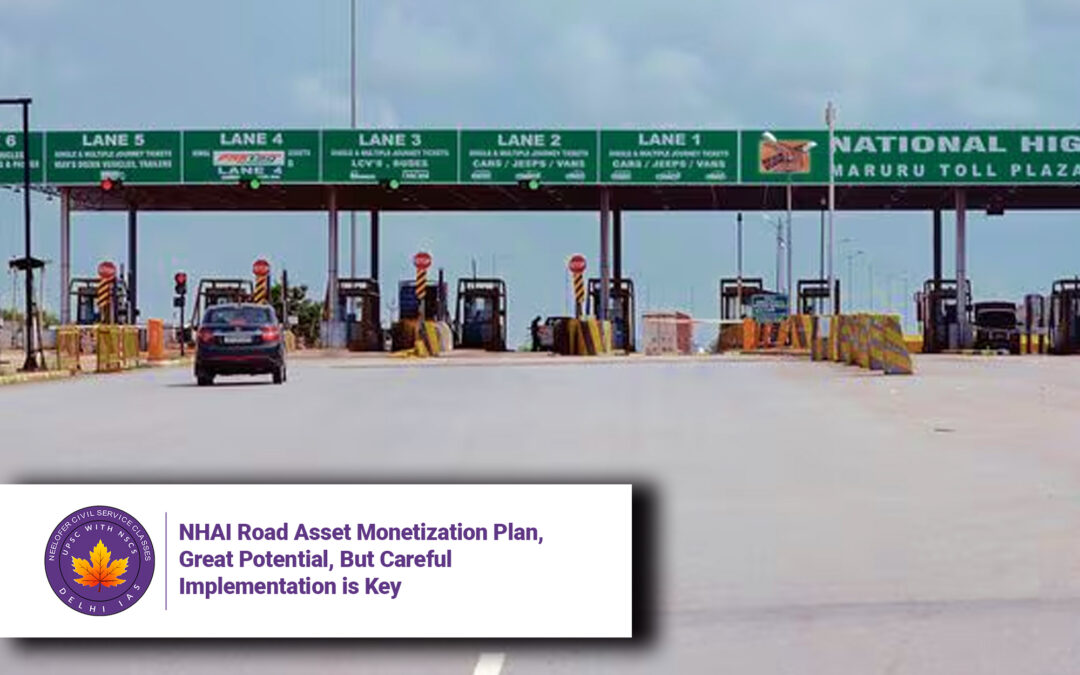
NHAI Road Asset Monetization Plan, Great Potential, But Careful Implementation is Key
Why in News?
The National Highways Authority of India (NHAI) has significantly expanded India’s national highway network and introduced an ambitious asset monetization strategy. The strategy aims to generate funds for new roads by unlocking the value of operational assets. With ₹1.4 trillion raised already and ongoing efforts to attract private investment through TOT, InvIT, and securitization, NHAI’s roadmap holds promise—if implemented effectively. 
Introduction
India’s national highway network has doubled to 1,46,000 km in the past decade. To finance this growth and sustain it, NHAI has pivoted from traditional financing methods toward asset monetization. The focus is on leveraging mature highway assets through three modes:
-
Toll-Operate-Transfer (TOT)
-
Infrastructure Investment Trust (InvIT)
-
Securitization of toll revenues
This marks a strategic shift to attract long-term capital and tap into alternative investment markets, including pension and insurance funds, both domestic and global.
Key Highlights:
-
TOT and InvIT Success:
NHAI started its monetization journey with the first TOT bundle in 2018, appealing to developers and banks. This was followed by NHIT (National Highways Infra Trust) in 2021, which attracted new investors by packaging toll assets into a transparent, dividend-yielding investment.
So far:-
2,564 km of roads have been monetized via TOT
-
₹48,995 crore has been raised
-
2,345 km of roads monetized via NHIT generated ₹43,638 crore
-
An additional ₹6,847 crore was secured through securitization (e.g., Delhi-Meerut Expressway)
-
-
Spectacular Market Response:
NHIT has raised more funds than initially expected, driven by investor trust in predictable revenue from toll roads. This includes India’s largest-ever road asset deal—₹17,733 crore. -
Future Focus:
NHAI has launched a 25-page Asset Monetisation Strategy paper focused on:-
Value maximization
-
Transparency
-
Long-term investor engagement
-
-
Private Sector and Governance:
The new model emphasizes private participation, professional management, and digital platforms for greater accountability. The success depends on clear road asset identification, forward-looking cash-flow forecasting, and smooth execution. -
Challenges Ahead:
Implementation is key. While the concept is strong, execution gaps—like lack of clarity for retail investors, separation of powers, and communication issues—must be addressed to maintain momentum.
Conclusion
NHAI’s asset monetization strategy is a path-breaking approach to infrastructure financing in India. With private partnerships, professional transparency, and strong governance, it could transform how India builds and maintains roads. However, success depends on refining investor confidence, ensuring policy clarity, and staying on track with execution.
Q&A Section:
-
Q: What is the main goal of NHAI’s asset monetization strategy?
A: To unlock value from existing highways and raise funds for future infrastructure projects. -
Q: What are the three main methods used for monetization?
A: Toll-Operate-Transfer (TOT), Infrastructure Investment Trust (InvIT), and securitization of toll revenues. -
Q: How much has NHAI raised through its monetization efforts so far?
A: Around ₹1.4 trillion, with notable deals including a ₹17,733 crore road bundle through NHIT. -
Q: What is NHIT and why is it important?
A: NHIT is the National Highways Infra Trust. It allows retail and institutional investors to invest in revenue-generating road assets through a public InvIT model. -
Q: What are the major challenges in implementing this strategy?
A: Clear asset identification, investor confidence, professional project management, and transparent governance.

