
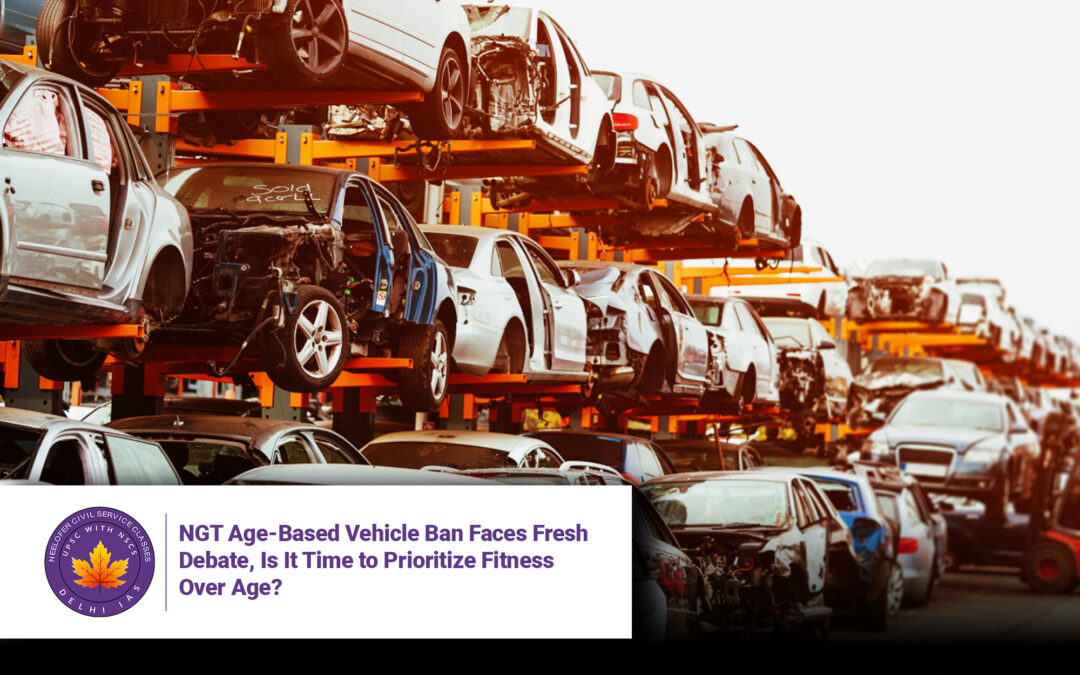
NGT Age-Based Vehicle Ban Faces Fresh Debate, Is It Time to Prioritize Fitness Over Age?
Why in News?
The National Green Tribunal (NGT)’s 2014 directive banning diesel vehicles older than 10 years and petrol vehicles older than 15 years from operating in Delhi NCR has once again stirred significant debate. A recent column by Dipankar De Sarkar, a former European and UK correspondent, highlights the emotional and practical toll of this ruling, emphasizing the personal experience of losing his beloved Mahindra Thar due to the age-based ban.
This personal story comes amid legal action by the Delhi Government, challenging the NGT’s policy on the grounds that it unfairly targets vehicles based on age rather than roadworthiness or emission output. As Delhi gears up for potential policy reform, the debate pivots around whether vehicle fitness should matter more than age—a position already adopted by countries like the UK.
Introduction
In India, owning a car is more than just a utility—it’s often a legacy, a companion, and sometimes even a symbol of identity. But over the past decade, rules laid down by the National Green Tribunal have begun to challenge this cultural sentiment in the name of environmental safety. Delhi’s controversial ban on older vehicles has led to large-scale scrapping of cars that are mechanically sound but deemed “unfit” solely due to their age.
Dipankar De Sarkar, a former journalist and global resident, narrates how this regulation led to the untimely demise of his cherished Thar—a vehicle he calls his “four-wheeled iron fortress.” His Thar, which once roamed the hills of north India effortlessly, had to be discarded despite being in prime physical condition. And this, not due to pollution levels or visible damage, but because it crossed the arbitrary age cap.
This article builds upon that personal account to explore the implications of such regulations, compare global practices, and analyze the legal and policy-related challenges now being raised.
The Policy: Age vs Fitness
In 2014, the National Green Tribunal introduced a ban on petrol vehicles older than 15 years and diesel vehicles older than 10 years in Delhi NCR. The Supreme Court upheld the ban in 2018. The policy aims to curb vehicular pollution in a city that consistently ranks among the most polluted in the world.
However, this blanket regulation makes no distinction between a well-maintained vehicle and a dilapidated one. Even if a vehicle is parked and unused, it is still liable to be seized and scrapped.
Key policy highlights:
-
Applicable only in Delhi NCR (for now).
-
No allowance for vehicle fitness or emission levels.
-
Vehicles can be scrapped without warning, even if parked.
-
Violations can result in the vehicle being towed and impounded.
The experience of De Sarkar and many others underscores how this policy is viewed by a section of citizens as impractical and insensitive to individual ownership, especially when the vehicle continues to function flawlessly.
The Emotional and Cultural Loss
In his article, Dipankar De Sarkar points out how owning a car in India is often treated as a lifelong investment, not a temporary asset. His Thar was not merely a machine but a memory-filled companion that served him with utmost reliability—even protecting him during accidents.
He contrasts this emotional bond with the cold bureaucratic system that mandates scrapping without evaluating roadworthiness. Cars like the Thar or even the humble Ambassador hold sentimental and practical value for their owners, yet are now being pushed out of existence by a one-size-fits-all law.
Another telling anecdote is of his friend whose 15-year-old WagonR, in excellent condition, was taken away by municipal authorities without consent. “They were enjoying themselves so much it reminded me of snatchers in the Harry Potter books,” he says, likening the enforcers to magical thieves.
The Global Perspective: UK’s MOT System
De Sarkar draws a stark contrast between Indian and UK policies. In the UK, vehicles are subject to an annual MOT (Ministry of Transport) test starting at 3 years of age. It includes:
-
Brakes, steering, visibility
-
Lights, reflectors, tires
-
Exhaust systems and emissions
-
Safety features such as seat belts
-
Vehicle structure and suspension
The UK doesn’t enforce a blanket ban based on age. Instead, if a vehicle passes this stringent annual test, it can continue to run—even if it’s 40 years old. Only vehicles that fail the MOT test are taken off the road. This method allows for:
-
Better enforcement against polluting vehicles
-
Fairer treatment of well-maintained older cars
-
Prevention of fraud (by uploading test results with photos and VIN numbers)
De Sarkar argues this should be the benchmark for Indian regulations as well. A structured fitness-based assessment would not only prevent unnecessary loss for car owners but would also target real environmental violators.
Delhi Government’s Legal Challenge
Delhi’s chief minister has recently voiced disagreement with the age-based ruling, initiating a legal challenge to the NGT ban. The Delhi government maintains that:
-
Fitness and emission testing should determine a vehicle’s life.
-
The current policy is regressive and anti-people.
-
It fails to recognize improvements in automobile technology and emission controls.
This could potentially pave the way for fitness-based certification centers, similar to the UK’s MOT system, that can provide data-driven, scientific vehicle assessments.
Such centers would require:
-
Certification from government authorities
-
Standardized testing parameters
-
Real-time digital reporting
-
Annual renewal systems
Environmental Argument: Real or Rigid?
Supporters of the NGT ruling say that age correlates with pollution levels, but this is not always true. A well-serviced petrol car from 2008 may emit less pollution than a newer, poorly maintained diesel SUV.
In fact, blanket scrapping might contribute to more environmental damage:
-
Energy and raw material waste from manufacturing replacements
-
Sudden surge in disposal and recycling burden
-
Creation of unnecessary consumer demand and financial strain
Instead of promoting sustainability, this could ironically lead to more carbon output.
Conclusion: Toward Smarter, Balanced Regulation
The issue is not about choosing between environment and emotion—it’s about balancing both through informed, flexible governance. As De Sarkar’s article points out, citizens are not averse to regulation, but they expect it to be based on common sense and fairness.
A network of vehicle fitness assessment centers, as seen in the UK, can ensure that only truly unfit vehicles are removed. This maintains air quality, protects public trust, and respects the relationship people have with their vehicles.
Delhi’s legal challenge could become the first step in reforming India’s vehicle regulation framework—if it results in a move from arbitrary bans to scientific evaluation.
Q&A Section
Q1. What is the NGT’s current policy on vehicle age in Delhi?
A: As per the NGT ruling of 2014 (upheld in 2018), diesel vehicles older than 10 years and petrol vehicles older than 15 years are banned in Delhi, regardless of their condition or usage.
Q2. Why is this policy being criticized?
A: Critics argue that the policy unfairly targets well-maintained vehicles solely based on age. It leads to forced scrapping even when the vehicle is roadworthy, and doesn’t account for actual pollution levels.
Q3. What alternative system does the UK follow?
A: The UK uses the MOT (Ministry of Transport) annual testing system. Vehicles are tested for roadworthiness, emissions, and safety features. Age is not a disqualifier if the car passes the test.
Q4. What is the Delhi Government’s current stance?
A: Delhi’s government is legally challenging the NGT’s ruling, stating that fitness, not age, should determine a vehicle’s usability. They propose a regulated system of certified fitness tests.
Q5. How might this affect car owners in Delhi and across India?
A: If the challenge succeeds and leads to policy reform, vehicle owners could benefit from being able to retain their well-maintained older cars. It may also trigger a nationwide shift toward fitness-based vehicle regulations.

