
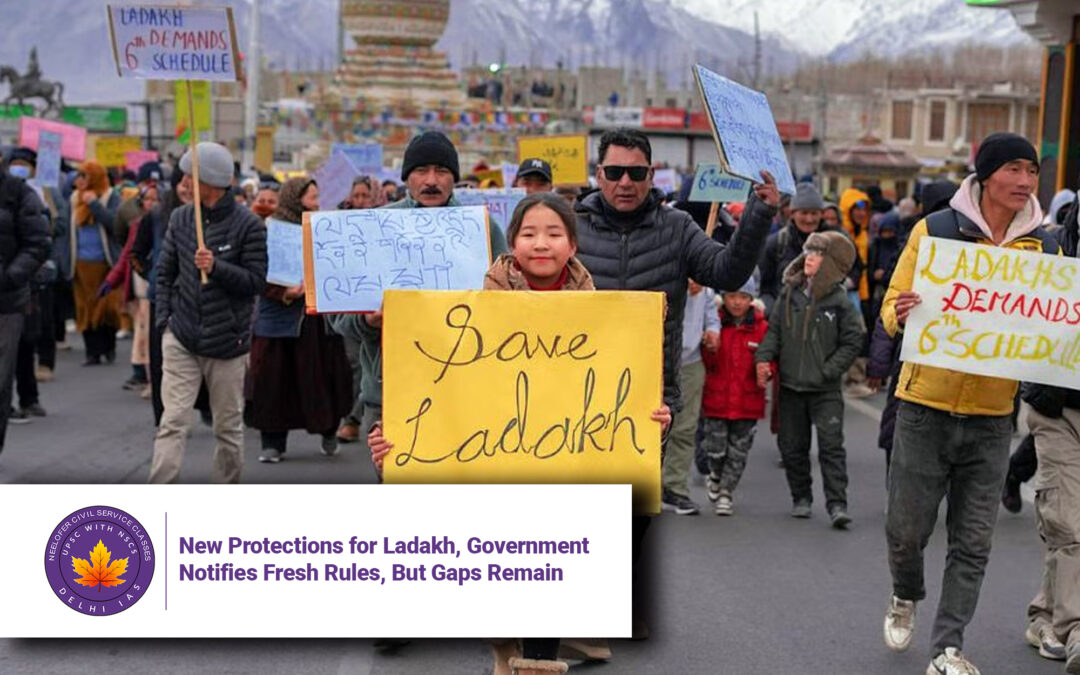
New Protections for Ladakh, Government Notifies Fresh Rules, But Gaps Remain
Why in News?
On June 2 and 3, 2025, the Central Government notified a set of new regulations aimed at protecting the land, jobs, and culture of Ladakh. These changes respond to civil society’s long-standing demands—especially for Sixth Schedule inclusion—but fall short in some critical ways. 
What Are the New Regulations?
The three key regulations notified are:
1. Ladakh Civil Services Decentralisation and Recruitment (Amendment) Regulation, 2023
-
Recruitment in government jobs is now limited to domiciles who:
-
Have lived in Ladakh for 15+ years, or
-
Are children of government employees serving in Ladakh for 10 years.
-
-
Applies to Group A, B, and C posts.
-
Candidates must clear Class 10 and 12 from local schools to be eligible.
2. Ladakh Civil Services Domicile Certification Regulation, 2023
-
Defines documentation needed to prove Ladakh domicile.
-
Handled by the Deputy Commissioner’s office.
3. Union Territory of Ladakh Reservation (Amendment) Regulation, 2023
-
New reservation introduced:
-
Scheduled Castes (SC): 10%
-
Scheduled Tribes (ST): 45%
-
Other Backward Classes (OBC): 4%
-
Economically Weaker Sections (EWS): 10%
-
Pahari ethnic group: 4%
-
Ex-servicemen: 6%
-
Sports quota: 2%
-
Persons with disabilities: 4%
-
Children of defense personnel: 2%
-
Leh and Kargil Women: 2%
-
Additional Amendments:
-
Changes to land laws, long-term leases, and village councils under new UT regulations (e.g. Hill Development Council Act amendments).
Why Is This Significant?
-
This marks the first major step by the Indian government to provide structured protection to Ladakhi identity, employment, and autonomy after abrogation of Article 370 in 2019.
-
It addresses concerns over outsiders purchasing land, taking jobs, and diluting local culture and demography.
But What’s Missing?
Despite these protections, civil society groups like the Apex Body (Leh) and Kargil Democratic Alliance (KDA) say the regulations fall short:
-
Lack of Sixth Schedule inclusion: Ladakhis want constitutional autonomy similar to tribal areas in Northeast India.
-
The new rules are executive in nature, not constitutional guarantees.
-
Concerns remain about future reversals, central control, and exclusion of tribal governance rights.
Five Key Takeaways
-
Government has introduced domicile-based recruitment and comprehensive reservation policies in Ladakh.
-
The rules respond to long-standing demands post-Article 370 abrogation, especially from the civil society movement.
-
Major gaps remain—land ownership protections, constitutional autonomy, and Sixth Schedule status are missing.
-
The regulations show Delhi’s willingness to engage, but also reveal a reluctance to give legislative power to Ladakhis.
-
The fight for real autonomy continues with upcoming talks and protests planned by local civil groups.
Q&A Section
1. What are the key highlights of the new regulations in Ladakh?
They include recruitment limited to Ladakh domiciles, strict domicile certification processes, and a detailed reservation system including ST, SC, women, ex-servicemen, and others.
2. Why are civil society groups still unhappy?
Because the government hasn’t included Ladakh under the Sixth Schedule, which would offer constitutional protections and real autonomous governance.
3. What is the Sixth Schedule and why is it important?
It is a provision in the Constitution that grants autonomy to tribal regions, allowing them to manage their resources and local laws. Ladakh’s civil society sees this as key to protecting their identity.
4. Who are the main stakeholders raising these demands?
The Apex Body of Leh, the Kargil Democratic Alliance, and many tribal groups and activists like Sonam Wangchuk have led hunger strikes and protests for these demands.
5. What’s next in this movement?
Groups plan to escalate their protests, with calls for dialogue with the Home Ministry and Prime Minister, urging full constitutional protection before the 2025 year-end.

