
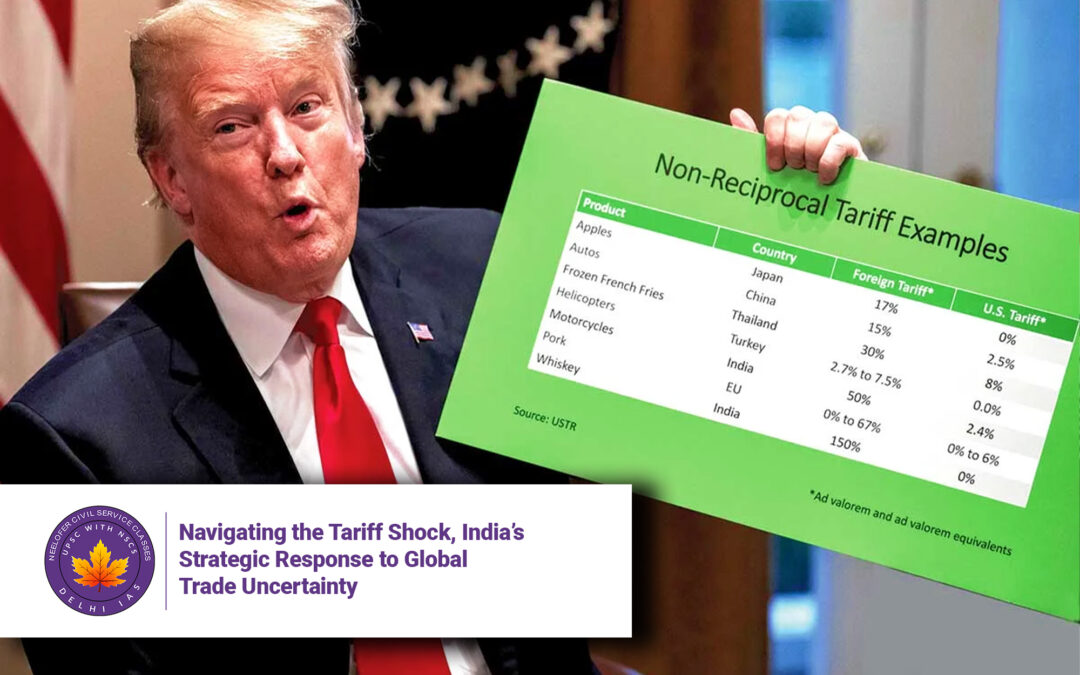
Navigating the Tariff Shock, India’s Strategic Response to Global Trade Uncertainty
Why in News?
With President Donald Trump launching aggressive trade measures to reshape the global trade order, India and the world find themselves amid a policy shift that could have significant long-term consequences. While a temporary tariff pause is in place, the economic implications remain complex and unpredictable. 
Introduction
The Trump administration’s trade offensive aims to impose a new global trade order — one based on transactional deals and a departure from multilateral norms. Although reciprocal tariffs have been temporarily paused, countries like India must now weigh their responses amid rising volatility and shifting alliances.
Key Issues and Background
-
Tariff Shock and Pause
The U.S. imposed tariffs up to 10%, but a temporary 90-day pause has delayed full implementation. India had already initiated reciprocal tariffs earlier, placing it in a relatively prepared position. -
India’s Relative Advantage
India’s early start in drafting bilateral trade retaliation gives it a stronger footing compared to others. It also benefits from limited dependence on rare earth mineral exports, unlike China, which is facing substantial trade challenges with the U.S. -
Global Realignment and Uncertainty
As the U.S. isolates itself from global trade, India must consider deeper integration with alternatives like the Comprehensive and Progressive Agreement for Trans-Pacific Partnership (CPTPP) and ongoing FTA talks with the UK and EU. -
Risks in Economic Management
If the tariff war escalates, inflation could rise due to higher import costs, forcing India’s central bank (RBI) to hike rates, dampening investment and economic sentiment. -
Capital Flow Volatility and Growth Impact
Trade disruptions, foreign investor uncertainty, and tightening liquidity conditions could weaken capital inflows and currency stability. This will directly impact India’s growth outlook and financial sector balance.
Five Key Takeaways
-
India’s early retaliation plan has been beneficial, but continued caution is necessary due to global uncertainty.
-
Trump’s trade model favors transactional deals, pushing countries to negotiate from a position of imbalance.
-
India must deepen trade relationships beyond the U.S., including with the EU, UK, and members of CPTPP.
-
RBI’s monetary policy must remain flexible, as it may need to balance inflation and currency depreciation risks.
-
Capital flows and investor confidence are at stake, necessitating stable macroeconomic management and global engagement.
Challenges and the Way Forward
-
Challenges:
-
Trade unpredictability with the U.S.
-
Inflation risk due to higher tariffs.
-
Currency volatility and capital outflows.
-
Disruption to global demand-supply chains.
-
-
Way Forward:
-
Diversify trade partners and finalize FTAs with the EU and CPTPP nations.
-
Strengthen internal resilience through industrial competitiveness and export promotion.
-
Coordinate monetary policy to manage inflation expectations while encouraging domestic growth.
-
Foster investor confidence through macroeconomic stability and regulatory clarity.
-
Avoid entering lopsided deals and stand firm on fair trade principles.
-
Conclusion
President Trump’s disruptive tariff policies may change the way global trade works, but they also open a window for nations like India to redefine their trade frameworks. Navigating this shift requires strategic patience, robust diplomacy, and a steadfast commitment to multilateralism. India’s path forward lies in building broad-based economic alliances while ensuring internal economic stability.
Q&A Section
1. Why is India in a relatively better position amid the U.S. tariff shock?
Because it began negotiating retaliatory tariffs much earlier and isn’t dependent on rare earth exports like China.
2. What are the risks of engaging directly with Trump’s trade agenda?
Deals could be one-sided, as Trump prefers zero-for-zero deals that favor the U.S., undermining long-term fairness.
3. How might the tariff war impact India’s inflation?
Higher import costs could lead to inflation, forcing the RBI to raise interest rates and potentially slowing economic growth.
4. What global partnerships should India consider to counter U.S. trade pressure?
Joining the Comprehensive and Progressive Agreement for Trans-Pacific Partnership (CPTPP) and finalizing FTAs with the UK and EU.
5. How does this uncertainty affect India’s financial markets?
It can lead to reduced capital inflows, higher borrowing costs, currency volatility, and investor nervousness.

