
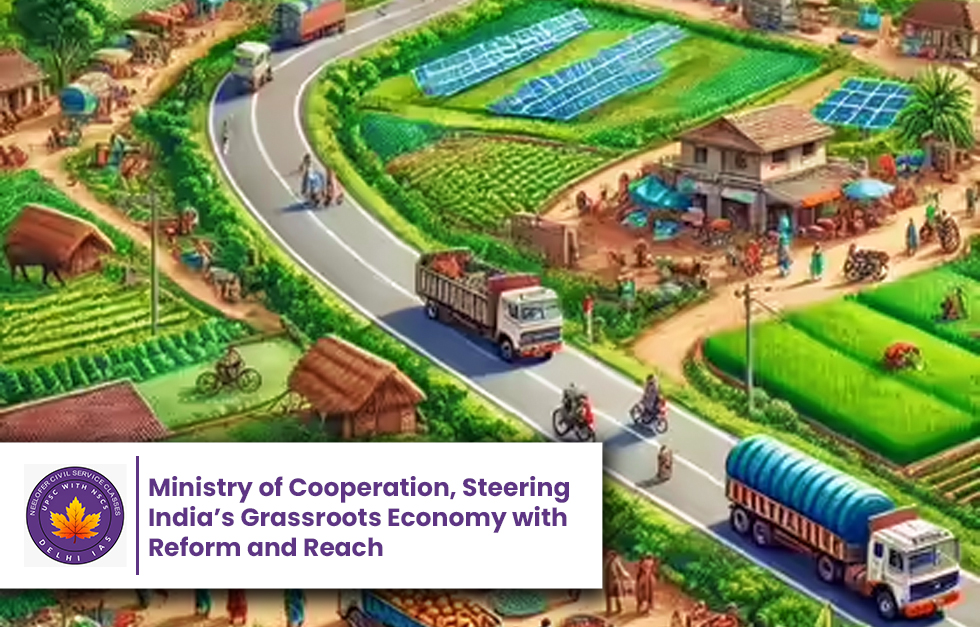
Ministry of Cooperation, Steering India’s Grassroots Economy with Reform and Reach
Why in News?
The Ministry of Cooperation, created in July 2021, marked a major administrative reform for India’s cooperative sector. Its aim is to strengthen India’s cooperative network, spanning agriculture, dairy, fisheries, banking, housing, credit, and rural livelihoods. By doing so, it seeks to empower local communities and boost economic growth at the grassroots level.
Introduction
For over a century, cooperatives have played an important role in India’s rural economy, ensuring fair prices for farmers, boosting rural credit, and providing essential community services. However, inefficiencies, limited reach, and outdated practices have often restricted their true potential.
The Ministry of Cooperation was established to rejuvenate this sector by providing policy support, structural reforms, and capacity building. Its core vision is to transform cooperatives into strong, vibrant economic units that reach even the remotest corners of the country.
Key Issues and Background
Grassroots Reach and Challenges
-
India has over 8.5 lakh cooperatives and more than 29 crore members. However, many cooperatives, especially at the village level, struggle with limited access to technology, weak management, lack of scale, and outdated governance.
-
Credit societies, Primary Agricultural Credit Societies (PACS), dairy cooperatives, and rural enterprises often face challenges in accessing markets, technology, and professional skills.
Need for Modernisation
-
Strengthening governance structures, digitising records, and bringing transparency are vital.
-
Supporting cooperative start-ups, diversifying activities beyond agriculture, and creating new value chains are essential to boost rural incomes.
Specific Impacts or Effects
-
The Ministry’s reforms have enhanced transparency and accountability.
-
New initiatives are helping cooperatives diversify into fisheries, animal husbandry, organic farming, rural industries, and agri-marketing.
-
The creation of national-level cooperatives like Bhartiya Beej Sahakari Samiti Ltd. (seed cooperative), Bhartiya Sahkarita Awas Samiti Ltd. (housing cooperative), and Bhartiya Dairy Sahakari Samiti Ltd. (dairy cooperative) aims to strengthen scale, competitiveness, and market access.
-
Digitisation of PACS and new software platforms are improving efficiency and record-keeping.
Challenges and the Way Forward
Challenges
-
Many cooperatives are still small, poorly governed, and lack professional leadership.
-
Adapting to technology and modern management practices is slow.
-
There is a need to train more cooperative leaders and members to handle new business models.
Steps Forward
-
Develop human resources through training institutes like the National Council for Cooperative Training.
-
Integrate cooperatives with new-age sectors like startups, digital services, organic products, and renewable energy.
-
Promote collaboration among states, central institutions, and stakeholders to expand cooperative reach and ensure uniform policies.
-
Foster innovative models like producer cooperatives, FPOs (Farmer Producer Organisations), and multi-purpose societies.
Conclusion
The Ministry of Cooperation represents a bold step in harnessing India’s cooperative strength for inclusive rural development. By empowering local communities, improving transparency, and expanding opportunities for millions, it can become a game-changer for India’s grassroots economy.
As Rajesh Arrawatia and Satyendra Pandey highlight, the Ministry must ensure that cooperative growth aligns with new market realities, addresses emerging challenges, and taps into India’s vast rural potential. With clear policy direction and stakeholder participation, India’s cooperatives can thrive as engines of social and economic progress.
5 Questions and Answers
Q1: When was the Ministry of Cooperation created and why?
A: It was created in July 2021 to strengthen and modernise India’s cooperative sector for grassroots economic growth.
Q2: What are the main sectors covered under the Ministry’s focus?
A: Agriculture, dairy, fisheries, housing, banking, rural credit, and rural enterprises.
Q3: What are some key initiatives?
A: National-level cooperatives for seeds, housing, and dairy; digitisation of PACS; governance reforms; market linkages; and capacity building.
Q4: What challenges do cooperatives face?
A: Poor governance, small size, limited scale, outdated practices, lack of professional management, and low adoption of technology.
Q5: What is the way forward?
A: Training, digitisation, diversification, market integration, and collaboration with stakeholders to unlock full potential.

