
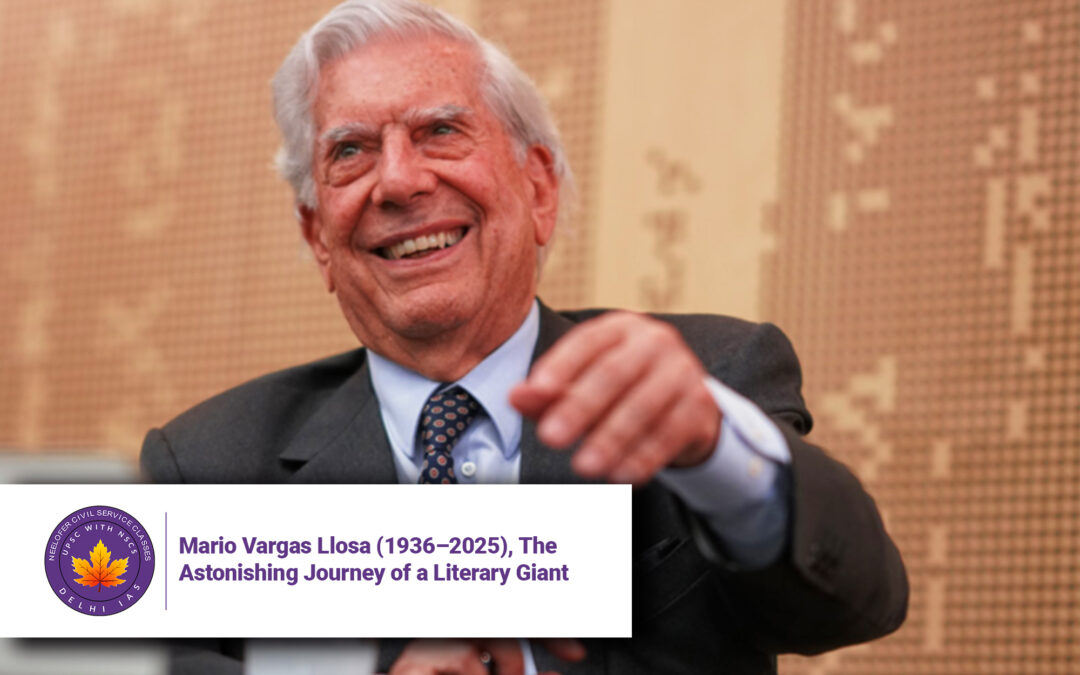
Mario Vargas Llosa (1936–2025), The Astonishing Journey of a Literary Giant
Celebrating the life and legacy of a Nobel Laureate who shaped global literature and stirred political debate
Why in News? 
Mario Vargas Llosa, the Peruvian Nobel Prize-winning author, essayist, and political figure, passed away on April 13, 2025. Known for his literary brilliance and political transformations, Llosa leaves behind a rich and controversial legacy that spans decades and continents.
Introduction
Mario Vargas Llosa was a towering figure of the Latin American Boom, alongside literary icons like Gabriel García Márquez and Julio Cortázar. He was not just a storyteller but also a fierce intellectual and a shifting political force — once a leftist revolutionary sympathizer who later embraced right-wing liberalism.
Key Issues
1. Literary Brilliance and Early Success
Llosa’s debut novel, The Time of the Hero (1963), made an immediate impact with its critique of Peru’s military elite. Over the decades, he penned several masterpieces including The Green House, The War of the End of the World, and The Feast of the Goat. His works combined psychological depth, political commentary, and experimental narrative techniques.
2. A Life of Contradictions
Vargas Llosa’s political evolution was perhaps his most astonishing transformation. He began as a supporter of leftist revolutions and figures like Che Guevara, only to shift dramatically to libertarianism, aligning with thinkers like Friedrich Hayek. He even ran for President of Peru in 1990, losing narrowly to Alberto Fujimori.
This ideological swing, often criticized, also defined his intellectual honesty and unwillingness to remain static. In his own words, echoing poet Enrique Rodó, “Each one of us is not one, but many.”
3. A Deep Disdain for Power
Despite his political engagements, Llosa often revealed a core suspicion of power in all forms. This theme is evident in his literature, particularly in The Feast of the Goat, a searing portrait of dictatorship and tyranny, and in The War of the End of the World, a grand tale of rebellion against Empire.
He once quoted Walter Benjamin’s line that literature’s highest calling is “to explode the continuum of history,” showing how deeply he believed in literature’s capacity to resist oppression.
4. Humor, Satire, and the “Impulse of Sympathy”
Llosa’s stories also embraced humor, irony, and compassion — as seen in The Bad Girl and Aunt Julia and the Scriptwriter. His ability to combine tragedy with tenderness reflected his belief in the complexity of human life. He encouraged readers not only to think deeply, but also to laugh and feel.
Challenges and the Way Forward
While Llosa’s political shifts made him a divisive figure, they also challenged static ideologies. The world of literature must carry forward his legacy of bold storytelling, critical inquiry, and emotional depth — especially in times when freedom of expression is under threat.
Conclusion
Mario Vargas Llosa’s life was a mosaic of brilliance and paradox. From literary giant to political candidate, from leftist dreamer to conservative icon, his legacy defies easy categorization. What remains undeniable is his enormous contribution to world literature — a voice that dared to challenge power, celebrate complexity, and elevate the written word.
Q&A Section
Q1: What made Mario Vargas Llosa a unique figure in world literature?
A: His combination of literary brilliance, political activism, and ideological transformation made him a rare and complex voice in global storytelling.
Q2: Which novel marked his literary debut and gained widespread attention?
A: The Time of the Hero (1963), which criticized Peru’s military elite and was banned by the military.
Q3: What was his political transformation over the years?
A: He shifted from supporting leftist revolutionary movements in Latin America to advocating for free-market liberalism and ran for President of Peru in 1990.
Q4: What themes dominated his work?
A: Power and its abuse, the fragility of freedom, political tyranny, human contradiction, humor, and empathy.
Q5: Why is Vargas Llosa’s legacy considered controversial yet profound?
A: His bold ideological shifts and political involvement made him polarizing, but his literary contributions and defense of democratic values earned global respect.

