
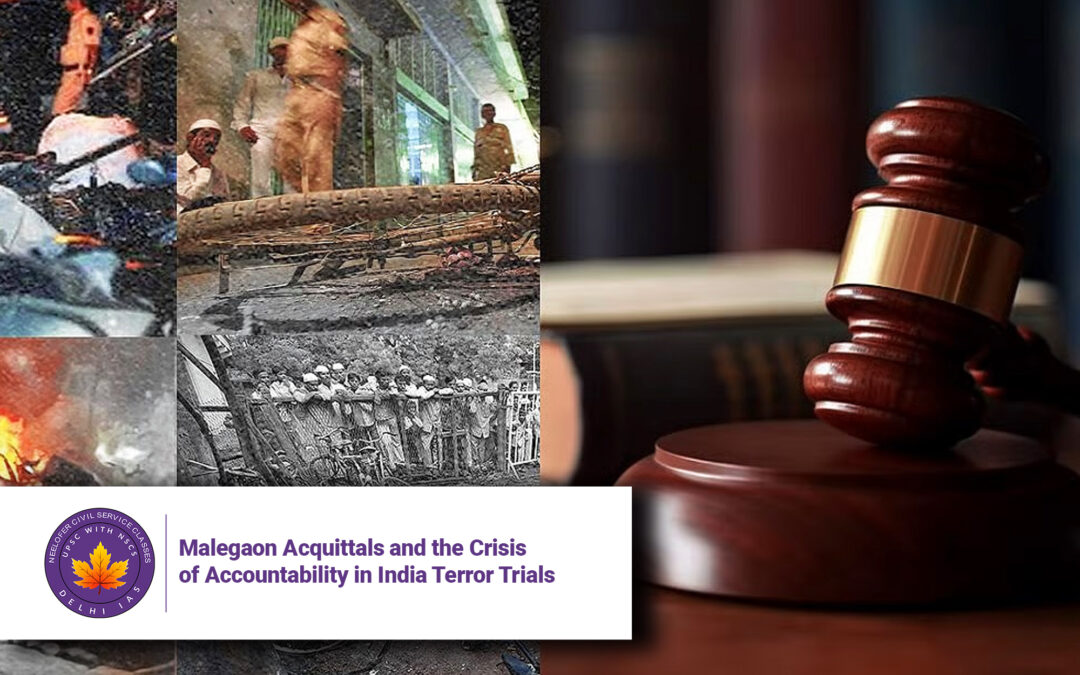
Malegaon Acquittals and the Crisis of Accountability in India Terror Trials
Overview
In a nation where the justice system is expected to provide both fairness and closure, the recent acquittal of all accused in the 2008 Malegaon blasts case by a special Mumbai court has once again thrown a spotlight on the glaring inefficiencies in India’s criminal justice system, particularly in handling terrorism cases. Despite the gravity of the crime, which claimed six lives and wounded many, the court ruled that the National Investigation Agency (NIA) failed to prove guilt beyond reasonable doubt, resulting in the release of all seven accused.
This decision comes almost 17 years after the horrific incident and 10 days after another major acquittal in the 2006 Mumbai serial train blasts case, which saw 12 accused being let off by the Bombay High Court. These repeated failures to secure convictions not only highlight the deficiencies of India’s investigative agencies but also raise deep concerns about accountability, political influence, and the slow pace of judicial processes in terrorism-related cases.
The Malegaon Case: A Timeline of Failure
The 2008 Malegaon blasts, which occurred during Ramzan, led to the deaths of six people in a busy market area in Maharashtra. Investigations into the incident, which were initially handled by state agencies and later taken over by the NIA, resulted in the arrest of several individuals, including prominent figures such as Pragya Singh Thakur (now an MP) and Lt Colonel Shrikant Purohit. These arrests were significant, not just because of the profiles of the accused, but because the case was one of the earliest examples associated with what later came to be controversially dubbed “saffron terror.”
Yet, despite the high-profile nature of the case and the serious implications of the charges, the court found numerous gaps in the prosecution’s case. Special Judge AK Lahoti, in his judgment, noted that while there existed a “grave degree of suspicion,” it was insufficient for conviction. The accused were granted “qualified acquittals,” meaning that the court acknowledged suspicious elements but found the evidence inadequate to sustain a legal finding of guilt.
Recurring Pattern: The Blight of Botched Investigations
The Malegaon verdict is not an isolated instance. It is part of a disturbing pattern of botched investigations, procedural lapses, and delayed trials that characterize India’s handling of many major terror cases. Consider the following examples:
-
2006 Malegaon blasts: 37 people died; no convictions.
-
2007 Samjhauta Express blasts: 68 killed; acquittals.
-
Mecca Masjid blasts (2007): 9 killed; all accused acquitted.
-
Ajmer Dargah blasts (2007): 3 killed; inconsistent outcomes.
In the Malegaon case, critical lapses were identified — flawed collection and documentation of evidence, procedural errors in recording key events (e.g., faulty panchanama), and reliance on hostile or unreliable witnesses. Such oversights not only weaken the case but also embolden narratives of systemic failure, bias, or worse — manipulation.
Justice Delayed is Justice Denied
Seventeen years is a long time for justice to remain elusive, especially in cases of national trauma like terror attacks. The delay in trial and adjudication erodes public trust in the judicial system and denies closure to victims and their families. It also means that those falsely accused spend years under stigma, imprisonment, or social ostracism.
Equally troubling is the impact on society. When perpetrators of terrorism are not brought to justice, it sends a message of impunity. It emboldens future threats, weakens deterrence, and leaves unresolved the critical question: Who was actually responsible for the terror act?
Political Undertones and Investigative Failures
The Malegaon case was politically sensitive from the outset. With individuals associated with right-wing ideologies under arrest, and the term “saffron terror” entering political discourse, the case became highly polarized. Pragya Singh Thakur, one of the primary accused, was elected to Parliament in 2019 on a BJP ticket, reflecting the larger political battles being fought around the narrative of the case.
The involvement of a serving army officer, Lt Col Shrikant Purohit, further complicated the case and heightened public interest. Despite the high stakes, the NIA chose not to appeal against the recent acquittals — a move that many find baffling. If the agency believed the accused were truly involved, why the reluctance to pursue justice through appeal?
Lessons for Reform: Fixing Accountability
The recent judgment calls attention to one glaring issue: the lack of accountability for failed investigations. Law enforcement and investigative agencies must be held responsible when their work does not meet legal and constitutional standards. The Malegaon case underscores the need for:
1. Professionalism in Investigations
Investigators must be trained in modern forensic techniques, adhere to due process, and avoid shortcuts like forced confessions or planted evidence.
2. Independent Oversight
An independent mechanism should audit and evaluate terror investigations. This body should have the power to recommend penalties for lapses.
3. Judicial Reforms for Time-Bound Trials
Fast-track courts and mandatory timelines for trial completion in terror cases can reduce procedural delays and increase public confidence.
4. Protection from Political Pressure
Investigations must remain free from political influence. Officers should be protected against transfers or harassment for pursuing sensitive leads.
5. Transparency in Prosecution Decisions
If cases are not to be pursued further, the public deserves a clear explanation. Silence from the NIA on Malegaon’s acquittals fuels distrust.
Conclusion: The Cost of Systemic Failures
The recent Malegaon acquittals serve as a grim reminder of the systemic rot that afflicts the prosecution of terror cases in India. It is not enough to file charges and make arrests — guilt must be proven beyond reasonable doubt through evidence, reliable witnesses, and strict adherence to law. Anything less not only fails the victims but undermines the rule of law and national security.
Terrorism cases must not become tools for political posturing or scapegoating. They demand the highest levels of integrity, diligence, and professionalism. Unless India reforms its investigative and judicial processes and fixes accountability for lapses, justice in terror cases will remain elusive — and faith in the system will continue to erode.
Q&A Section
1. Why were all accused in the 2008 Malegaon blasts acquitted?
The special court in Mumbai acquitted all seven accused in the Malegaon blasts case due to poor investigation by the NIA. Judge AK Lahoti noted there was a “grave degree of suspicion” but no concrete evidence to convict the accused. Gaps in the prosecution’s case, procedural flaws, and unreliable witness testimonies led to the court giving the benefit of the doubt to the accused.
2. What common issues plague the investigation of terror cases in India?
Several recurring problems exist: procedural lapses, poor evidence gathering, unreliable witnesses, long trial durations, political interference, and lack of proper forensic support. These problems often result in acquittals despite the gravity of the crimes. In the Malegaon case, for instance, even basic documentation like the panchanama was found to be faulty.
3. How long did it take for the Malegaon case to reach a verdict, and what does this signify?
It took 17 years for the Malegaon case to reach a verdict. Such extreme delays deny justice to victims and suspects alike. Prolonged trials erode public trust in the system, exacerbate the trauma of victims’ families, and make evidence gathering more difficult as time passes. Timely justice is critical, especially in terror cases.
4. Why didn’t the NIA appeal the acquittals in this case?
The NIA has not provided any public explanation for not appealing the acquittals. Given the high-profile nature of the case and the political sensitivity surrounding it, the lack of an appeal raises serious questions about the agency’s commitment to securing justice. The absence of further legal action weakens confidence in the prosecution’s intentions.
5. What reforms are needed to improve the handling of terrorism-related cases?
Key reforms include:
-
Time-bound trials and fast-track courts.
-
Improved forensic training and use of technology.
-
Independent oversight of investigative procedures.
-
Protections for investigators from political interference.
-
Accountability for investigative lapses.
Only by implementing these reforms can the justice system ensure both fairness and effectiveness in tackling terrorism.

