
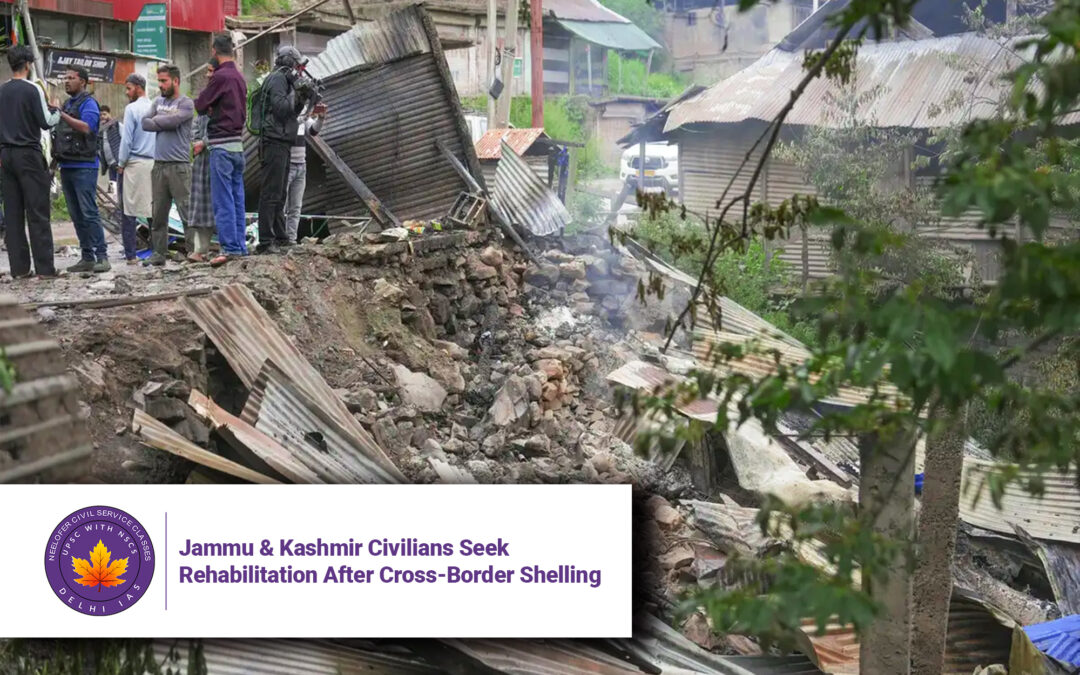
Jammu & Kashmir Civilians Seek Rehabilitation After Cross-Border Shelling
Why in News?
Recent Pakistani shelling in Jammu & Kashmir’s border regions—particularly Poonch and Uri—has caused significant civilian casualties and infrastructure damage. Union Home Minister Amit Shah’s visit to affected areas and promises of relief highlight the urgent need for physical and economic security for displaced residents.

Key Developments
1. Impact of Pakistani Shelling
-
Casualties & Damage:
-
18 civilians killed in Poonch alone.
-
1,500+ houses damaged (690 in Poonch, 534 in Uri).
-
Shelling targeted towns across Poonch, Baramulla, Rajouri, and Kupwara.
-
-
Humanitarian Crisis:
-
Displaced families describe government relief of ₹12 lakh per fully damaged house as “insufficient” to rebuild multi-storey concrete homes.
-
Life remains disrupted despite the ceasefire holding; residents struggle to return to normalcy.
-
2. Government Response
-
Amit Shah’s Visit:
-
Announced a comprehensive relief package and distributed job appointment letters to kin of the deceased.
-
Emphasized building more underground bunkers for civilian safety.
-
-
Infrastructure Gaps:
-
9,800 bunkers constructed so far (8,000 in Jammu, 1,500 in Kashmir Valley), but demand rises for individual bunkers in remote border areas.
-
3. Political Outreach
-
Rahul Gandhi (Congress) also visited victims, signaling bipartisan concern.
-
Local Sentiment: Visits by leaders boosted morale, but long-term rehabilitation remains a challenge.
Challenges Ahead
-
Inadequate Compensation: Current relief funds fail to cover reconstruction costs.
-
Bunker Shortages: Sparse populations in border areas lack immediate access to shelters during shelling.
-
Psychological Trauma: Fear persists despite ceasefire; residents demand lasting solutions.
Way Forward
-
Enhanced Relief Measures:
-
Increase compensation for fully damaged homes and include livelihood support.
-
-
Expanded Bunker Network:
-
Prioritize individual bunkers in vulnerable hamlets.
-
-
Community Resilience Programs:
-
Regular drills and early-warning systems for border villages.
-
-
Political Consensus:
-
State and Central governments must collaborate to fast-track rehabilitation.
-
Conclusion
The shelling underscores the human cost of cross-border tensions in J&K. While immediate relief efforts are critical, sustainable solutions—like adequate bunkers, fair compensation, and economic rehabilitation—are vital to restoring normalcy. The Centre and UT administration must act swiftly to address grievances and prevent further alienation of border communities.
5 Key Questions
Q1: Which areas were worst hit by Pakistani shelling?
*A1: Poonch and Uri, with 1,500+ houses damaged and 18 civilian deaths in Poonch alone.*
Q2: What relief did Amit Shah announce?
A2: A comprehensive package, job letters for victims’ families, and more bunkers.
Q3: Why are residents dissatisfied with current relief?
*A3: ₹12 lakh per house is insufficient to rebuild concrete multi-storey homes.*
Q4: What infrastructure is needed to mitigate future shelling risks?
*A4: Individual bunkers in remote areas and better early-warning systems.*
Q5: How can long-term recovery be ensured?
*A5: Higher compensation, livelihood programs, and coordinated state-Centre action.*

