
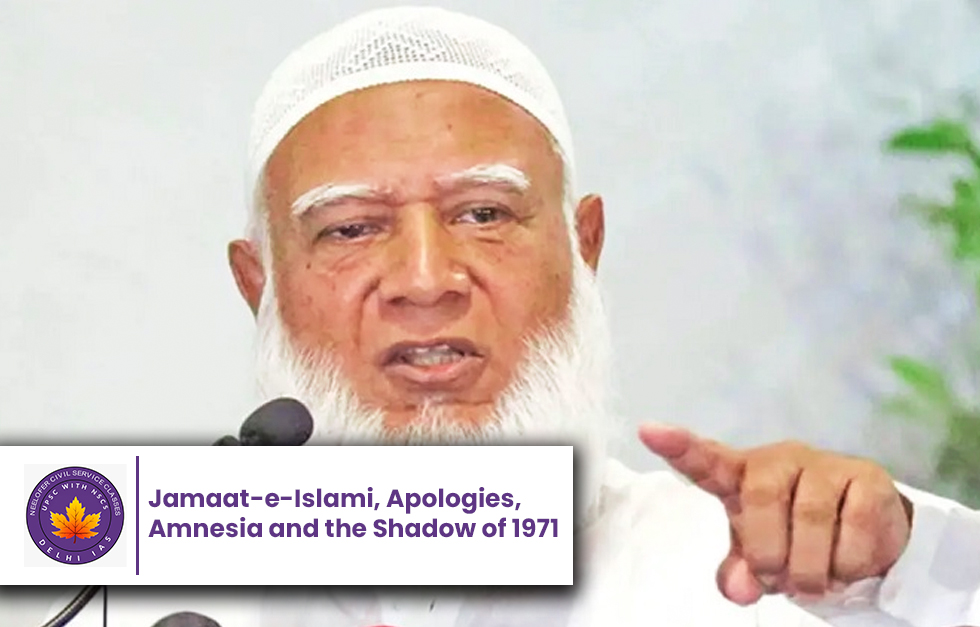
Jamaat-e-Islami, Apologies, Amnesia and the Shadow of 1971
In the wake of the 2024 July Uprising that ended Sheikh Hasina’s 15-year rule, Jamaat-e-Islami Bangladesh is trying to rebrand itself as a progressive and tolerant Islamic party — but its controversial history remains a major obstacle.
Why in News?
After the dramatic 2024 July Uprising in Bangladesh, Jamaat-e-Islami has launched a fresh attempt to resurrect its political image. It is seeking to position itself as moderate and tolerant, trying to shed decades-old baggage linked to its role in the 1971 Liberation War and subsequent war crime allegations. 
Introduction
Jamaat-e-Islami Bangladesh’s past is deeply intertwined with the country’s traumatic birth in 1971. Its leaders were accused of collaborating with Pakistan’s military during the Liberation War and involved in widespread atrocities. This legacy has continued to haunt its political fortunes for decades.
Key Issues and Background
Tumultuous Political Journey
-
Banned after Bangladesh’s independence in 1971 for alleged war crimes.
-
Resurfaced during military rule and regained political relevance in the late 1980s and 1990s.
-
Emerged as the third largest political party by the 1990s.
-
Several top leaders were tried under the International Crimes Tribunal (ICT) Act for war crimes.
War Crimes Trials
-
ICT was set up by Sheikh Hasina’s Awami League government to try 1971 war crimes.
-
Key Jamaat leaders like Motiur Rahman Nizami, Ali Ahsan Mohammad Mujahid, Abdul Quader Molla and Delwar Hossain Sayeedi were convicted and executed or jailed.
-
The trials polarised Bangladesh’s politics and deepened divides over history and identity.
Specific Impacts or Effects
-
The party remains deeply stigmatised in Bangladesh’s political discourse.
-
Calls for Jamaat to apologise for its wartime role have grown stronger, but the party has avoided direct acknowledgment.
-
Its association with radical Islamist groups globally and in Bangladesh complicates its attempts to appear moderate.
-
Young supporters see a chance to revive the party by rebranding it as inclusive, but victims’ families and secular groups resist this narrative.
Challenges and the Way Forward
Challenges
-
Overcoming the legacy of war crimes trials and public memory.
-
Winning trust among younger voters who expect democratic accountability.
-
Competing with mainstream Islamist and right-wing parties like BNP.
Steps Forward
-
Acknowledge past atrocities openly and seek public apology and reconciliation.
-
Reorient policies towards inclusive, development-focused politics rather than identity-based sectarianism.
-
Engage with civil society to rebuild credibility.
-
Separate itself from extremist ideologies and global jihadist links.
Conclusion
The Jamaat’s road back to political legitimacy is not easy. In Bangladesh’s collective memory, 1971 remains a defining event that shapes its politics and national identity. For Jamaat, real transformation can only happen through truth, reconciliation and genuine reform. Whether it can truly do so remains to be seen.
5 Questions and Answers
Q1: What triggered Jamaat-e-Islami’s political revival attempt in 2024?
A: The July Uprising that unseated Sheikh Hasina’s 15-year rule created a political vacuum Jamaat wants to fill.
Q2: Why is Jamaat controversial?
A: It is accused of collaborating with the Pakistani army during Bangladesh’s 1971 Liberation War.
Q3: What is the ICT Act?
A: The International Crimes Tribunal Act was used to try 1971 war crimes.
Q4: How did the ICT impact Jamaat?
A: Many top leaders were convicted and executed, intensifying divisions in society.
Q5: What does Jamaat need to do for genuine revival?
A: Apologise for its wartime role, modernise its ideology, and cut ties with extremism.

