
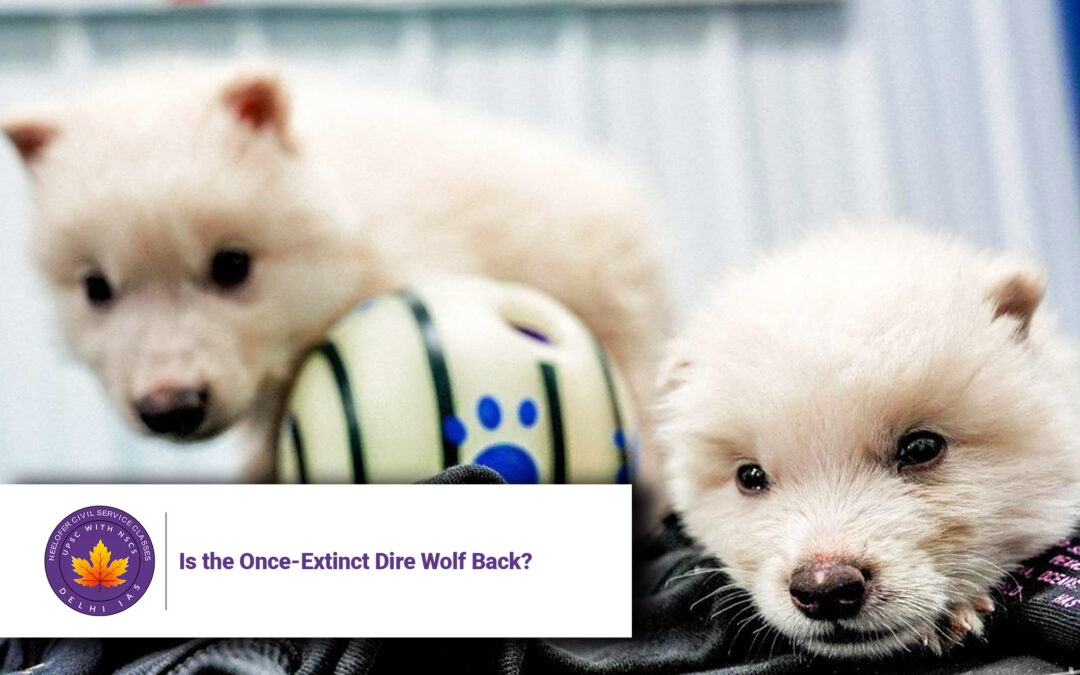
Is the Once-Extinct Dire Wolf Back?
The ethics, science, and impact of bringing back ancient species in today’s world
Why in News?
On April 7, 2025, Colossal Biosciences, a biotech company based in Texas, USA, claimed it had successfully “resurrected” the dire wolf — a species believed to have gone extinct around 12,000 years ago. This groundbreaking announcement has sparked global debates around ethics, conservation, and ecological impacts of “de-extinction”. 
Introduction
De-extinction is the process of reviving extinct species using advanced biotechnology. Colossal Biosciences, which has previously worked on resurrecting the woolly mammoth, has now made headlines by announcing the birth of three dire wolf pups named Romulus, Remus, and a third unnamed pup. The development was met with both amazement and concern.
Key Issues
1. Is the Dire Wolf Truly Back?
According to Colossal, the genome of the gray wolf (Canis lupus) was edited to match that of the dire wolf (Aenocyon dirus) to a 99.9% similarity — approximately 2.445 billion out of 2.447 billion base pairs were identical. However, even a 0.06% genetic difference equals 1.47 million base differences — meaning the recreated animal may resemble a dire wolf but is genetically distinct.
2. Scientific vs. Genetic Accuracy
Despite claims, what has been produced is more of a dire wolf “proxy” or hybrid, rather than an exact clone. While it may resemble the ancient predator in appearance and behavior, its genetic uniqueness and role in the ecosystem remain uncertain.
3. Ecological and Ethical Concerns
Bringing back animals that lived in a vastly different ecological context — like dire wolves — raises risks:
-
Modern ecosystems are fragmented.
-
Climate, prey species, and plant communities have drastically changed.
-
Reintroduced predators could harm existing ecosystems.
There is concern that such initiatives could distract from more urgent conservation efforts aimed at protecting endangered species that still exist.
4. Political and Conservation Impact
Some experts worry that such announcements can weaken conservation policies. For instance, the U.S. Interior Secretary Doug Burgum was quoted criticizing the government’s approach to environmental regulations following Colossal’s announcement.
Challenges and the Way Forward
While the idea of bringing back extinct species captures public imagination, it raises questions:
-
Is it ethical to recreate animals that no longer have a role in today’s ecosystems?
-
Should resources be diverted from protecting existing biodiversity to reviving extinct ones? A more balanced approach might involve using such technologies to support current wildlife rather than resurrect ancient species.
Conclusion
The birth of the genetically modified dire wolf pups may go down in history as a technological marvel. But it also marks a turning point in conservation science — opening a new era filled with complex ethical and ecological questions. As exciting as de-extinction is, it must be approached with responsibility and humility.
Q&A Section
Q1: What exactly did Colossal Biosciences do?
A: Colossal claimed to have used gene-editing techniques on gray wolf DNA to create animals genetically similar (99.9%) to the extinct dire wolf, resulting in the birth of three live pups.
Q2: Are these new animals truly dire wolves?
A: Not exactly. They are genetically very close but still distinct. Even a 0.06% difference in DNA accounts for 1.47 million base pair variations, making them a new, similar species — not exact replicas.
Q3: Why is de-extinction considered controversial?
A: It raises ecological and ethical issues. Reintroducing long-extinct animals could disrupt current ecosystems, divert conservation funds, and influence policy decisions that may harm protection of existing species.
Q4: How could this affect conservation policy?
A: Some fear that high-profile de-extinction projects might shift public and political focus away from protecting endangered species that are still alive and urgently need help.
Q5: What is Colossal’s broader mission?
A: Colossal aims to “secure the health and biodiversity of our planet’s future” by reviving extinct species like the woolly mammoth, Tasmanian tiger, and dire wolf, and reintroducing them into the wild.

