
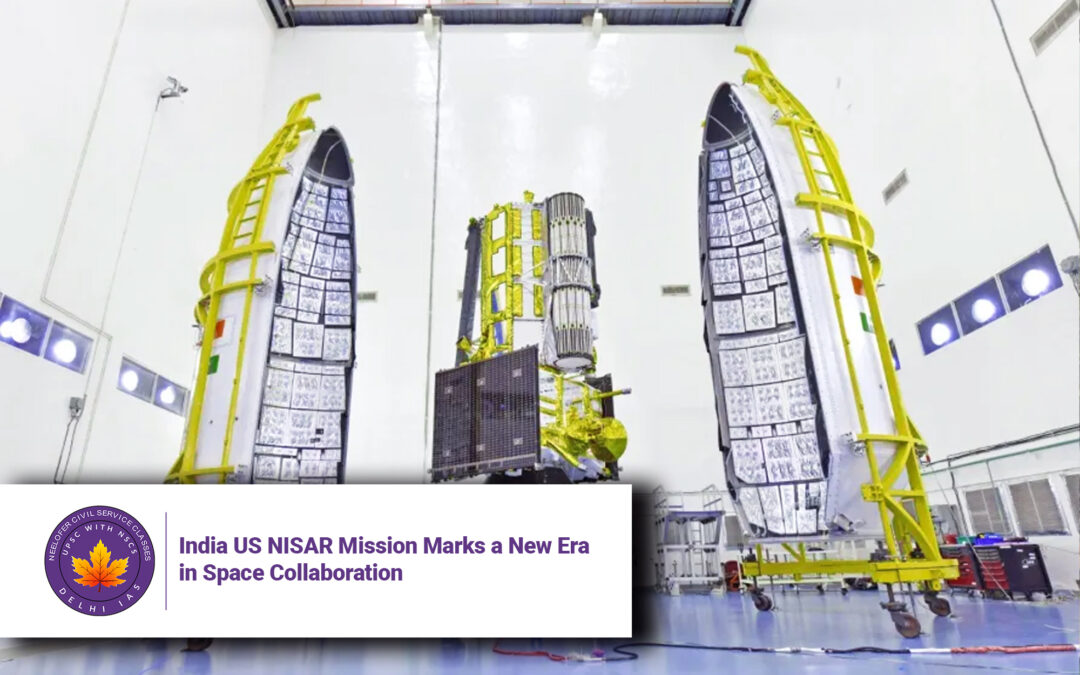
India US NISAR Mission Marks a New Era in Space Collaboration
Why in News?
On Wednesday, the NASA-ISRO Synthetic Aperture Radar (NISAR) mission is set to launch, marking one of the most significant collaborative efforts in space exploration between India and the United States. With a budget of $1.5 billion, this Earth-observation satellite aims to deliver precise and freely available data for global use, every 12 days. 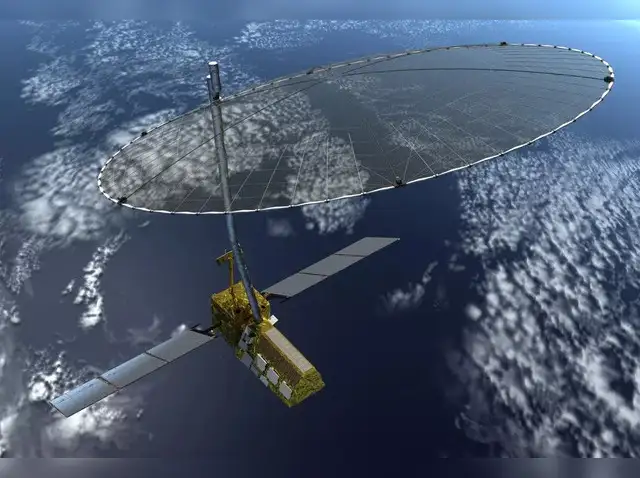
Introduction
NISAR is not just another satellite; it is a historic convergence of two contrasting space philosophies. On one hand is NASA’s urge to explore distant planets and cosmic bodies, and on the other is ISRO’s commitment to using space technology for societal development. Together, they have created the world’s most expensive Earth observation satellite designed for global benefit.
Key Highlights of the NISAR Mission
-
Dual-band Radar Capability: NISAR will use both L-band and S-band Synthetic Aperture Radar (SAR) to detect changes in Earth’s surface with centimetre-level accuracy.
-
Mission Payload: A 2,800 kg satellite observatory to study biomass, sea level rise, groundwater, ice mass, natural hazards, and more.
-
Data Accessibility: Unlike many missions, all NISAR data will be open and free to the public.
-
Technological Collaboration: NASA provided the L-band radar and mission electronics, while ISRO contributed the S-band radar, satellite bus, and launch services using a GSLV rocket.
Background and Development
Originally conceptualised by NASA as part of the DesDynI (Deformation, Ecosystem Structure, and Dynamics of Ice) mission, it was meant to study environmental hazards and climate change. The collaboration took shape when ISRO joined, offering launch capability and cost-effective engineering.
This collaboration brought together NASA’s Jet Propulsion Laboratory (JPL), rooted in deep-space exploration, and ISRO’s Space Applications Centre (SAC), known for its societal-driven space innovations. JPL’s history traces back to the 1930s when Caltech students (the “Suicide Squad”) laid its foundation with makeshift rocket tests.
ISRO’s SAC, based in Ahmedabad, began with the mission of bringing space benefits to ordinary people. In 1975, SAC led the Satellite Instructional Television Experiment (SITE), using a NASA satellite to broadcast educational content to 2,400 Indian villages. This spirit of practical innovation led to the development of the Indian Remote Sensing (IRS) programme and India’s first radar imaging satellite, RISAT-1.
Significance of the Collaboration
-
Shared Goals: Both agencies brought their strengths — NASA’s deep-space expertise and ISRO’s focus on utility-driven innovations.
-
Cost-Effective Model: Shared costs, resources, and risk led to high-efficiency output without overburdening one party.
-
Blueprint for Future: NISAR’s model offers a future path for spacefaring nations to collaborate with trust and complementarity.
The partnership was formalised in 2014 following Prime Minister Narendra Modi’s visit to the US, with NASA administrator Charles Bolden and ISRO chairperson K. Radhakrishnan signing documents to jointly launch this Earth-science satellite.
Conclusion
NISAR reflects a powerful truth: space innovation does not need to be competitive. It proves that global challenges such as climate change, disaster management, and ecosystem monitoring require global partnerships. The mission signals a future where space programmes are driven by collaboration, not rivalry — and where science serves humanity on Earth just as much as it reaches for the stars.
Q&A Section
Q1. What is the main objective of the NISAR mission?
To provide highly accurate and freely available Earth observation data on ecosystems, biomass, groundwater, sea level rise, and natural hazards every 12 days.
Q2. How does NISAR represent a convergence of two space philosophies?
NASA represents a space exploration-centric approach, while ISRO focuses on using space for societal benefits. NISAR combines both views in a single mission.
Q3. What are the main technological contributions from NASA and ISRO?
NASA contributed the L-band radar and electronics; ISRO provided the S-band radar, satellite bus, launch vehicle, and launch services.
Q4. Why is the NISAR mission considered unique globally?
It’s the first satellite to use dual-band Synthetic Aperture Radar (SAR) on such a large scale, offering centimetre-level data that’s open to the public.
Q5. What larger message does NISAR send to the world?
That international cooperation in space can lead to powerful scientific breakthroughs and that shared missions can solve global problems more effectively than isolated efforts.

