
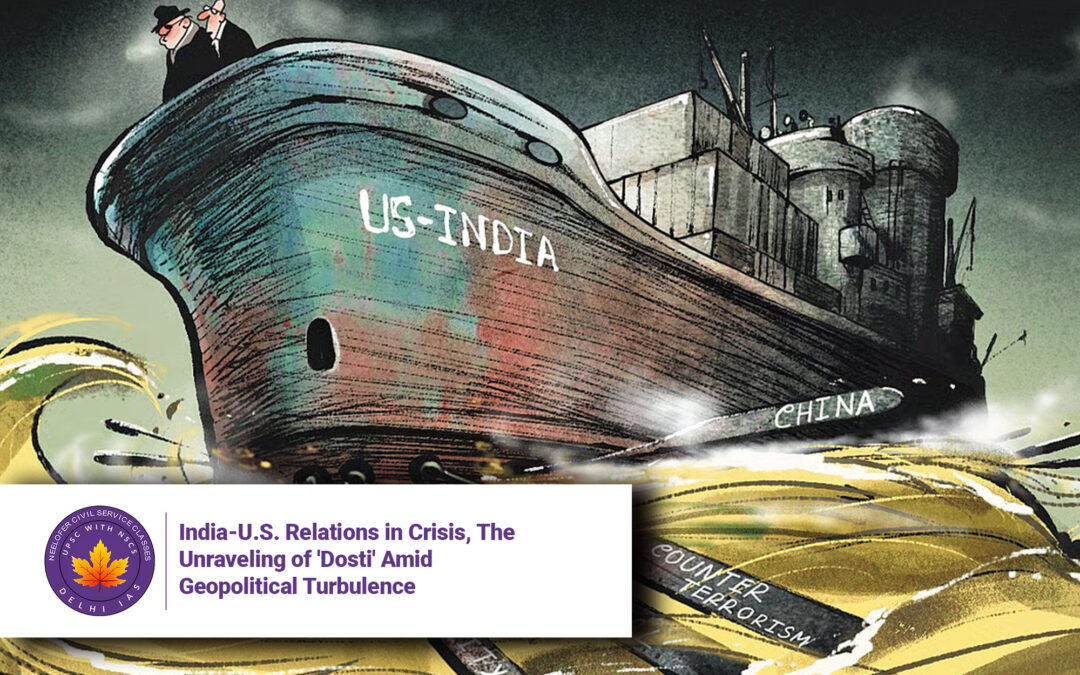
India-U.S. Relations in Crisis, The Unraveling of ‘Dosti’ Amid Geopolitical Turbulence
Why in News?
Recent events—from the U.S.-brokered India-Pakistan ceasefire to visa restrictions on Indian students—have exposed deepening fractures in the much-touted Modi-Trump “dosti” (friendship), revealing transactional tensions and strategic divergences between the two nations. 
Key Flashpoints
-
The Forced Ceasefire (May 2025):
-
China-Pakistan Nexus: U.S. intelligence revealed Pakistan’s use of Chinese hypersonic missiles (PL-15) and aircraft during clashes, with Chinese officers embedded in Pakistan’s military command.
-
Trump’s Intervention: Despite India’s upper hand in the conflict, Trump strong-armed a ceasefire to protect his family’s crypto deal (World Liberty Financial) with Pakistan, signed days after the Palaisan terror attack.
-
-
Diplomatic Snubs:
-
Silence on Hostilities: Modi’s government protested none of the following:
-
Deportation of Indian immigrants in shackles.
-
Steep U.S. tariffs on Indian goods.
-
Harvard’s ban on Indian students.
-
-
Visa Crackdowns: Suspension of student visa interviews and threats of revocation target Indian nationals.
-
-
The China Factor:
-
Beijing’s direct military support to Pakistan (missiles, air defense breaches) forced India to neutralize Chinese-linked targets, escalating regional tensions.
-
Xinhua’s gloating over Pakistan’s “new era of warfare” underscores China’s proxy war strategy.
-
Broken Promises vs. Harsh Realities
-
MEGA vs. MICA: Modi’s “Make India Great Again” (MICA) and Trump’s “America First” slogans collided when commercial interests overrode strategic ties.
-
Communication Breakdown: Modi and Trump haven’t spoken since May 7, 2025—only Vance and Rubio relayed U.S. demands.
5 Critical Questions Answered
Q1: Why did Trump broker the India-Pakistan ceasefire?
A: To safeguard his family’s crypto venture (WLT) with Pakistan, signed April 26, 2025—days after the Palaisan attack.
Q2: How did China escalate the conflict?
A: By providing missiles, aircraft, and battlefield guidance to Pakistan, with officers in Pakistan’s command centers.
Q3: What’s the status of India-U.S. relations now?
A: In “shambles”—no public protests from India on tariffs, deportations, or student bans reveal muted diplomacy.
Q4: What’s the nuclear blackmail reference?
A: U.S. intel hinted at Pakistan’s nuclear threats, prompting India’s “no submission” stance—but details remain classified.
Q5: What’s next for India’s strategy?
A: A recalibration of both military doctrine (China-Pak axis) and U.S. policy (less reliance on Trump’s transactional deals).
Conclusion
The Modi-Trump “dosti” lies fractured, unmasked as a marriage of convenience now buckling under geopolitical realpolitik. With China emboldened and U.S. priorities skewed by private interests, India must chart an independent course—one that prioritizes strategic autonomy over photo-op diplomacy. As P. Chidambaram notes: That’s the way the cookie crumbles.
— With inputs from defense analysts and diplomatic sources

