
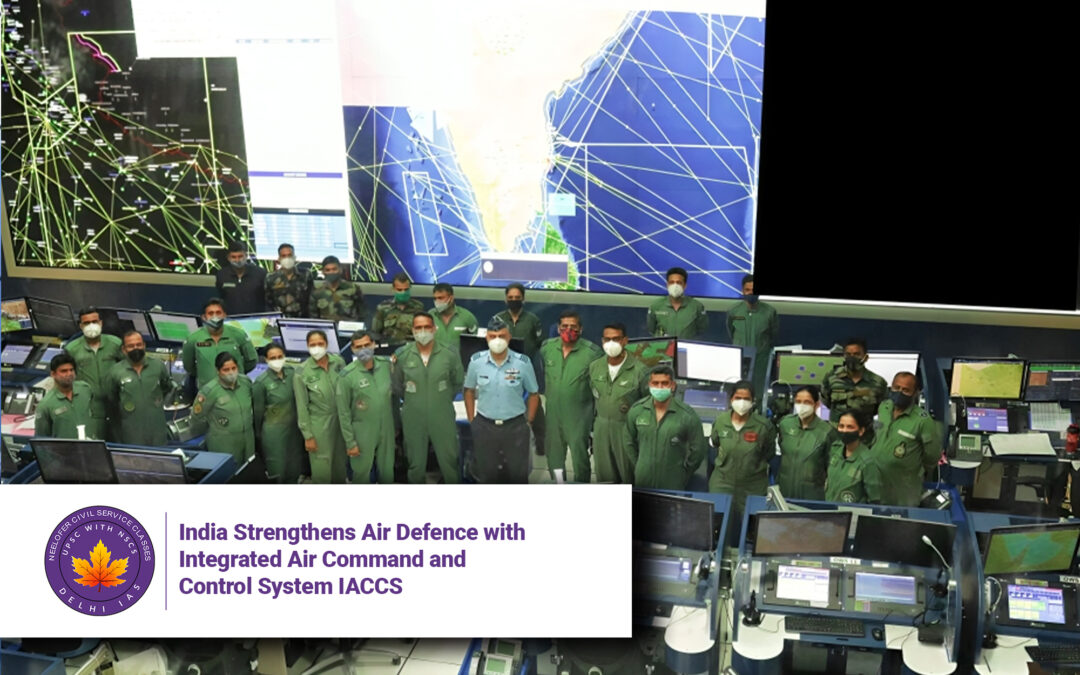
India Strengthens Air Defence with Integrated Air Command and Control System IACCS
Why in News?
During the media briefing on Operation Sindoor on May 13, the Indian Air Force (IAF) demonstrated the capabilities of the Integrated Air Command and Control System (IACCS) — a critical component of India’s multi-layered air defence network. This event showcased how India has bolstered its air defence against aerial threats, including drones, missiles, and enemy aircraft. 
Introduction
In the face of growing aerial threats from hostile neighbors, especially from Pakistan, India has taken robust measures to strengthen its airspace surveillance, detection, interception, and neutralization capabilities. The IACCS, developed by Bharat Electronics Limited (BEL), is central to these efforts. It integrates multiple layers of sensors and weapon systems into a cohesive, real-time air defence response network.
Key Issues
-
What is IACCS?
IACCS is an automated command and control system developed by BEL. It integrates real-time data from various air defence assets — such as radar systems, fighter aircraft, surface-to-air missiles, and anti-drone weapons — to detect and respond swiftly to threats. It offers complete situational awareness and ensures timely decision-making from centralized and distributed command centres. -
Multilayered Air Defence Umbrella
India’s air defence follows a multi-tiered strategy:-
First Layer: Deals with short-range threats like drones using counter-drone systems, C-UAS, and MANPADS (Man-Portable Air Defence Systems).
-
Second Layer: Point and area defence with short-range missiles.
-
Third Layer: Medium-range surface-to-air missiles.
-
Fourth Layer: Long-range surface-to-air missiles like S-400 and LR-SAMs.
These layers together provide overlapping protection across different altitudes and distances.
-
-
Integration with Akashteer
IAF’s IACCS is integrated with Akashteer, the Indian Army’s automated air defence control and reporting system. This integration ensures seamless coordination between Army and Air Force operations, enhancing response capabilities and preventing duplication or delay. -
Advanced Technologies Used
The IACCS uses a mix of:-
Surveillance radars (long to short range),
-
AWACS (Airborne Warning and Control System),
-
AEW&C (Airborne Early Warning and Control),
-
Artificial Intelligence for threat assessment,
-
Real-time communication across command levels.
-
-
Significance for National Security
India’s focus on building this air defence grid reflects its preparedness against modern aerial warfare, especially from unmanned aerial vehicles (UAVs), cruise missiles, and ballistic missiles. The capability to detect, track, and neutralize these threats with minimal delay is a crucial deterrent.
Challenges and the Way Forward
-
Continuous Upgradation: As aerial threats evolve, India must regularly upgrade its systems and integrate newer technologies like AI and machine learning.
-
Better Civil-Military Integration: Air defence efforts should be integrated with civil aviation safety and disaster response mechanisms.
-
Public Awareness and Transparency: While sensitive data must be protected, transparency in defence preparedness helps build public trust and national morale.
-
Indigenous Development: Continued push for indigenous defence systems under the Aatmanirbhar Bharat initiative will reduce dependency on foreign imports.
Conclusion
India’s IACCS and its multi-layered air defence structure mark a major leap in protecting national airspace. From drones to long-range missiles, the Indian Air Force, in collaboration with the Army, has created a smart, responsive, and modern defence shield. These efforts not only safeguard military assets but also protect civilian lives and national infrastructure from aerial attacks.
Five Questions and Answers
Q1. What is the Integrated Air Command and Control System (IACCS)?
A: IACCS is an automated command and control system developed by BEL that integrates data from all air defence assets to detect, identify, intercept, and destroy hostile intrusions.
Q2. What are the key layers of India’s air defence system?
A: The four key layers include:
-
Counter-drone and MANPADS (short-range)
-
Point and short-range missile defence
-
Medium-range missile systems
-
Long-range missile systems
Q3. What is Akashteer, and how does it relate to IACCS?
A: Akashteer is the Indian Army’s air defence control and reporting system. It is integrated with IACCS to ensure joint operation efficiency between the Army and Air Force.
Q4. How does the IACCS use technology in defence?
A: It employs radar systems, AI-driven threat analysis, AWACS, AEW&C, and real-time command integration to ensure quick response to aerial threats.
Q5. Why is a multi-layered defence system important?
A: It ensures that aerial threats at different altitudes and distances (from UAVs to ballistic missiles) are intercepted at various stages, minimizing the chances of a successful enemy attack.

