
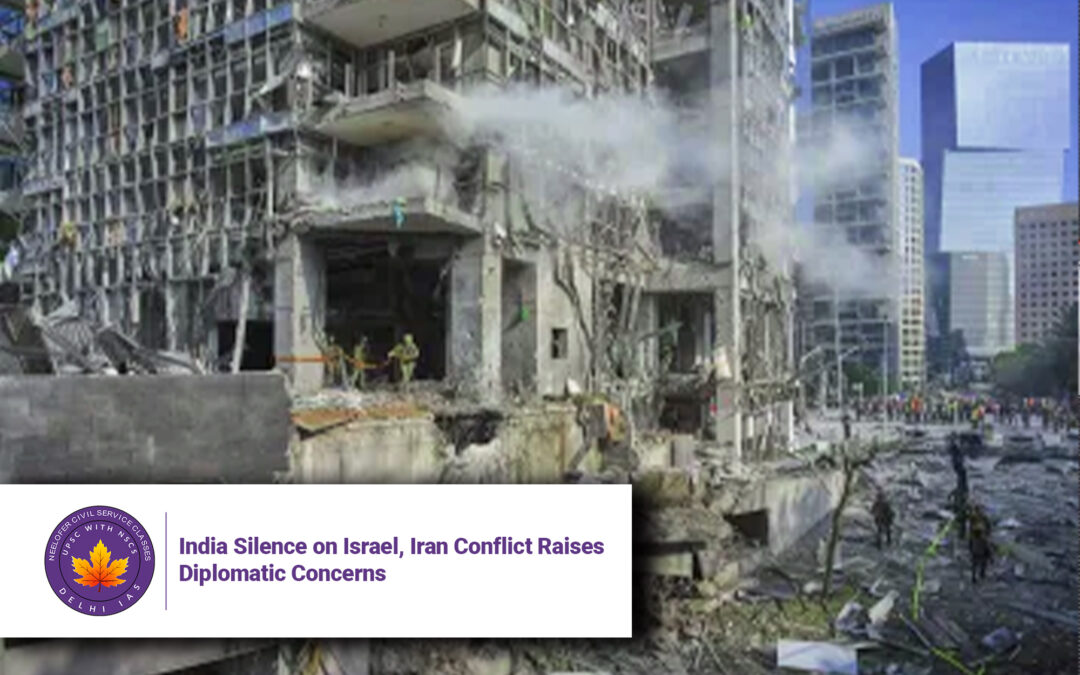
India Silence on Israel, Iran Conflict Raises Diplomatic Concerns
Why in News?
On June 13, 2025, Israel launched a military strike on Iran, escalating tensions in West Asia and drawing condemnation from several global actors. The Indian National Congress, led by Sonia Gandhi, has strongly criticized the Government of India for its continued silence, terming it a departure from India’s moral and diplomatic traditions. 
Introduction
Israel’s latest attack on Iranian soil, involving bombings and targeted assassinations, has been widely condemned as a disproportionate and dangerous escalation. Coming amidst ongoing Gaza violence and stalled nuclear negotiations, this military move threatens to destabilize the region and heightens the risk of broader conflict.
Key Features
● Breakdown of Diplomacy
-
This attack came despite five rounds of U.S.-Iran nuclear talks, with a sixth planned for June 2025.
-
U.S. intelligence had assessed that Iran was not pursuing a nuclear weapons programme, a view reiterated by officials like Tulsi Gabbard.
-
Iran remains a signatory to the Nuclear Non-Proliferation Treaty (NPT) and had been compliant with the 2015 Joint Comprehensive Plan of Action (JCPOA) until it was unilaterally abandoned by the U.S. in 2018.
● Israel’s Internal Politics and Aggression
-
Under PM Benjamin Netanyahu, Israel has pursued aggressive expansion of illegal settlements, blockaded Gaza, and undermined peace processes, especially the two-state solution.
-
Netanyahu’s alliance with ultranationalist factions and refusal to cooperate on Palestinian statehood has worsened regional tensions.
● Humanitarian Impact
-
In Gaza, over 55,000 Palestinians have died since October 2023.
-
Civilian infrastructure, including hospitals and neighborhoods, has been destroyed.
-
This has left Gaza’s population on the brink of famine and ruin.
Specific Impacts or Effects
● Regional Instability
-
Escalating strikes risk triggering a wider war in West Asia, particularly given Iran’s influence in the region and its ties with proxy groups.
-
Tensions also affect the safety of Indian nationals working across West Asia.
● India’s Global Image
-
New Delhi’s lack of condemnation has drawn criticism from global observers and domestic opposition parties alike.
-
It reflects a shift from India’s non-aligned, peace-seeking diplomacy to realpolitik silence, undermining India’s role as a global voice of balance.
Challenges and the Way Forward
Challenges:
-
Balancing relationships with both the U.S.-Israel axis and Iran.
-
Safeguarding Indian diaspora interests across volatile West Asian regions.
-
Upholding India’s moral authority in global diplomacy while navigating changing geopolitical alliances.
Way Forward:
-
India must publicly reaffirm support for the two-state solution, which envisions a secure Israel and a sovereign Palestine.
-
Call for immediate ceasefire, restarting of nuclear negotiations, and unhindered humanitarian aid to affected regions.
-
India should revive its role as a mediator and peace advocate, especially within the Global South.
Conclusion
The Congress has called India’s current foreign policy approach a “disturbing departure” from its historically moral and just diplomatic traditions. In the face of increasing global conflict and regional instability, India’s silence is no longer neutral — it risks being complicit. As a leader in the Global South and a long-standing proponent of peaceful diplomacy, India must now use its voice to demand peace, restraint, and justice in West Asia.
Q&A Section
Q1. What prompted Sonia Gandhi’s statement on India’s foreign policy?
Israel’s June 13, 2025 strike on Iran and India’s silence on the humanitarian crisis in Gaza.
Q2. What is the 2015 Iran Nuclear Deal and who brokered it?
The Joint Comprehensive Plan of Action (JCPOA), brokered by the U.S., EU, Russia, China, and others, which limited Iran’s nuclear activity in exchange for sanction relief.
Q3. How has Israel’s leadership contributed to the current crisis?
Through aggressive settlement policies, blockade of Gaza, and rejection of the two-state solution under PM Netanyahu.
Q4. What is the Congress party demanding from the Indian government?
A return to principled diplomacy, a clear condemnation of disproportionate violence, and renewed support for Palestinian rights.
Q5. Why does India’s silence matter globally?
India has historical moral weight in global diplomacy and a large diaspora in West Asia, making its voice critical in calls for peace and justice.

