
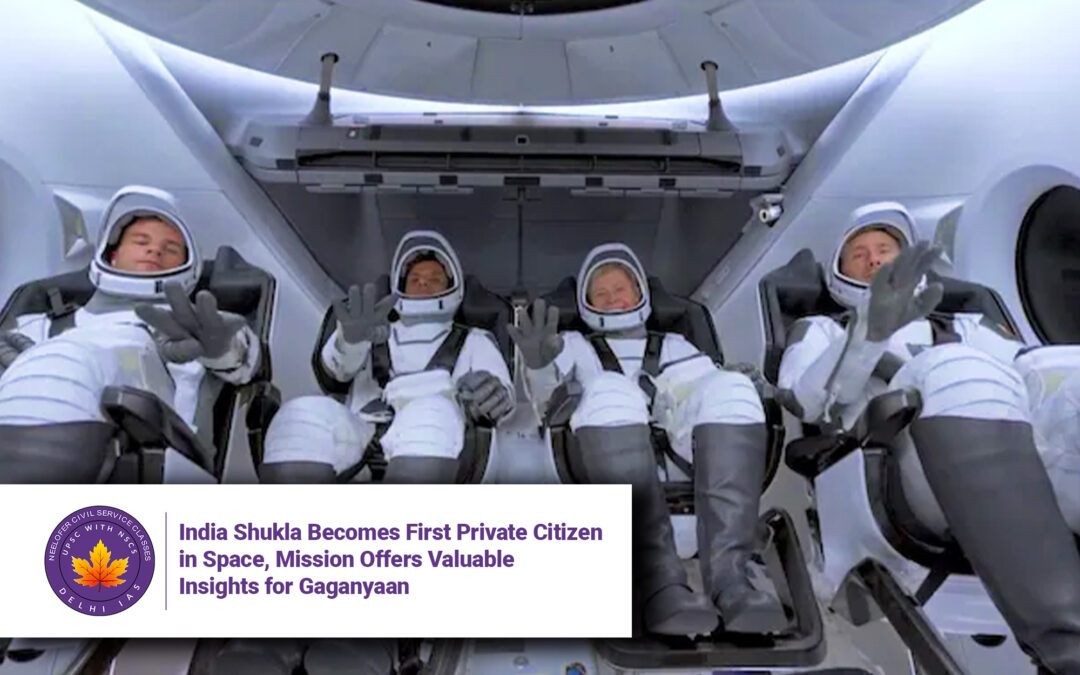
India Shukla Becomes First Private Citizen in Space, Mission Offers Valuable Insights for Gaganyaan
Why in News?
On June 25 (IST), Indian-origin astronaut Shubham Shukla lifted off from NASA’s Florida spaceport aboard the Axiom-4 commercial space mission to the International Space Station (ISS), becoming the first Indian since Rakesh Sharma (1984) to achieve such a feat. His mission is expected to provide crucial insights for India’s upcoming human spaceflight program, Gaganyaan. 
Introduction
Shubham Shukla’s historic journey into space marks a significant moment for India’s aspirations in space exploration. As a part of the Axiom-4 mission, his flight is not only symbolic but strategically important. It offers a practical window into training, operations, and human performance in space, thereby contributing vital data to ISRO’s human spaceflight preparation.
Key Highlights
-
First Private Indian in Space:
Shukla is the first Indian-origin individual to travel to space on a paid, commercial flight, after Rakesh Sharma’s government-sponsored journey in 1984. -
Part of Axiom-4 Mission:
Axiom is a private space company working with NASA and SpaceX, using SpaceX’s Dragon spacecraft to transport astronauts to the ISS. -
Cost and Policy Questions:
The Indian government paid an estimated ₹458 crore (part of the ₹20,000 crore Gaganyaan budget) for Shukla’s seat and training. However, ISRO has not publicly detailed the rationale behind this expenditure, which raises accountability and transparency questions. -
Support from Prashant Nair:
Shukla was backed and trained by Prashant Nair, a key figure who helped coordinate the mission, highlighting a unique public-private collaboration. -
Implications for Gaganyaan:
This mission could serve as a model for future private-public partnerships and showcases the growing importance of integrating Indian talent with global space tech companies.
The Way Forward
As India moves closer to launching Gaganyaan, it must clearly define its strategic priorities and be transparent about fund allocations. Missions like Shukla’s, though expensive, offer invaluable experience. However, public scrutiny and expectations around space budgets necessitate clearer communication from ISRO and the Department of Space.
Conclusion
Shubham Shukla’s journey to the ISS is not just a personal achievement but a pivotal step in India’s space ambitions. It serves as a testbed for future missions and reflects the evolving dynamics of space exploration where government and private entities must work hand-in-hand.
5 Questions & Answers
1. Who is Shubham Shukla and why is he in the news?
He is an Indian-origin astronaut who became the first Indian private citizen to reach space via the Axiom-4 mission to the ISS.
2. What is Axiom-4?
It is a commercial space mission organized by Axiom Space in partnership with NASA and SpaceX, using the Dragon capsule to transport astronauts.
3. How does this mission relate to India’s Gaganyaan program?
It offers insights into human spaceflight training, system testing, and ISS operations—all vital for India’s Gaganyaan manned mission scheduled for 2027.
4. What is the controversy surrounding the mission?
There is criticism due to the lack of clarity from ISRO and the Department of Space on the rationale and benefits of spending ₹458 crore on the mission.
5. What does this signify for India’s future in space exploration?
It demonstrates India’s willingness to integrate with global private players and signals a shift toward collaborative models for future human spaceflights.

