
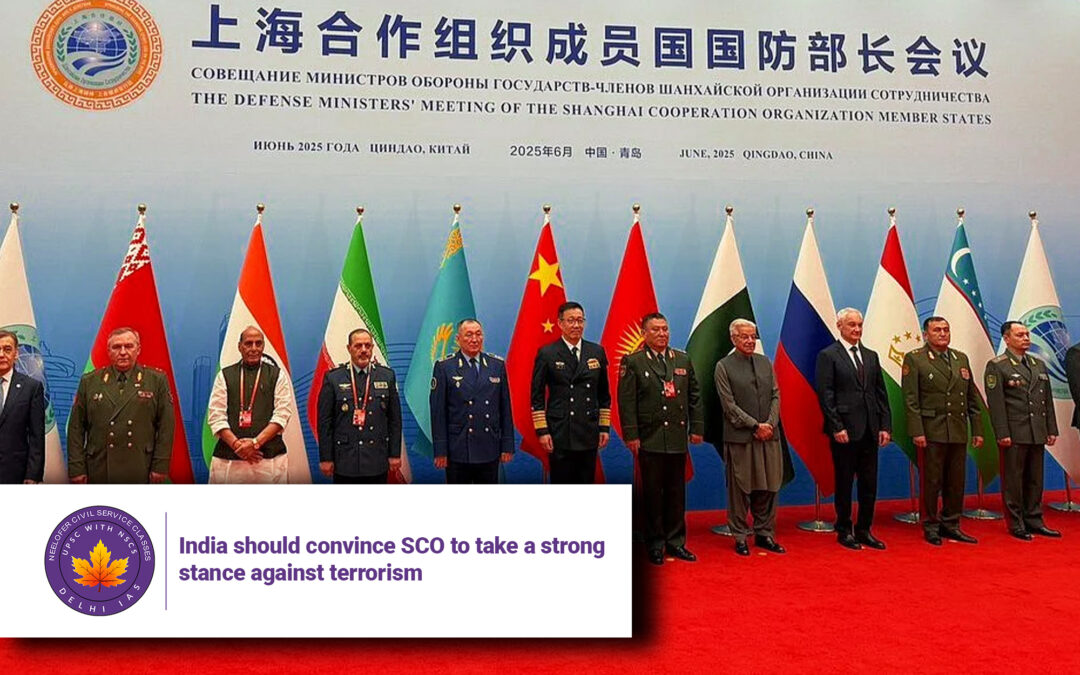
India should convince SCO to take a strong stance against terrorism
Why in News?
The recent Qingdao meeting of Defence Ministers of the Shanghai Cooperation Organisation (SCO) ended without a joint communique, primarily because India refused to endorse the statement that lacked any reference to terrorism. This marks India’s continued diplomatic push to make counter-terrorism a central part of SCO’s agenda. 
Introduction
Defence Minister Rajnath Singh, who represented India, was asked to withdraw his endorsement from a joint declaration at the behest of “one nation”—a reference to Pakistan—because the draft omitted any mention of terrorism. India’s refusal was based on principle, as terrorism remains one of the key global and regional threats, and the SCO’s silence on this issue is increasingly viewed as a diplomatic failure.
Key Issues and Institutional Concerns
1. Operation Sindoor and India’s firm stand
At the SCO meeting, Defence Minister Rajnath Singh emphasized India’s strong opposition to terrorism and presented Operation Sindoor (post-Pulwama) as an example of India’s proactive counter-terrorism efforts. He urged member nations to collectively respond to the threat.
2. Avoiding references to terrorism under pressure
The draft joint communique was reportedly altered due to pressure from China and Russia to avoid references to cross-border terrorism and issues in Balochistan, which India viewed as unacceptable.
3. Violation of SCO Charter’s spirit
India pointed out that SCO’s founding Charter of 2002 clearly includes combating “terrorism, separatism, and extremism” as core objectives. The Regional Anti-Terrorist Structure (RATS) was established with this very aim. India argued that omitting terrorism from the declaration weakens SCO’s foundational goals.
4. India’s concerns about selective approach
India has raised concerns that certain countries are selectively opposing terrorism, and that the group must take a uniform and strong stand rather than allowing certain members to shield terrorism-supporting regimes.
5. India’s future approach within SCO
India has conveyed that if SCO is to remain relevant, it must act decisively on terrorism. It is also considering whether such forums remain useful when foundational threats are deliberately sidestepped for political convenience.
Challenges and the Way Forward
-
Reinforce counter-terrorism frameworks under RATS with mandatory cooperation from all SCO nations.
-
Raise the issue diplomatically at the SCO Summit in Kazakhstan and other multilateral forums.
-
Push for a binding anti-terror declaration that doesn’t allow veto by individual members.
-
India may also consider building a coalition within SCO with other like-minded members like Central Asian countries who are directly impacted by terrorism.
-
Emphasize the need for SCO to move beyond rhetoric and deliver concrete results, else risk losing credibility as a security forum.
Conclusion
India’s refusal to endorse a weak SCO declaration on terrorism underlines its principled foreign policy. As a key regional power and a victim of state-sponsored terrorism, India’s leadership demands that the SCO not remain silent on issues of global concern. Going forward, India will likely leverage both diplomatic pressure and regional alliances to restore SCO’s counter-terrorism focus.
Q&A Section
1. Why did India not support the joint declaration at the SCO Defence Ministers’ meeting?
India objected to the draft because it lacked any reference to terrorism—a major regional and global threat.
2. What is Operation Sindoor, and how is it relevant to the SCO meeting?
Operation Sindoor refers to India’s military action after the Pulwama attack. It was cited by Rajnath Singh to showcase India’s readiness to combat terrorism.
3. What does the SCO Charter say about terrorism?
The SCO Charter of 2002 explicitly includes combating terrorism, separatism, and extremism as part of its foundational goals.
4. Why did the joint communique avoid mentioning terrorism?
Reportedly, pressure from Pakistan (backed by China and Russia) led to the omission, reflecting political sensitivities within SCO.
5. What future steps can India take in the SCO?
India may push for binding declarations, form coalitions with like-minded member states, and raise the issue in future SCO summits and bilateral engagements.

