
India Response to the Pahalgam Terror Attack, Solidarity and Strategy
Why in News?
On April 16, 2025, militants struck at a tourist party in Pahalgam, Kashmir, killing 26 people—20 of them foreign visitors—and injuring many more. The atrocity, claimed by the Islamic State–Khorasan Province (ISKP), marks one of the deadliest terror incidents in the Valley in recent years and underscores the persistent threat of cross-border terrorism. 
Background
-
The Attack: Gunmen opened fire on a group of tourists at Betaab Valley, scattering families enjoying spring excursions. Videos from the scene show panicked tourists fleeing under assault rifle fire.
-
Perpetrators: ISKP, which—despite being driven out of much of its Afghan stronghold—continues to direct or inspire operations across South Asia. Investigators suspect local Lashkar-e-Taiba handlers facilitated the strike.
-
Kinetic and Psychological Impact: Beyond loss of life, such attacks aim to fracture the region’s hard-won social cohesion by pitting communities against one another.
Government Reaction
-
Home Minister Amit Shah visited Pahalgam hours after the attack and declared, “Bharat won’t bend to terrorism.”
-
Prime Minister Narendra Modi cut short his Delhi schedule to join a high-level security review, urging unity: “We must not allow terrorists to divide us by religion or region.”
-
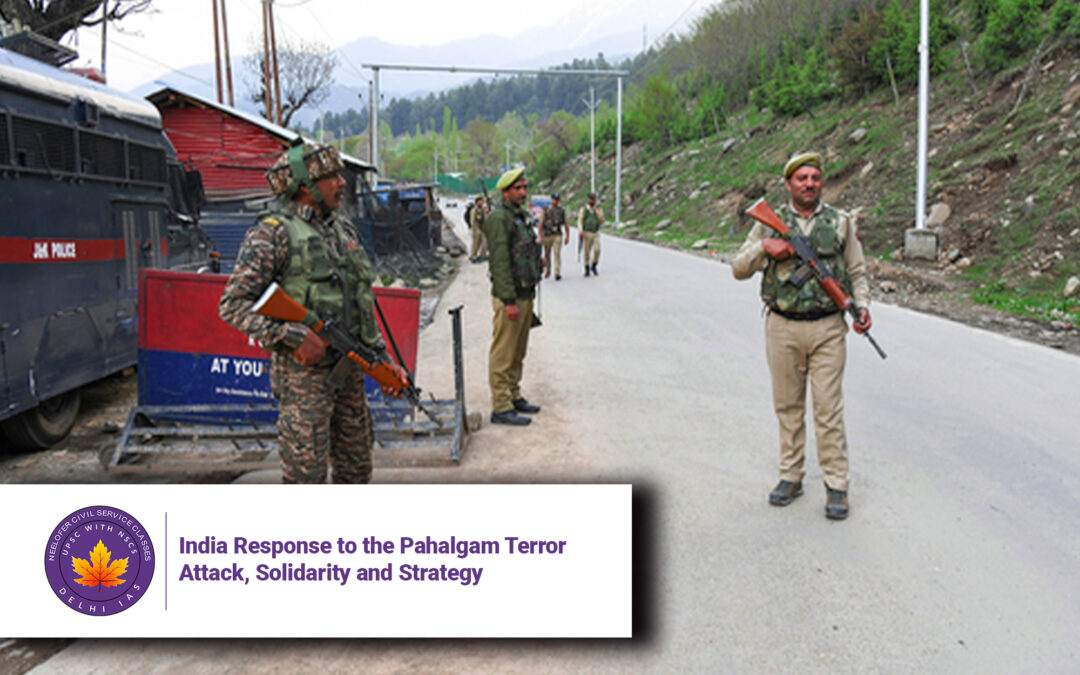
Security Measures: Army, CRPF, and local police have launched combing operations across Aru, Chandanwari, and Baisaran; checkpoints have been reinforced on Srinagar–Anantnag highways; aerial surveillance drones are on 24-hour patrol.
Strategic Context
Since 2019, India has pursued a multi-pronged approach in Kashmir:
-
Infrastructure & Connectivity: New roads, tunnels (e.g., Zojila), and air links to integrate the Valley more closely with the rest of the country.
-
Economic Development: Special tourism corridors, hydro-power projects, and skill-building campuses to create livelihoods beyond militancy.
-
Legal & Administrative Reform: The abrogation of Article 370, Union Territory status, and a new domicile law to encourage demographic stability.
These steps have largely reduced violent incidents but leave open the threat of “spectre attacks” designed to stoke fear.
Why India Must Remain Firm and Focused
-
Social Cohesion: Terrorists aim to provoke communal backlash. India’s strength lies in its pluralism—any response must safeguard harmony.
-
Realist Foreign Policy: Sustained international pressure on Pakistan to dismantle ISKP support networks is essential.
-
Balanced Deterrence: While punitive operations must continue, India should also invest in intelligence, community policing, and de-radicalization to undercut extremist recruitment.
5 Key Q&A
Q1. Who claimed responsibility for the Pahalgam attack, and what links point to Pakistan?
A: The Islamic State–Khorasan Province (ISKP) claimed the strike. Security agencies have traced handlers to Lashkar-e-Taiba operatives in Pakistan-administered Kashmir and suspect logistical aid from Pakistan’s Inter-Services Intelligence (ISI).
Q2. How many people were killed and injured?
A: Twenty‐six tourists (including 20 foreigners) were killed, and over a dozen were wounded. The victims represented at least five nationalities, signaling the global stakes of Kashmir’s security.
Q3. What immediate steps did the Indian government take?
A: Home Minister Amit Shah and PM Modi personally reviewed security measures. Forces were redeployed, aerial drones activated, and border fencing along the Line of Control reinforced. An all-India terror alert was issued for sensitive tourist spots.
Q4. What’s the significance of the 2019 policy shift in Kashmir?
A: The abrogation of Article 370, upgraded infrastructure, and new domicile rules aimed to integrate Kashmir economically and politically, reducing local grievances that militants exploit. While incidents have fallen, this attack shows the fight is not over.
Q5. How can India prevent future terror strikes while preserving civil liberties?
A: By combining targeted counter-terrorism operations with community engagement—empowering local police, expanding intelligence networks, and investing in youth-focused development. Upholding the rule of law and protecting religious freedom will deny terrorists their goal of communal division.
Conclusion:
The Pahalgam massacre is a stark reminder that terrorism remains a persistent threat in South Asia. India’s response—rooted in unity, realism, and sustainable development—must ensure that the Valley’s progress is neither reversed nor its social fabric torn. In the words of Home Minister Shah, “India must remain firm and focused in the face of terror.”

