
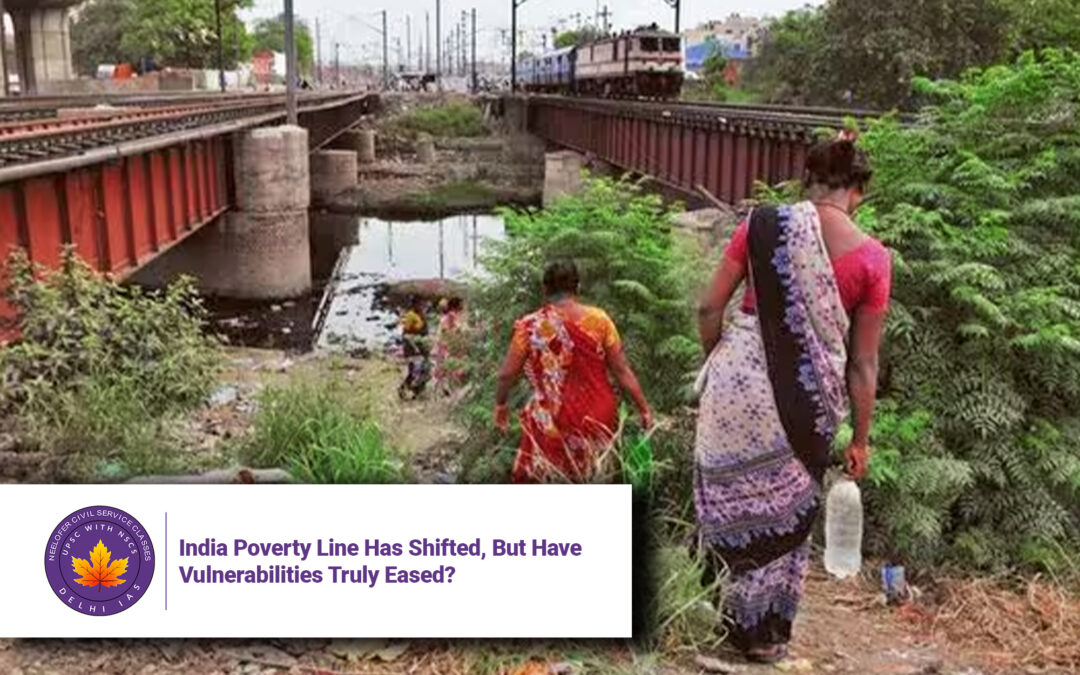
India Poverty Line Has Shifted, But Have Vulnerabilities Truly Eased?
Why in News?
The World Bank’s recent data indicates a sharp decline in extreme poverty in India—from 22.5% in 2011 to just 3.3% in 2022–23. However, despite this impressive figure, the deeper challenge remains: persistent vulnerabilities in access to health, education, sanitation, nutrition, and regional inequalities. 
Introduction:
India’s success in reducing extreme poverty is commendable. Over 280 million people have exited extreme poverty levels since 2011. But while these numbers shine globally, do they reflect improved living conditions for all Indians?
A close look reveals that while poverty measurement has evolved, the real-life experience of deprivation—across health, education, nutrition, and access to services—remains uneven and deeply rooted in geography and social structures.
Key Insights:
-
Limitations of Monetary Poverty Data:
The standard poverty line captures income-based deprivation. But frameworks like the UNDP’s Multidimensional Poverty Index (MPI) highlight gaps in sanitation, education, nutrition, etc. The current poverty discourse may miss out on these basic human rights. -
Disparities Across States:
States like Kerala, Goa, and Tamil Nadu perform better on multidimensional indicators, while Bihar, UP, and Jharkhand lag far behind. For example, only 22.8% of households in Maharashtra use clean cooking fuel compared to 3.6% in Bihar. -
Unequal Access to Public Services:
Education and health remain unevenly distributed. States with weaker governance see slower progress. Structural issues, not just income, determine deprivation levels. -
Rural-Urban Divide:
Income poverty may be low in both rural and urban areas, but access to services like piped water, safe sanitation, and electricity is much higher in urban areas. -
Recent Government Schemes:
While flagship programs like PM Awas Yojana and PM Jan Dhan Yojana have increased access, outcomes are still skewed. For instance, food insecurity persists, and the latest State of Working India 2023 report highlights employment challenges, especially among youth.
Five Key Takeaways:
-
India’s extreme poverty rate dropped to just 3.3% in 2022–23, according to the World Bank.
-
Despite this, millions still lack access to clean cooking fuel, safe sanitation, quality education, and reliable healthcare.
-
Inter-state disparities are stark—southern and western states fare better, while Bihar, UP, and Jharkhand continue to struggle.
-
Employment growth and nutrition indicators remain critical bottlenecks.
-
Poverty measurement must go beyond income and reflect multidimensional vulnerabilities.
Q&A Section:
1. Has poverty really reduced in India?
Yes, based on monetary terms, extreme poverty has fallen sharply from 22.5% in 2011 to 3.3% in 2022–23. However, many still face multidimensional poverty.
2. What is multidimensional poverty?
It includes lack of access to essentials like health, education, clean fuel, sanitation, and housing—beyond just income.
3. Which states are still lagging in poverty indicators?
States like Bihar, Uttar Pradesh, and Jharkhand show poor results in access to public services and infrastructure, despite some monetary gains.
4. What are some indicators of vulnerability still affecting people?
Indicators include lack of clean drinking water, poor schooling quality, low nutrition levels, informal employment, and unequal income distribution.
5. What is the suggested way forward?
Poverty policy should shift towards multidimensional assessment, regional equity, and targeted improvements in public service access rather than focusing solely on income thresholds.
Conclusion:
While India’s poverty numbers have drastically improved on paper, the ground reality is far more complex. To truly alleviate deprivation, the country must move beyond income statistics and address access to essential services. Only then can India ensure dignity, equity, and opportunity for all—across states, castes, and classes.
Disclaimer: This current affairs summary is based on editorial content from a provided image and aims to distill key information into a structured format.

