
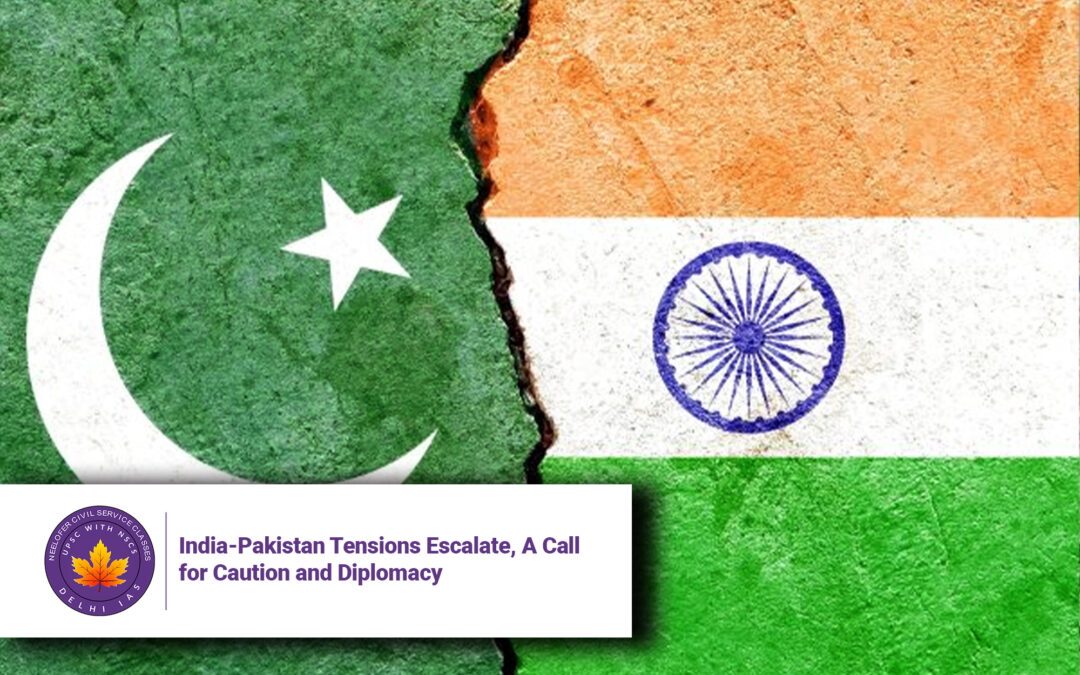
India-Pakistan Tensions Escalate, A Call for Caution and Diplomacy
Why in News?
In light of increased cross-border attacks from Pakistan-based terrorist groups, including the recent Pahalgam and Uri incidents, India has taken decisive actions, raising the potential for heightened military conflict. The current situation has prompted urgent calls for de-escalation and strategic restraint. 
Introduction
India has clarified its response policy to attacks emanating from Pakistan and Pakistan-occupied Kashmir (PoK). With Indian Air Force strikes and surgical operations following major terror attacks, there is now an urgent need to balance assertive defence with diplomatic outreach, avoiding a slide into full-scale war.
Key Issues and Background
Recent Attacks and India’s Response
-
Attacks like the Pahalgam massacre and earlier events such as the Pulwama bombing triggered robust Indian responses including precision airstrikes and heightened military alertness.
-
On May 7, India witnessed another terror attack, causing loss of lives and sparking national outrage.
Political Unity on National Security
-
All major political factions in India have shown rare unity on the matter of national security, reflecting the bipartisan consensus on the need for a strong posture against terrorism.
-
Prime Minister Modi’s government has declared there will be no tolerance for cross-border terrorism, and has acted decisively in retaliation.
The Core of the Concern
-
While military responses may offer short-term deterrence, the region risks being drawn into a larger military conflict if diplomacy and backchannel engagement are not maintained.
-
Past leaders like Manmohan Singh and Musharraf attempted peaceful dialogue (e.g., Manmohan-Musharraf formula), but current political atmospheres are not as conducive.
Key Observations
-
Global diplomatic channels have remained mostly silent, with no major push from international players like the United States or China to mediate or de-escalate.
-
India’s leadership must not only defend the borders but also retain strategic maturity by avoiding an unchecked spiral into war.
-
A historical lesson reminds us that escalation has no winners, and it’s the citizens on both sides who suffer the most.
Conclusion
India must continue asserting its right to self-defence against terror attacks while simultaneously pursuing diplomatic engagement to prevent war. Leadership on both sides of the border must rise above populist sentiment and revive backchannel diplomacy. For peace in the subcontinent, political courage and strategic patience are essential.
5 Questions and Answers
Q1. Why is there a renewed focus on India-Pakistan tensions?
Answer: Recent terror attacks from Pakistan-based groups, including one in Pahalgam, have led to Indian military responses and raised fears of conflict escalation.
Q2. How has the Indian government responded?
Answer: The Indian government has undertaken surgical and air strikes, emphasized zero tolerance for terrorism, and received bipartisan political support for its actions.
Q3. What are the risks of continued escalation?
Answer: A continued tit-for-tat military escalation could spiral into a full-scale war, destabilizing the region and harming both economies and civilian lives.
Q4. Are there any international efforts to de-escalate tensions?
Answer: So far, the international response has been muted, with no significant mediation from global powers like the US or China.
Q5. What can be done to ease tensions going forward?
Answer: Both nations need to revive diplomatic engagement, reduce inflammatory rhetoric, and pursue backchannel negotiations similar to past efforts like the Manmohan-Musharraf peace framework.

