
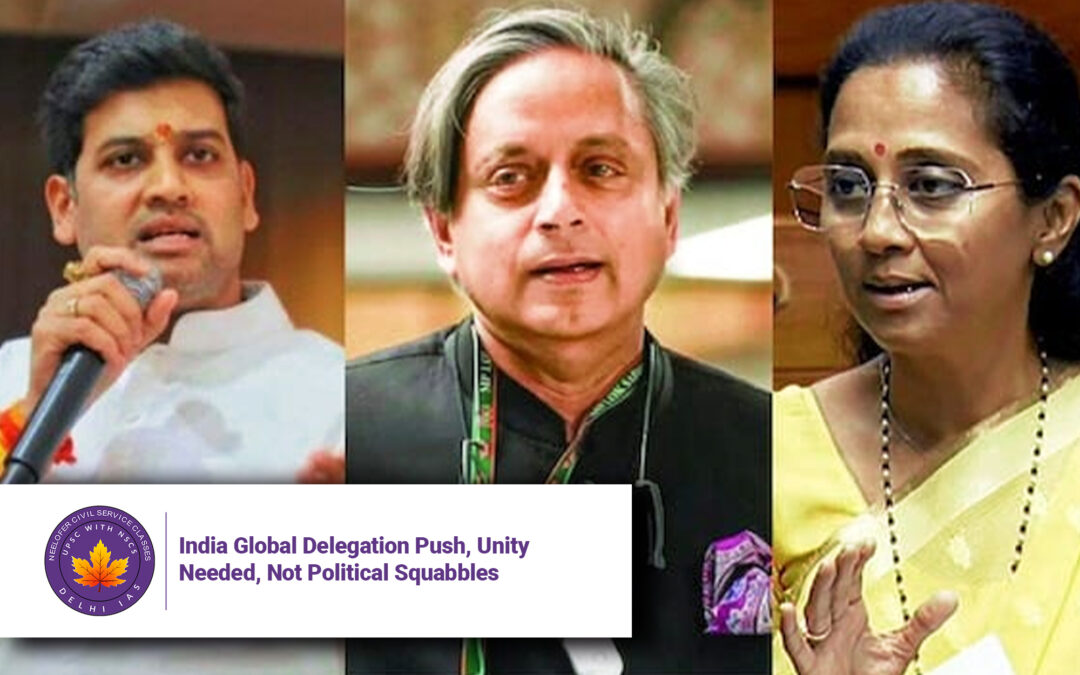
India Global Delegation Push, Unity Needed, Not Political Squabbles
Why in News?
The Narendra Modi government has announced a seven-member delegation to visit global capitals and rally support for India amidst heightened tensions with Pakistan following the April 22, 2025 Pahalgam terror attack. However, the move has sparked political controversy over the selection of members, overshadowing the key objective of showcasing India’s pluralism and unity to the world. 
Introduction
In an effort to gain diplomatic backing against Pakistan’s support for cross-border terrorism, India is sending high-level delegations abroad. The aim is to underline India’s secular, democratic values and contrast them with Pakistan’s extremist ideologies. But instead of rallying together, domestic parties are caught in a political tussle over representation in these delegations.
Key Highlights from the Editorial
1. Purpose of the Delegation
-
The delegation includes political, diplomatic, and strategic experts.
-
Its main aim: to highlight India’s secular and pluralistic character in contrast to Pakistan’s ideology of religious nationalism.
-
Delegates from diverse political, religious, caste, and regional backgrounds have been included to reflect this message.
2. Pakistan’s Contrasting Message
-
Just before the Pahalgam attack, Pakistani Army Chief Asim Munir reiterated the idea of Pakistan as a Muslim homeland, excluding Hindus and other communities.
-
India aims to counter this narrative by emphasizing its inclusive national identity.
3. The Political Controversy
-
The Congress party criticized the selection process, claiming they were excluded and calling it a partisan move.
-
The government insists the selection was balanced and not intended to exclude anyone.
-
Notably, Shashi Tharoor, a Congress MP and respected diplomat, is among the delegates, contradicting claims of exclusion.
4. The Real Diplomatic Need
-
With international pressure growing, especially in light of recent terror attacks, India must present a united front.
-
Decades of diplomatic effort have shaped India’s global image as a pluralistic democracy, and internal bickering risks undermining that image.
5. Call for Political Maturity
-
The editorial urges all political parties to rise above domestic rivalries.
-
It emphasizes that national interest and foreign policy must take precedence over political point-scoring during such critical moments.
Conclusion
At a time when India’s national security and international reputation are at stake, internal political disputes over the composition of delegations only weaken its case abroad. Unity in messaging is crucial. This is a moment for bipartisan collaboration, not divisiveness. India’s strength lies in its pluralism—and to effectively communicate that to the world, all political factions must speak in one voice.
Q&A Section
Q1. Why is the Indian government sending delegations abroad?
To gain global diplomatic support against Pakistan’s backing of terrorism and to promote India’s inclusive national identity.
Q2. What is the controversy regarding these delegations?
The Congress party claims it was not adequately consulted during the selection of delegates, suggesting political bias by the ruling BJP.
Q3. How does India aim to contrast itself with Pakistan through this initiative?
By showcasing diversity, secularism, and unity in its delegation, India aims to counter Pakistan’s ideology of a religious state for Muslims.
Q4. Who is part of the delegation from the opposition?
Despite criticism, Shashi Tharoor, a senior Congress MP and former diplomat, is part of the delegation.
Q5. What is the editorial’s main recommendation?
All political parties should stop quarreling and present a united front to the world, especially during such sensitive geopolitical times.

