
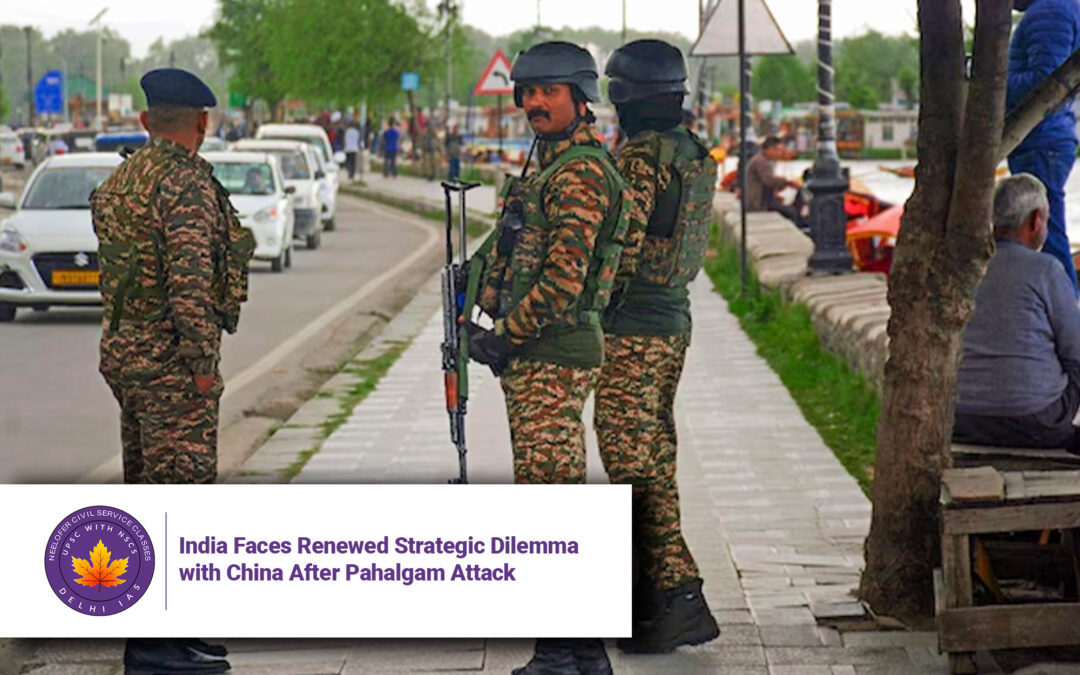
India Faces Renewed Strategic Dilemma with China After Pahalgam Attack
Why in News?
India is confronting a dual-front strategic challenge in the wake of a brutal terrorist attack in Pahalgam, Jammu & Kashmir. While Pakistan-sponsored terror is being dealt with firmly, the bigger diplomatic and security puzzle now re-emerging is China’s increasing assertiveness and growing cooperation with Pakistan. 
Introduction
The Pahalgam terrorist attack has reignited debates about India’s regional security. As India reviews its counter-terror strategy toward Pakistan, it simultaneously finds itself in a complex situation with China, especially regarding the unresolved border dispute, bilateral talks, and China’s growing influence in South Asia.
Key Issues
1. Pakistan’s Involvement and India’s Response
-
India has called out Pakistan as the primary sponsor of terror and taken strong diplomatic measures.
-
An “All-of-government” approach has been adopted by India, covering diplomacy, military, and intelligence coordination.
2. The China Factor
-
China blocked efforts at the UN to list terrorists involved in Pahalgam.
-
It continues to support Pakistan at international forums while denying India’s concerns.
-
Chinese presence in Pakistan-occupied Gilgit-Baltistan, near India’s borders, is increasing under the China-Pakistan Economic Corridor (CPEC).
3. Stalled India-China Dialogue
-
The Special Representative (SR) mechanism on boundary talks remains inactive since 2019.
-
China’s lack of interest in resuming talks and its continued militarisation of border zones pose a long-term security threat.
Alternative Approaches & Strategic Considerations
-
Experts suggest India must recalibrate its China policy based on hard realism rather than expectations of goodwill.
-
Options include diplomatic pressure through multilateral platforms, strengthening ties with QUAD nations, and enhancing domestic border infrastructure.
Challenges and the Way Forward
-
China uses Pakistan as a tool to pressure India and divert attention from its own actions along the Line of Actual Control (LAC).
-
With the US increasingly focused on China, India must ensure its China strategy is aligned with broader Indo-Pacific policies.
Conclusion
India’s counter-terror efforts must now be balanced with a strategic recalibration towards China. Ignoring the China challenge in favour of short-term peace may prove costly. Strong, consistent engagement based on realism and national interest is the only viable path forward.
5 Q&A Based on the Article
Q1. What recent event has escalated tensions in South Asia according to the article?
A: The brutal terrorist attack in Pahalgam, Jammu & Kashmir, allegedly backed by Pakistan, has heightened regional security concerns for India.
Q2. How is China involved in complicating India’s regional security?
A: China has supported Pakistan diplomatically, blocked India’s UN resolutions, and expanded its presence in disputed regions near India’s borders through the CPEC project.
Q3. What is the current status of India-China border talks?
A: Talks remain stalled since 2019, with no significant engagement under the Special Representative mechanism.
Q4. Why is the China-Pakistan nexus seen as a bigger challenge for India?
A: Because it combines diplomatic resistance, military threats, and strategic encirclement of India, posing long-term national security concerns.
Q5. What steps can India take to deal with the China question effectively?
A: India can enhance border readiness, strengthen global alliances (like QUAD), and adopt a more hard-nosed, realist policy in its dealings with China.

