
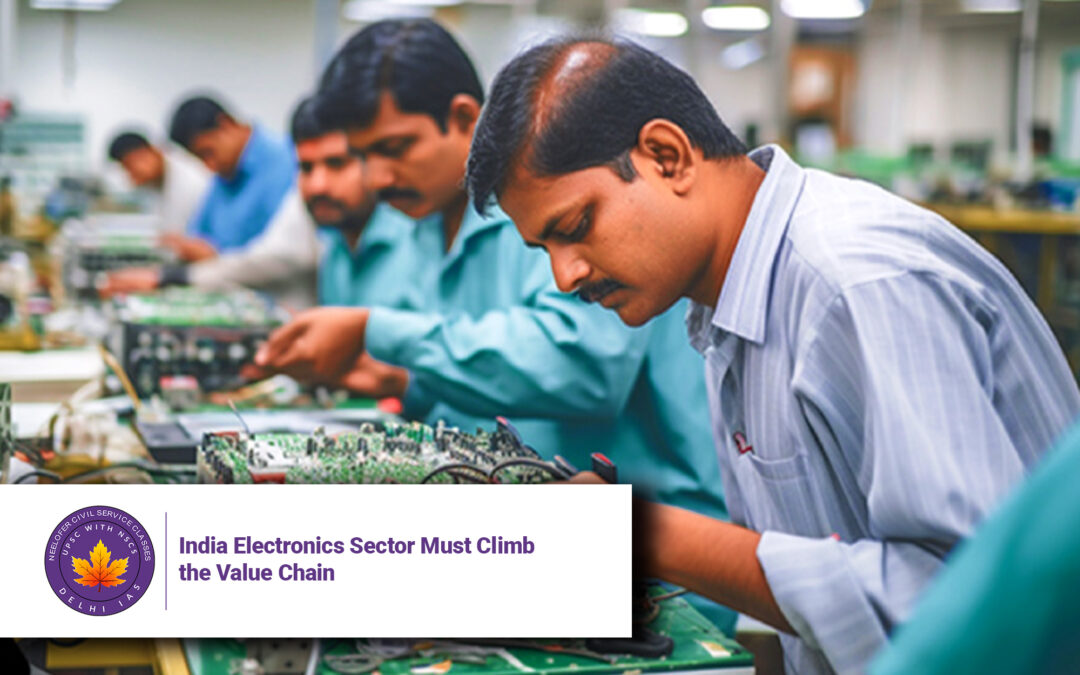
India Electronics Sector Must Climb the Value Chain
Why in News?
India’s electronics exports reached $29 billion in FY24, nearly tripling in just three years. While this growth is impressive, experts argue that the country’s electronics sector still heavily relies on low-value assembly and imports. The urgent need now is to move beyond assembling and into sophisticated, high-value manufacturing. 
Introduction
India is emerging as a key player in the global electronics industry, especially in smartphone exports. However, most of this growth is driven by assembling imported components, which offers limited economic value. Experts emphasize the need for India to shift towards designing and manufacturing core components, including semiconductors and displays.
Key Issues and Background
1. Dependency on Imports
India’s electronics growth is driven largely by foreign companies importing parts and assembling them locally. Around 82% of India’s electronics exports are from just four foreign firms, mainly assembling smartphones.
2. Limited Value Addition
India ranks only above Vietnam in the value it adds to final electronic products. Local firms often engage in basic tasks like packaging or PCB assembly, while real gains lie in making semiconductors, displays, and chipsets.
3. Supply Chain Vulnerability
Heavy import dependence makes India vulnerable to global supply chain shocks, as seen during the COVID-19 pandemic. It also limits India’s control over pricing, quality, and innovation.
4. Competition from China and Vietnam
India trails behind China and Vietnam in high-value manufacturing. While Vietnam adds around 18% value in electronics, India adds less than 15%. China’s ecosystem remains far ahead in design, innovation, and advanced manufacturing.
Key Takeaways
-
India’s export growth is commendable but shallow, relying on foreign players assembling devices locally.
-
Local value addition remains low, hindering long-term economic and strategic gains.
-
Semiconductor and display manufacturing are vital for deeper value creation.
-
A strong domestic ecosystem including design, fabrication, and testing is essential for sustainable growth.
-
Strategic government interventions like PLI schemes and chip fabs need focus on R&D and IP creation.
Challenges and the Way Forward
Challenges
-
Lack of local component manufacturing units
-
Minimal R&D investment from domestic firms
-
Poor coordination between private and public stakeholders
-
Limited talent pool in chip design and manufacturing
Steps Forward
-
Expand PLI schemes to support upstream manufacturing
-
Create chip and display fabrication hubs
-
Encourage public-private R&D in electronics
-
Attract global tech firms to set up design and fabrication in India
-
Build human capital through targeted skilling programs
Conclusion
India’s electronics sector stands at a crossroads. To transform from an assembly hub into a true electronics powerhouse, it must aggressively pursue sophisticated manufacturing and innovation. This shift will not only boost exports but also reduce import dependence, create high-value jobs, and enhance national security in an era dominated by digital technology.
5 Questions and Answers
Q1: What recent milestone did India achieve in electronics exports?
A: India’s electronics exports touched $29 billion in FY24, nearly tripling from earlier levels in just three years.
Q2: Why is this growth seen as limited in value?
A: Because most exports come from foreign companies assembling imported parts, with little domestic manufacturing or innovation.
Q3: What does “moving up the value chain” mean for India?
A: It means India should manufacture critical components like semiconductors and displays, not just assemble finished products.
Q4: How does India compare with countries like China and Vietnam?
A: India adds less value to electronics products than both China and Vietnam, who are more advanced in component manufacturing.
Q5: What is the recommended path forward for India’s electronics sector?
A: Invest in high-value manufacturing, support R&D, build chip and display fabs, and strengthen public-private collaboration.

