
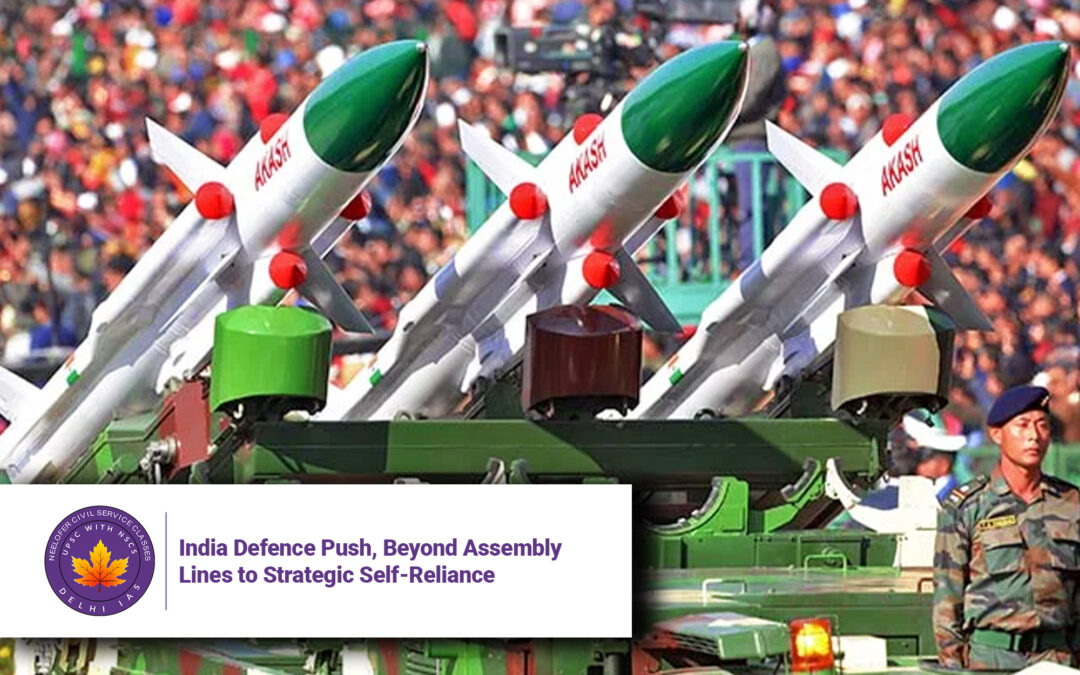
India Defence Push, Beyond Assembly Lines to Strategic Self-Reliance
Why in News?
In the backdrop of global geopolitical instability and rising regional threats, India is accelerating its efforts to boost defence manufacturing capabilities. Recent discussions and collaborations—especially with the United States and key Western players—highlight India’s focus on self-reliance in defence, not just through assembly lines but via deep technological partnerships and indigenous innovation.
Introduction
India is at a critical juncture in reshaping its defence production ecosystem. The traditional approach of importing defence equipment is evolving into one that stresses co-development and co-production. India is now taking cues from global defence ecosystems, including the lessons of China’s rapid defence technology growth, to refine its strategy. 
Key Issues
1. From Assembly to Collaboration:
The focus is shifting from simple assembly line manufacturing to knowledge-driven collaboration. Joint ventures like the India-U.S. GE-F414 engine deal (for fighter jets like the Tejas Mk2) represent a step toward full technology transfer and joint R&D.
2. China’s Model and its Lessons:
China has successfully emerged as a major defence manufacturer through state-backed R&D, targeted investments, and reverse-engineering tactics. India, however, aims to follow a more open, innovation-led path, working with democratic nations and private industry.
3. Challenge of Integration:
Unlike China, India faces challenges in synchronizing its private sector and public defence firms (like HAL, DRDO, BEL). The result is duplication and delay—issues India must address to scale effectively.
4. Global Tensions and Strategic Urgency:
Conflicts like the Russia-Ukraine war and rising tensions with China over border issues underscore the urgency for India to be self-reliant in critical defence technologies such as drones, AI warfare systems, and hypersonic missiles.
Alternative Approaches
-
Quad and AUKUS as Platforms:
India can leverage defence platforms such as Quad (with the U.S., Japan, Australia) and AUKUS (with the U.K. and Australia) for deeper military tech sharing and R&D participation. -
Private Sector Empowerment:
India must integrate startups and private firms into defence projects, moving beyond legacy PSUs. Public-private-academia collaboration, modeled on the U.S. DARPA system, can accelerate innovation.
Challenges and the Way Forward
-
Challenges:
Bureaucratic bottlenecks, slow procurement processes, and limited private sector involvement hinder rapid progress. Import dependence still remains high for critical technologies. -
Way Forward:
-
Enhance defence diplomacy with like-minded nations.
-
Foster a competitive ecosystem for domestic companies.
-
Encourage Indian startups in drone tech, space security, and cyber warfare.
-
Ensure time-bound execution of joint production deals like the GE jet engine agreement.
-
Conclusion
India’s defence transformation must focus on technology depth, not just assembly breadth. The time has come for India to create a robust, innovation-driven, export-ready defence ecosystem. Strategic collaborations with nations like the U.S. are vital—but India’s future lies in building its own defence intellectual capital. With geopolitical tensions intensifying, Atmanirbharta in defence is no longer a slogan but a national security imperative.
Five Questions & Answers
1. What is the significance of India’s defence collaboration with the U.S.?
It marks a move toward co-production and co-development, especially with deals like the GE-F414 engine partnership for fighter jets.
2. How has China developed its defence capabilities?
China used centralized R&D, heavy state funding, and reverse-engineering of foreign technology to become a major defence exporter.
3. What are the major challenges India faces in defence manufacturing?
Coordination gaps between PSUs and private firms, slow execution, lack of deep-tech R&D, and dependency on imports.
4. Why is assembly line production not enough?
Assembly does not provide access to critical intellectual property or advanced capabilities; India needs to create, not just build.
5. What is the way forward for India’s defence ecosystem?
Integrate private startups, build R&D partnerships with allies, adopt efficient procurement systems, and focus on innovation-led self-reliance.

