
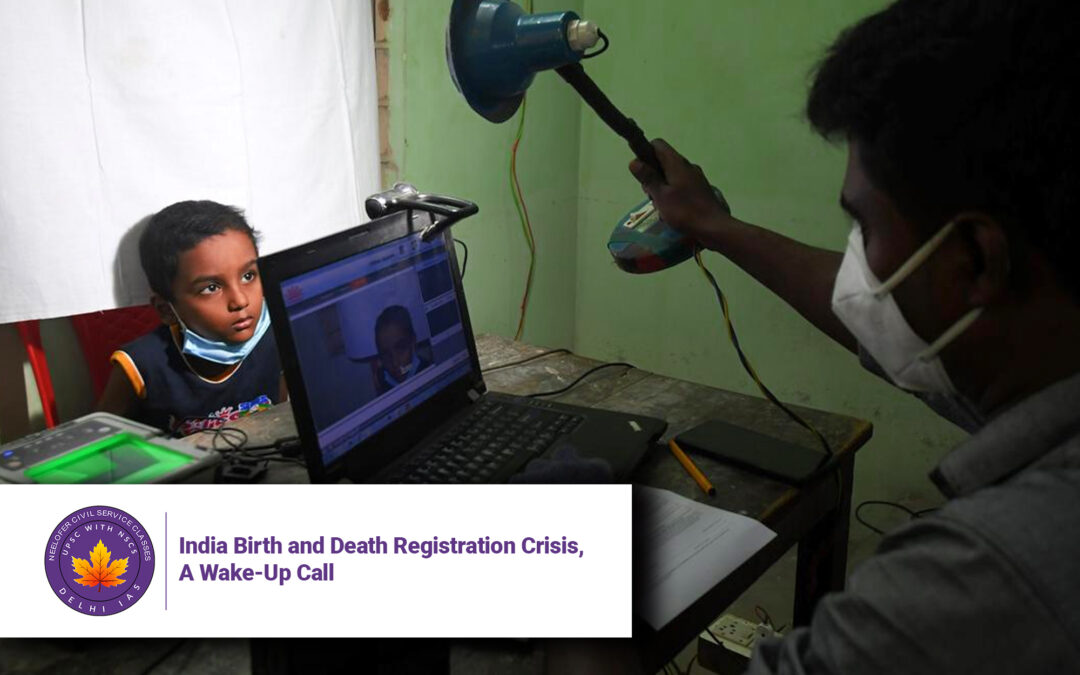
India Birth and Death Registration Crisis, A Wake-Up Call
Why in News?
On March 17, 2024, the Registrar General of India (RGI) issued a circular to private and government hospitals, warning them to report births and deaths within 21 days as mandated by law. The move comes amid growing concerns about under-registration and systemic delays in vital event documentation. 
Introduction
The Registration of Birth and Death Act, 1969 mandates the registration of all births and deaths within 21 days. However, a significant portion of these events still goes unregistered. This gap can hinder access to essential services and obscure important health and demographic data needed for policy planning.
Key Issues and Background
1. Gaps in Registration
-
According to the RGI, 10% of births and deaths are still not registered in India.
-
In 2011, registration coverage was just 82.4% for births and 66.4% for deaths.
-
Although improvements have been made, 100% universal registration is still not achieved.
2. Hospital Negligence
-
Some hospitals delay registration until relatives approach them, which violates the mandate.
-
Others advise the family to self-register rather than initiating the process.
-
The RGI stressed that certificates must be issued within 7 days, but many institutions are non-compliant.
The Core of the Concern
1. Legal Mandate
-
Under the Registration of Births and Deaths (RBD) Act, registration is mandatory.
-
Section 23(2) penalizes negligence with fines up to ₹1,000 (previously ₹50).
2. Government Responsibility
-
Under the Civil Registration System (CRS), government hospitals serve as registrars.
-
Private hospitals must report to registrars but cannot register events independently.
Key Observations
1. Digital Certificates and Centralised Portal
-
Since October 1, 2023, digital birth certificates have become the sole official document for services like school admission, passport applications, and marriage registration.
-
India uses the CRS portal, which integrates with other databases such as NPR, ration cards, and electoral rolls.
2. Delay in Vital Statistics Report
-
The Vital Statistics Report, crucial for public health and policy, hasn’t been published since 2020.
-
It compiles state-level data on births, deaths, stillbirths, and infant mortality.
-
Some states (e.g., Kerala, Mizoram) have published the 2022 report, but most others haven’t published data since 2020.
Conclusion
Despite legal mandates and digital infrastructure, India’s birth and death registration system faces challenges in enforcement and awareness. Timely registration is not just a formality; it is crucial for planning public services and ensuring citizens can access their rights. The March 2024 circular is a reminder that systemic reforms and accountability are essential to achieve the goal of 100% registration.
Q&A Section
Q1. What does the March 17, 2024 circular by the RGI state?
Ans: It urged hospitals to report births and deaths within 21 days and warned that around 10% of such events are still not registered in India.
Q2. What is the penalty for not registering births and deaths under the law?
Ans: Under Section 23(2) of the RBD Act, the penalty is up to ₹1,000 for negligence in registration.
Q3. When did digital birth certificates become the sole legal document for identity proof?
Ans: Effective October 1, 2023, digital birth certificates became the only legal document for services like school admission and marriage registration.
Q4. What is the status of the Vital Statistics Report for India?
Ans: The national-level report has not been published since 2020, although a few states have released their own reports for 2022.
Q5. Can private hospitals register births and deaths independently?
Ans: No, private hospitals must report the events to the registrar; they are not authorized to register them independently.

