
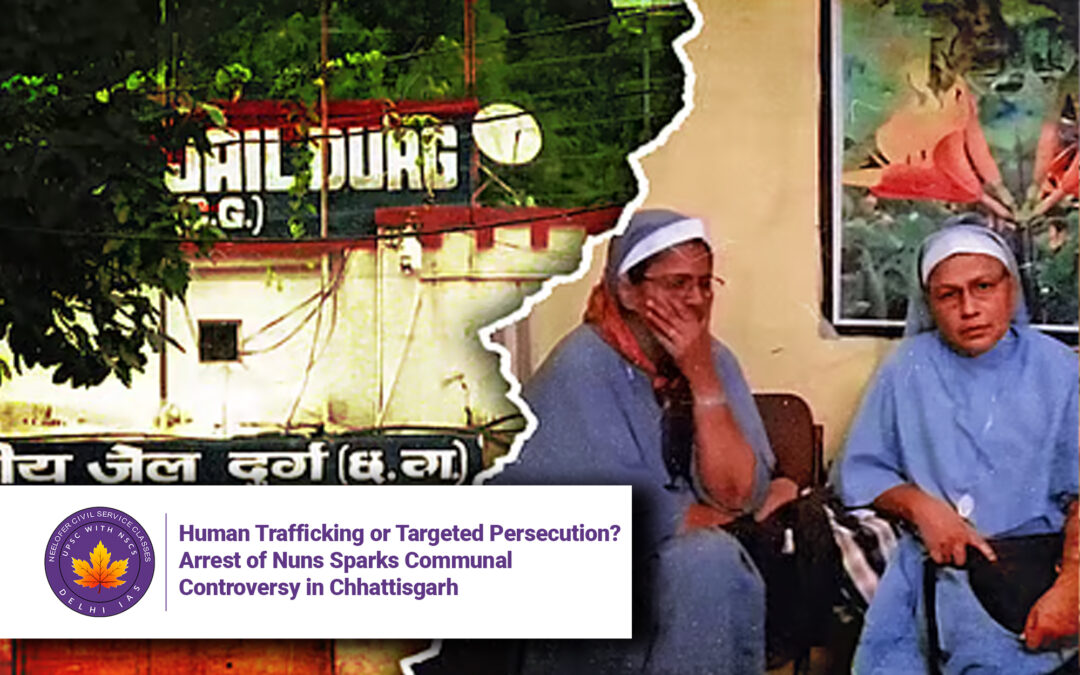
Human Trafficking or Targeted Persecution? Arrest of Nuns Sparks Communal Controversy in Chhattisgarh
Why in News:
The arrest of two Catholic nuns by Chhattisgarh police on charges of human trafficking and forced religious conversion has triggered a political and social storm across the country. Allegations of religious persecution and communal agenda have been raised by multiple parties and rights organizations, reigniting the national debate over anti-conversion laws and their misuse.
Introduction:
On July 25, 2025, two Keralite Catholic nuns—Sister Preeti Mary and Sister Vandana Francis—of the Assisi Sisters of Mary Immaculate, were arrested by Chhattisgarh police at Durg railway station while escorting tribal girls to a convent in Agra for job opportunities. The police acted on a complaint filed by a Bajrang Dal member and charged the nuns under:
-
Section 4 of the Chhattisgarh Freedom of Religion Act, 1968 (forced conversion), and
-
Section 143 of the BNS (human trafficking).
The incident has drawn national condemnation, with several accusing the police and state machinery of executing a communal agenda under the pretext of legal enforcement.
Key Issues and Background:
-
Accusation vs Consent:
While authorities allege that the nuns were engaged in “conversion through inducement,” the families of the tribal girls have clearly stated that there was no coercion, and the girls had given full consent to travel for job-related opportunities. -
Communal Vigilantism:
The arrests have been widely condemned by leaders from across the political spectrum.-
Kerala MPs from both the Left Democratic Front (LDF) and the United Democratic Front (UDF) held protests outside Parliament.
-
The Catholic Church, through its publication Deepika, and other Christian organizations, have also denounced the arrests.
-
-
Misuse of Anti-Conversion Laws:
This case is not isolated. Across States like Uttar Pradesh, Madhya Pradesh, Chhattisgarh, Rajasthan, Odisha, and others, anti-conversion laws are increasingly being misused to target interfaith marriages and religious minorities, especially Christians. -
Historical Context:
India has a history of violence against Christian missionaries, most notably the 1999 killing of Australian missionary Graham Staines and his two children in Odisha. The Constitution guarantees freedom of religion, yet the state actions often contradict this fundamental right.
Specific Impacts or Effects:
-
Fear Among Missionary Workers:
Such arrests may deter Christian organizations from engaging in charitable or employment-based outreach, particularly in tribal areas, out of fear of legal harassment. -
Increased Communal Polarisation:
The incident has deepened divisions between Hindutva groups and Christian tribals, especially in regions where religious identity intersects with tribal rights. -
Tribal Discontent and Identity Crisis:
-
Groups like the RSS are calling for tribal people to return to their “Hindu roots.”
-
On the other hand, tribal outfits are resisting this call and are demanding a separate Sarna religious code, seeking recognition of their indigenous practices outside the binary of Hindu-Christian faiths.
-
-
Debate on Scheduled Tribe Status:
In Chhattisgarh, which has a 2% Christian population (2011 Census), a parallel controversy is brewing over whether tribals converting to Christianity should be delisted from Scheduled Tribe status, raising constitutional and social equity concerns.
Challenges and the Way Forward:
-
Reforming Anti-Conversion Laws:
These laws should not be tools of persecution. Any legislation meant to protect citizens should define coercion strictly and not interfere with voluntary religious expression. -
Ensuring Rule of Law over Mob Influence:
Vigilante groups like Bajrang Dal must not be allowed to set the law in motion. Legal actions should be evidence-based, not agenda-driven. -
Protecting Minority Rights in Tribal Regions:
Policies should prioritize development, education, and employment instead of stoking identity-based conflicts. -
Central Oversight and Political Accountability:
State machinery must be held accountable for constitutional violations. Civil society and media must remain vigilant in protecting India’s pluralistic values.
Conclusion:
The arrest of two Catholic nuns in Chhattisgarh is a symptom of a larger malaise—the systematic targeting of religious minorities under the guise of law enforcement. In a country whose Constitution guarantees the freedom to practice and propagate religion, actions driven by majoritarian pressures are a dangerous deviation.
India must draw a clear line between lawful protection and communal persecution. The goal should not be to criminalize faith-based outreach, but to ensure that no citizen’s rights are trampled in the name of religion, ideology, or vote-bank politics. True national integrity lies in upholding justice, not prejudice.
5 Questions and Answers:
1. Who were the nuns arrested and why?
Sisters Preeti Mary and Vandana Francis from Kerala were arrested in Chhattisgarh on charges of human trafficking and religious conversion while escorting tribal girls for jobs.
2. What laws were invoked against them?
They were booked under Section 4 of the Chhattisgarh Freedom of Religion Act, 1968, and Section 143 of the BNS (trafficking).
3. Was there evidence of forced conversion?
No. The girls’ families confirmed that there was no coercion, and the girls gave consent to travel.
4. Why is the arrest controversial?
It is seen as an act of religious persecution, influenced by communal agendas and misuse of anti-conversion laws.
5. What broader issues does the case highlight?
The incident underscores misuse of anti-conversion laws, rising communal vigilantism, and debates over tribal identity and religious freedom in India.

