
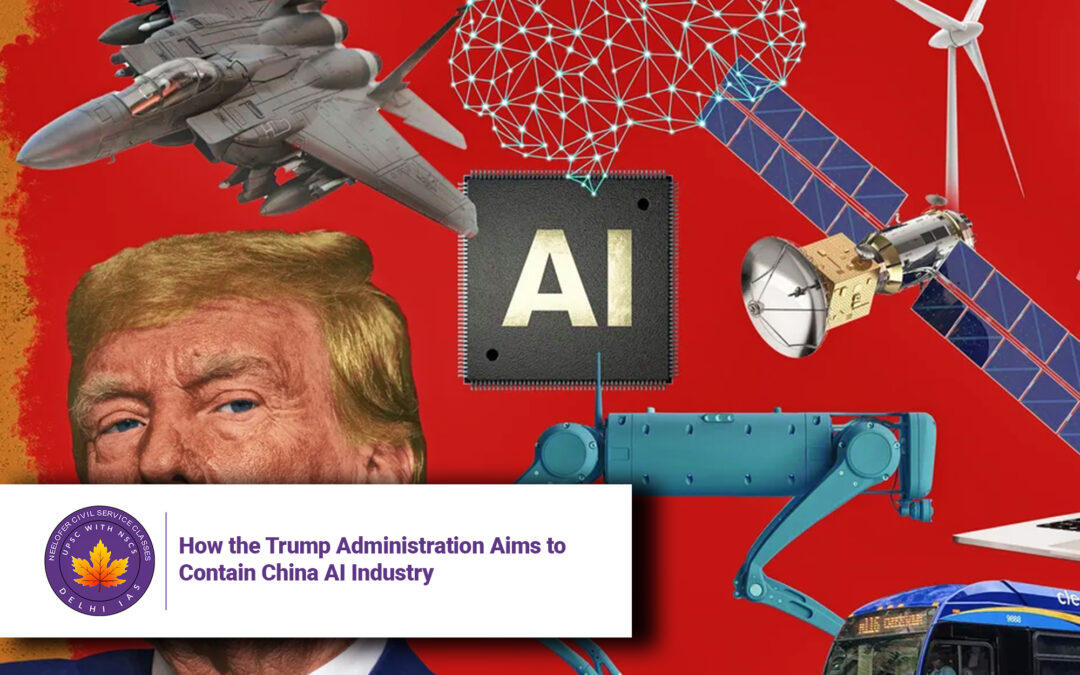
How the Trump Administration Aims to Contain China AI Industry
Why in News?
The U.S. Department of Commerce recently reviewed a major AI-related policy — the ‘Artificial Intelligence Diffusion Rule’ — which was introduced under former President Joe Biden. The rule, meant to regulate the global flow of advanced AI chips, is now being reconsidered as the Trump administration gears up for a more aggressive and transactional approach to counter China’s technological rise. 
Introduction
Artificial Intelligence (AI) and its supply chains are the new battleground in the escalating U.S.-China rivalry. With AI emerging as a crucial tool for military, economic, and surveillance applications, the United States is now reshaping its export policies and diplomatic strategies to slow China’s advancements in the sector.
Key Issues and Background
1. Shift from Biden’s Strategy
The Biden administration had introduced the ‘AI Diffusion Rule’ to manage global chip exports through a multilateral system of control. It aimed to curb AI capabilities of adversaries while maintaining an inclusive and non-confrontational image. However, it was seen as “slow, inclusive, and uncoordinated.”
2. Trump’s More Aggressive Stance
The Trump administration plans to revoke the existing framework and adopt a unilateral approach that includes:
-
Direct restrictions on AI chip exports.
-
Punitive actions against specific buyers.
-
Greater reliance on bilateral trade tools.
3. Global AI Chip Control as Strategic Leverage
China’s use of advanced U.S.-made AI chips, especially in military and surveillance applications, has alarmed American policymakers. Controlling this tech is now seen as essential to limiting China’s AI development and global influence.
4. New Trade Weaponization
Under Trump, the U.S. is expected to:
-
Reintroduce tariffs on Chinese AI-related goods.
-
Apply strict restrictions similar to those used against Huawei.
-
Increase chip export controls by leveraging U.S. technological dominance.
5. Economic and Diplomatic Implications
This new approach is expected to:
-
Force global tech firms to pick sides.
-
Strain U.S.-China diplomatic relations.
-
Amplify economic warfare in the form of tariffs, sanctions, and AI embargoes.
Specific Impacts or Effects
-
The move signals a shift from global cooperation to great power confrontation.
-
U.S. allies may face pressure to align with Washington’s more transactional policy.
-
AI-driven industries in China may suffer due to restricted access to high-end chips and tools.
-
The global AI innovation landscape may become fragmented as tech rivalry deepens.
Challenges and the Way Forward
Challenges
-
Diplomatic backlash from allies who prefer multilateral rules.
-
Risk of retaliation from China, including countersanctions and tech restrictions.
-
Fragmentation of global supply chains and innovation networks.
Steps Forward
-
Building stronger alliances with tech-leading nations like Japan, South Korea, and the EU.
-
Creating clear and enforceable rules for AI chip exports to adversarial states.
-
Expanding R&D investments in AI to maintain U.S. leadership without solely relying on export bans.
Conclusion
The Trump administration’s renewed focus on containing China’s AI rise marks a return to hardline policies that prioritize strategic dominance over global cooperation. As AI becomes central to military, economic, and geopolitical power, its control will remain a defining issue in the ongoing superpower rivalry between the U.S. and China. The world must brace for more fragmentation, economic strain, and political ambiguity in the tech-driven future.
5 Questions and Answers
Q1: What is the ‘Artificial Intelligence Diffusion Rule’?
A: It was a Biden-era policy framework to manage the global export of AI chips through multilateral cooperation.
Q2: Why is the Trump administration reconsidering the rule?
A: Trump views the policy as weak and too slow. His administration wants a bolder, more unilateral strategy to contain China.
Q3: What steps might the Trump administration take?
A: Reimposing tariffs, direct export restrictions, blocking AI-related tech deals, and building strategic alliances.
Q4: How will this affect global AI development?
A: It may lead to fragmentation of global AI research and development, with countries forced to pick sides.
Q5: What are the possible long-term outcomes?
A: Greater geopolitical tension, disrupted tech supply chains, and a more confrontational U.S.-China relationship.

