
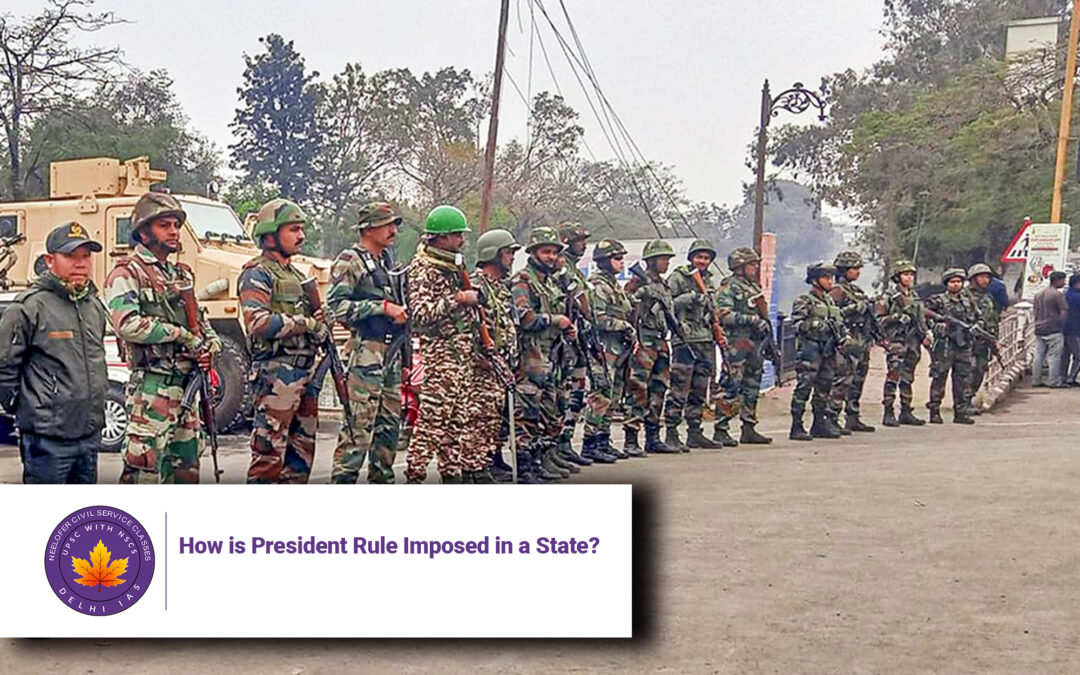
How is President Rule Imposed in a State?
Why in News?
A delegation of 10 MLAs from the Manipur Assembly recently met the Governor, demanding the formation of a viable government, as the state has been under President’s Rule since February 2024. This brings into focus the constitutional and political mechanisms that govern the imposition and revocation of President’s Rule in Indian states. 
Introduction
The Indian Constitution empowers the President to impose direct central rule in any state under certain circumstances through Article 356. Commonly known as “President’s Rule,” this provision has historically been both controversial and frequently debated for its misuse and political overreach.
What is President’s Rule?
Under Article 356, President’s Rule can be imposed in a state if the President (i.e., the Union government) is satisfied that the state government cannot be carried on in accordance with the provisions of the Constitution. This is usually based on a report from the Governor or other inputs.
Once invoked, the state government is dismissed, the Legislative Assembly may be suspended or dissolved, and the President administers the state directly through the Governor, with the aid of the Union government.
How is it Imposed and Approved?
-
The Proclamation of President’s Rule must be approved by both Houses of Parliament within two months.
-
Once approved, it can last up to six months at a time and can be extended up to three years with periodic parliamentary approval.
What Did the Supreme Court Rule?
In the landmark S.R. Bommai case (1994), the Supreme Court:
-
Restricted the misuse of Article 356.
-
Ruled that Article 356 should only be invoked in case of a constitutional breakdown, not for political differences.
-
Stated that the Legislative Assembly should not be dissolved until Parliament approves the imposition.
-
Empowered courts to review the imposition of President’s Rule.
Instances of Use and Misuse
-
Some Governors have dissolved Assemblies either on their advice or on Union government instructions.
-
President’s Rule has been imposed after internal party splits, no-confidence motions, or loss of majority.
-
Controversial dissolutions include:
-
Punjab (1951)
-
Kerala (1959)
-
Madhya Pradesh (1980)
-
Jammu and Kashmir (2018)
-
-
Recent impositions: Uttarakhand (2016), Arunachal Pradesh (2016), and Manipur (2024).
Why Has It Been Imposed in Manipur?
-
Ethnic violence, breakdown of civil administration, and the failure of government machinery led to the imposition in February 2024.
-
There is growing pressure to restore an elected government due to concerns about democratic governance and stability.
Can It Be Revoked?
Yes. If a viable government can be formed and the Assembly is intact or re-elected, the President can revoke the Rule. Recent calls by MLAs in Manipur reflect this demand.
The Gist Box Summary
-
Article 356 allows President’s Rule when the constitutional machinery fails in a state.
-
Dr. B.R. Ambedkar had hoped Article 356 would remain a dead letter, but it has been invoked many times.
-
Requires Parliamentary approval within two months.
-
The S.R. Bommai judgment limits its use and allows judicial review.
-
Governor’s role is crucial but has often been controversial due to political bias.
Five Key Takeaways
-
President’s Rule is constitutionally permitted under Article 356 but should be a last resort.
-
The Governor’s report is central but not always impartial; it must reflect a true constitutional breakdown.
-
S.R. Bommai judgment is the cornerstone in checking misuse, ensuring judicial review and parliamentary oversight.
-
Political motives have historically influenced the use of Article 356, sometimes weakening federalism.
-
In states like Manipur, restoring an elected government is essential for democratic legitimacy and governance.
Q&A Section
1. What is Article 356 of the Constitution?
It allows the President of India to impose President’s Rule in a state when the constitutional machinery fails, usually based on the Governor’s report.
2. What was the significance of the S.R. Bommai case?
The 1994 judgment set strict guidelines, stating that Article 356 cannot be misused for political purposes and made the President’s decision subject to judicial review.
3. How long can President’s Rule remain in force?
It initially lasts six months, extendable up to three years with Parliament’s approval every six months.
4. What triggered President’s Rule in Manipur?
A constitutional breakdown due to ethnic violence, administrative collapse, and the inability of the elected government to function led to its imposition in February 2024.
5. Can President’s Rule be revoked once imposed?
Yes, if a viable government is formed or elections are held and a new government assumes office, the President can revoke the Rule.

