
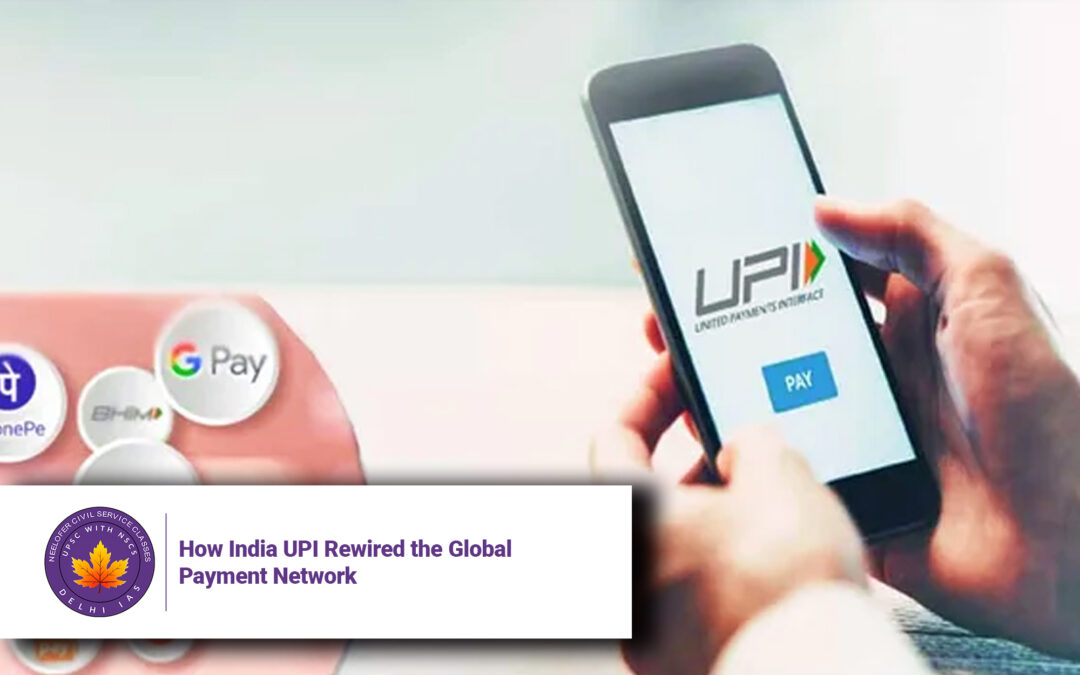
How India UPI Rewired the Global Payment Network
Why in News?
India’s Unified Payments Interface (UPI) has become the world’s leading real-time digital payment system, surpassing global giants like Visa and Mastercard. In a landmark achievement, UPI has reached over 650 million daily transactions and 67% bank onboarding, showcasing India’s transformation from a cash-reliant society to a global fintech leader. UPI’s success not only represents a domestic revolution in digital finance but also serves as a blueprint for global financial systems aiming for inclusivity, openness, and innovation.
Introduction
Just a decade ago, India’s digital payment infrastructure was fragmented, with traditional payment gateways marked by friction, exclusivity, and high barriers for small businesses. However, in 2016, the launch of the Unified Payments Interface (UPI) redefined the financial landscape. What began as an experimental digital framework soon evolved into a revolutionary platform—democratizing access to digital finance, empowering small merchants, and enabling real-time interoperable transactions for millions.
By 2025, UPI not only exceeded Visa’s peak of 639 million daily transactions but also established itself as a benchmark for digital payments globally. From supporting women entrepreneurs through “UPI for Her” initiatives to onboarding kirana stores and enabling Aadhaar-based identity verification, UPI has fundamentally reshaped digital finance.
Key Issues
1. Openness by Design
UPI is more than just a mobile app—it’s a reimagination of national financial infrastructure. It represents India’s successful transition from disconnected digital silos to an open, secure, and inclusive ecosystem. Traditionally, digital payments were plagued by exclusive payment rails, card-based systems, and barriers such as separate logins, OTPs, and high transaction costs. UPI broke this mold through:
-
Zero-fee transactions
-
Open-source and interoperable systems
-
Inclusive and government-supported policy architecture
-
Collaborative public-private partnerships
It encouraged participation from banks, fintech startups, merchants, and end-users under a multi-stakeholder framework. This shift made UPI not only a technological innovation but a socio-economic empowerment tool.
2. Infrastructure-led Advantage
Legacy payment giants like Visa and Mastercard operate on margin-first, closed ecosystems, heavily relying on exclusive merchant relationships. Their proprietary infrastructure, while secure, lacked the flexibility and openness needed to cater to India’s dynamic and price-sensitive market.
In contrast, UPI was built on public digital infrastructure supported by India Stack (Aadhaar, Jan Dhan, Mobile, and UPI). This infrastructure allowed real-time settlements, seamless bank account interoperability, and scalable APIs—making UPI more agile and adaptable than its Western counterparts.
3. The Policy Push: Government as a Catalyst
India’s success with UPI also rests heavily on strong government and regulatory support. Several major initiatives helped lay the foundation for UPI’s explosive growth:
-
Jan Dhan Yojana: Financial inclusion for millions via basic savings accounts.
-
Aadhaar: Biometric-based identity verification enabled seamless account linking and fraud prevention.
-
Demonetization (2016): A sudden cash crunch nudged citizens towards digital payments.
-
Digital India Mission: Encouraged digitization across sectors.
-
Regulatory Support from RBI and NPCI: Ensured system resilience, scalability, and compliance.
Together, these initiatives created a fertile ground for UPI’s rapid evolution.
4. Inclusive Ecosystem in Motion
One of UPI’s greatest strengths is its inclusivity. It removed friction, encouraged collaboration, and opened the gates for new players. By breaking down entry barriers, UPI welcomed fintech innovators, public and private banks, rural kirana stores, and urban vendors alike.
Examples of inclusion:
-
UPI for Her: Targeted support for women in business.
-
MSMEs Onboarding: Local businesses could now accept payments digitally without incurring high costs.
-
Pandemic Acceleration: During COVID-19, digital transactions surged as physical contact declined, further embedding UPI into daily life.
5. UPI’s Tech Built for Scale
UPI’s technological backbone is designed for mass use and rapid scalability:
-
Open APIs: Allowed third-party apps like Google Pay, PhonePe, and Paytm to integrate easily.
-
Real-time settlements: Enabled instant fund transfers, even between different banks.
-
Aadhaar-based Biometric Authentication: Ensured identity security and fraud control.
-
Voice-enabled Transactions: Enhanced accessibility for the less digitally literate population.
These features made UPI suitable not just for India’s 1.4 billion population but for any country seeking scale and speed in its financial systems.
Global Disruption and Expansion
UPI’s journey from a domestic platform to a global disruptor is remarkable. Today, UPI is live or being piloted in:
-
Singapore
-
UAE
-
Mauritius
-
Sri Lanka
In addition, cross-border QR code payments and remittance integration are being tested to expand UPI’s global footprint. NPCI International Payments Limited (NIPL) is actively partnering with international payment systems to make UPI an interoperable, global standard for digital finance.
Why UPI Broke the Mold
What makes UPI different from Visa or Mastercard?
-
Zero-fee model: Unlike Visa’s merchant-driven fees, UPI operates on a zero-MDR (merchant discount rate) structure, removing cost barriers for small businesses.
-
Open Rails: UPI is built on shared rails accessible to all players.
-
Inclusive partnerships: Rather than exclusivity, UPI encourages collaboration.
-
No proprietary dominance: Anyone—bank or fintech—can innovate on top of UPI.
This open architecture has inspired new global conversations around payment systems, particularly in Africa and Southeast Asia.
Beating Giants by Redefining the Game
Legacy systems were built on margins, exclusivity, and private networks. UPI challenged this model head-on. Its design was rooted in inclusion and public digital infrastructure. UPI didn’t compete with Visa and Mastercard on their turf—it created a new game with new rules.
It didn’t just mimic innovation; it transformed access:
-
In 2011, only 35% of Indian adults had financial accounts.
-
By 2025, over 89% are included in the digital financial ecosystem.
-
Agent-led models and language interfaces (like voice-based UPI) have driven usage even among rural and illiterate users.
Today, UPI handles over 30 million real-time intra-bank transfers every day across 250+ banks and service providers.
From Bharat to the World: UPI as a Global Standard
UPI didn’t emerge by accident. It was a product of strategic thinking and collaborative governance. Its influence is now global. From Japan to Africa, policymakers are studying India’s UPI for lessons on:
-
Reducing digital transaction costs
-
Improving financial inclusion
-
Innovating payment ecosystems
Already, India has formal partnerships or MoUs with countries across Asia, Middle East, and Africa to export its fintech expertise. The Reserve Bank of India (RBI) and NPCI have also started exploring the use of UPI for international remittances and real-time fund settlement.
Challenges and the Way Forward
Despite its many achievements, UPI still faces several challenges:
-
Sustainability of the zero-MDR model: Banks and fintech companies must find new ways to monetize services built on UPI.
-
Cybersecurity Risks: As UPI adoption grows, so do threats. Strengthening end-user authentication and fraud monitoring will be key.
-
Global Acceptance: While UPI has entered foreign markets, widespread adoption will require significant effort, regulatory cooperation, and trust-building.
Future growth may include:
-
Integration with CBDCs (Central Bank Digital Currencies)
-
Voice commerce and AI-powered payment assistants
-
Expanding access to offline UPI payments using NFC and feature phones
-
Building an ecosystem of credit, insurance, and savings on top of UPI rails
Conclusion
UPI’s meteoric rise is more than a fintech success story—it’s a testament to the power of visionary governance, inclusive policy design, and digital infrastructure built for the masses. It has redefined how the world views payments: not as a privilege for the few but as a public utility for all.
India’s model proves that openness, interoperability, and trust can outpace even the most entrenched legacy systems. As other countries look to modernize their financial systems, UPI offers a proven roadmap—from Bharat to the world.
Five Questions & Answers
Q1. What is UPI and why was it created?
A: UPI (Unified Payments Interface) is a real-time digital payment system launched in India in 2016 to unify various banking services and enable instant money transfers. It was designed to promote financial inclusion and simplify payments in a cash-reliant economy.
Q2. How does UPI differ from traditional payment systems like Visa or Mastercard?
A: Unlike Visa or Mastercard, UPI uses open-source infrastructure, has zero transaction fees, allows real-time payments between any banks, and is supported by public digital identity systems like Aadhaar.
Q3. What are some key achievements of UPI by 2025?
A: UPI handles over 650 million daily transactions, has onboarded 67% of Indian banks, and supports real-time global payments in countries like UAE and Singapore.
Q4. What role did the Indian government play in UPI’s success?
A: The Indian government facilitated UPI’s growth through initiatives like Jan Dhan Yojana (bank account access), Aadhaar (digital identity), and demonetization (boosting digital transactions), along with regulatory support from RBI and NPCI.
Q5. What challenges lie ahead for UPI?
A: Key challenges include maintaining security at scale, monetizing services in a zero-fee model, ensuring global interoperability, and integrating future technologies like AI and CBDCs.

