
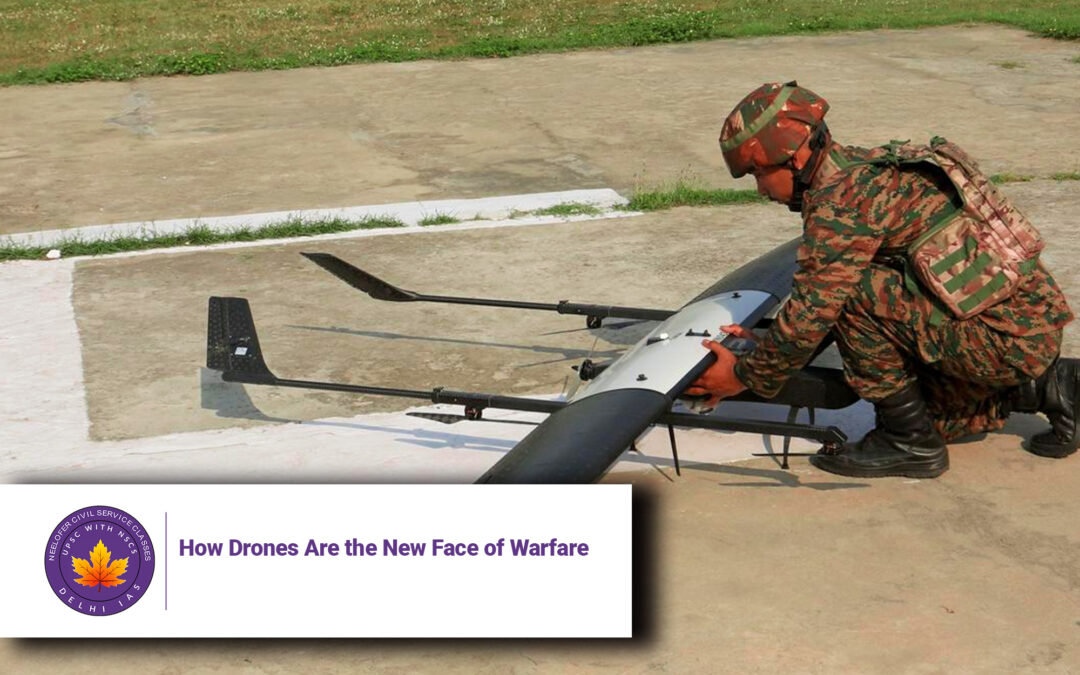
How Drones Are the New Face of Warfare
Why in News?
India’s Operation Sindoor, conducted after the Poonch terror attack, marked a notable shift in India’s use of Unmanned Aerial Vehicles (UAVs) in active combat.
Globally, drones are rapidly becoming the weapon of choice, serving as a force multiplier while blurring lines between military-grade and commercial technologies. 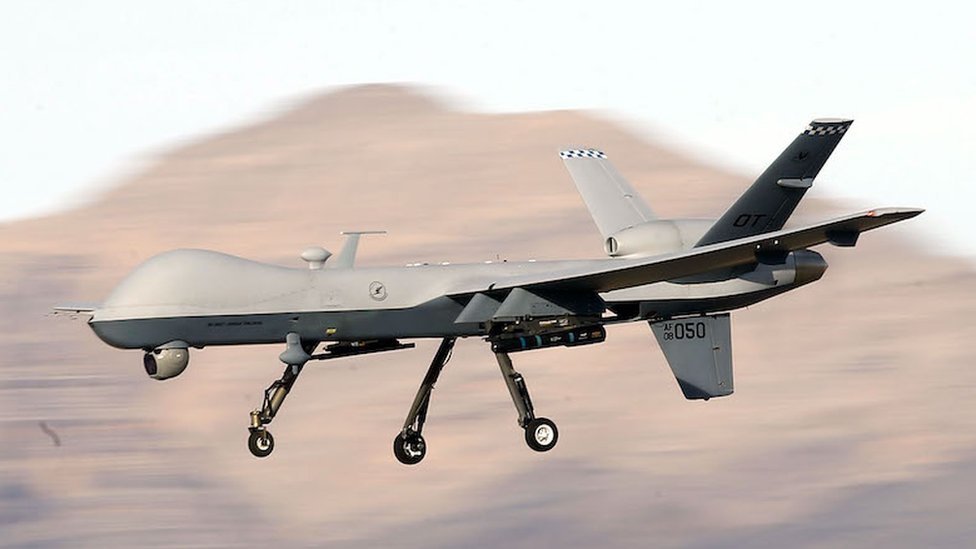
Introduction
The modern battlefield is being reshaped by drone warfare.
Whether used for surveillance, targeted strikes, or loitering munitions, drones are redefining combat tactics.
India is joining this global wave, adopting drones not just for force protection but as an integral part of its military doctrine.
Key Issues and Global Trends
1. Lessons from Ukraine
-
The Ukraine war has become a real-world laboratory for drone warfare.
-
Drones are used for target identification, artillery correction, and direct strikes.
-
The rapid innovation cycle has pushed drones from experimental to battle-proven tools.
2. Blurring Military and Commercial Lines
-
Today’s drones combine military and commercial components.
-
3D printing and open-source software enable even non-state actors to develop combat-capable drones.
-
This democratization poses new security challenges.
3. Tactical and Strategic Advantages
-
Drones provide cost-effective precision strike capabilities.
-
They help fill capability gaps and can complement conventional weapons.
-
Swarming drones, loitering munitions, and kamikaze drones offer tactical flexibility.
-
Drones also allow forces to project power without risking pilots’ lives.
Drone Use in India
1. Operation Sindoor
-
India used drones for real-time surveillance and target identification in Poonch.
-
Drones helped neutralize key threats with minimal collateral damage.
2. Growing Capabilities
-
India is investing in indigenous drone production.
-
Platforms like DRDO’s SWiFT, Rustom series, Wing Loong, and others are being developed.
-
The government aims to build a robust drone industry to support defence modernisation.
3. Defence Industry Push
-
India has relaxed restrictions on importing drone components.
-
There is a concerted push to build dual-use platforms that serve both military and civilian needs.
-
The private sector is increasingly involved, with firms innovating on loitering munitions and counter-drone systems.
Challenges and Concerns
1. Counter-Drone Defences
-
As drone use rises, so does the need for effective countermeasures.
-
Systems like Directed Energy Weapons (DEWs), jammers, and hard-kill options are being explored.
2. Airspace Management
-
Increased drone usage requires better airspace control.
-
Civil-military coordination is essential to avoid fratricide or operational interference.
3. Legal and Ethical Issues
-
The indiscriminate use of drones raises questions of proportionality and public perception.
-
India needs clear doctrinal guidance on drone deployment and rules of engagement.
Implications for India
-
The widespread adoption of drones will reshape India’s military doctrine.
-
Drones offer a new dimension of strategic depth, particularly against asymmetric threats from adversaries like Pakistan and China.
-
A focus on indigenous R&D and industrial capacity building will be key to sustaining this momentum.
Conclusion
India must learn from global conflicts and invest in building a resilient drone ecosystem.
Drones will remain a key element of modern warfare, and India’s ability to integrate them effectively will be crucial to maintaining its operational edge.
5 Questions & Answers
Q1: What recent Indian operation showcased active drone use?
A: Operation Sindoor, following the Poonch terror attack.
Q2: How is the Ukraine war influencing global drone warfare?
A: It has acted as a real-world laboratory, accelerating drone innovation and tactical use.
Q3: What challenges does India face in adopting drones?
A: Building counter-drone defences, improving airspace management, and addressing legal/ethical issues.
Q4: What indigenous drone platforms is India developing?
A: DRDO’s SWiFT, Rustom series, Wing Loong clones, and loitering munitions.
Q5: Why are drones considered force multipliers?
A: They provide precision, cost-effectiveness, and the ability to fill capability gaps while reducing human risk.

