
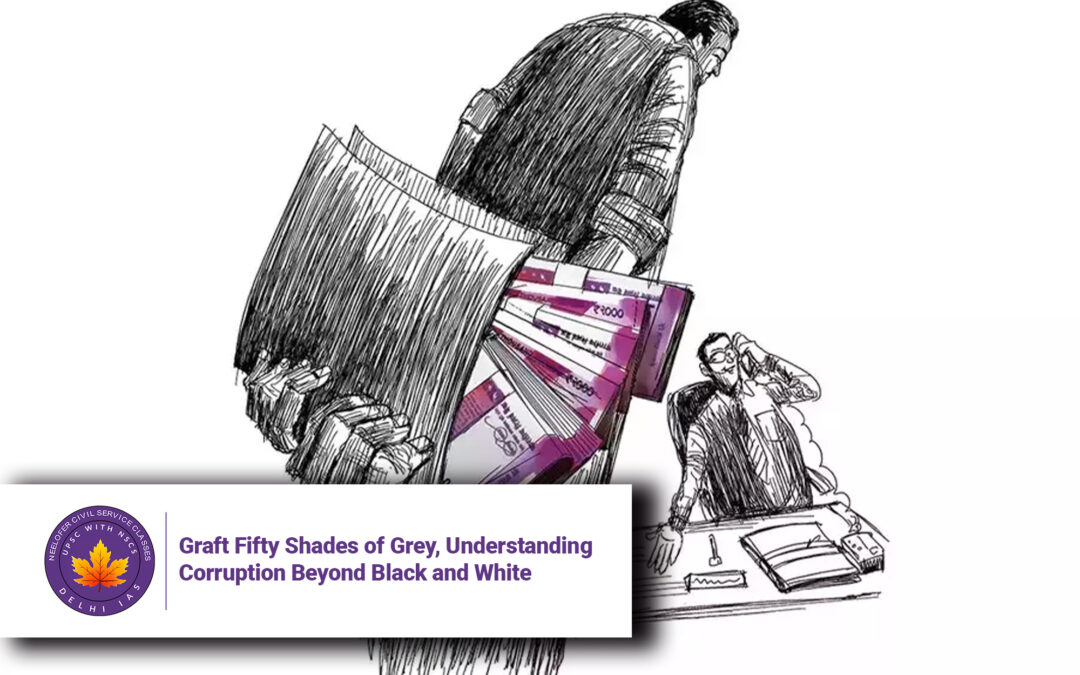
Graft Fifty Shades of Grey, Understanding Corruption Beyond Black and White
Why in News?
As corruption remains a headline concern across the globe, an analysis reveals that its impact, causes, and implications are more nuanced than often perceived. New insights challenge the binary view of corruption as purely a sign of national decay, offering a deeper understanding of how it interacts with economic development.
Introduction
Corruption is often cited as a major obstacle to development. However, according to recent analyses by economists and historians, corruption may not be as straightforward an indicator of national dysfunction as is commonly assumed. It appears deeply intertwined with institutional development, income distribution, and even early-stage economic growth.
Key Issues and Observations
-
Corruption: Symptom or Cause?
Corruption has been historically present in nations during their early growth phases. For example, America’s “robber baron” era a century ago was marked by blatant graft—but eventually gave way to institutional reforms. The same pattern appears in several emerging economies today. -
Poverty and Corruption: A Two-Way Street
While poorer countries tend to be more corrupt, the causality isn’t linear. Corruption may lead to poverty and underdevelopment, but poverty can also foster corruption due to weaker institutions and systems. -
Informal Economies and ‘Black Money’
A major form of hidden corruption lies in informal sectors. Italy’s informal economy is nearly 30% of GDP, the highest among developed nations. In developing economies like Nigeria, Peru, and Thailand, it can be as high as 60%. -
Income Inequality and Rent-Seeking
Corruption is strongly tied to income inequality. Surveys show that the most corrupt nations also rank high in income disparity. Corruption often takes root in real estate, mining, construction, and government contracts—sectors that create “bad billionaires,” who owe wealth more to privilege and lobbying than to innovation or productivity. -
India’s Mixed Story
India has seen a notable decline in billionaire wealth as a share of GDP—from 56% to 26%. However, concerns remain as some of the wealthiest individuals still earn from unproductive or rent-seeking sectors. While reforms have reduced the informal sector, its productivity remains a challenge.
Key Takeaways
-
Corruption can sometimes be a phase in early development, not just a sign of decay.
-
Fighting corruption must be balanced—overzealous crackdowns can hurt business and scare off investment.
-
Informal sectors and rent-seeking behavior are major enablers of corruption.
-
Wealth inequality and the presence of “bad billionaires” are strong indicators of systemic graft.
-
National context—stage of development, income level, and governance quality—matters in assessing corruption.
Challenges and the Way Forward
Nations must resist one-size-fits-all approaches to tackling corruption. Instead of focusing only on punishment, strategies should aim to improve institutional quality, reduce income inequality, and promote formalization of the economy. Reforms in education, innovation, and fairer wealth distribution are essential to curb the root causes of systemic corruption.
Conclusion
Corruption is not simply a black-and-white issue. Depending on the stage of a nation’s development and the structure of its economy, corruption may manifest differently and have varying impacts. Only with nuanced understanding and tailored reforms can countries hope to sustainably reduce graft and build strong, equitable societies.
Q&A Section
Q1. What is the central idea behind ‘Graft’s Fifty Shades of Grey’?
The article argues that corruption is not always a straightforward sign of decay. In many countries, it reflects early stages of development and institutional growth, requiring a more nuanced understanding.
Q2. How is corruption linked to income inequality?
Corrupt nations often have extreme income inequality, where a few wealthy individuals—‘bad billionaires’—amass fortunes through rent-seeking activities rather than productive contributions.
Q3. What role do informal economies play in corruption?
Informal or black economies, where earnings are not declared to avoid taxes, contribute significantly to corruption. In some countries, they make up over 50% of GDP, limiting transparency and accountability.
Q4. Why is it risky to implement blanket anti-corruption crackdowns?
Excessive or poorly designed anti-corruption measures can hurt businesses, deter investments, and trigger self-defeating cycles of inefficiency and economic paralysis.
Q5. What should nations focus on to tackle corruption effectively?
Countries should invest in institutional reforms, education, and innovation while promoting fair competition and formal employment sectors to address the root causes of corruption.

