
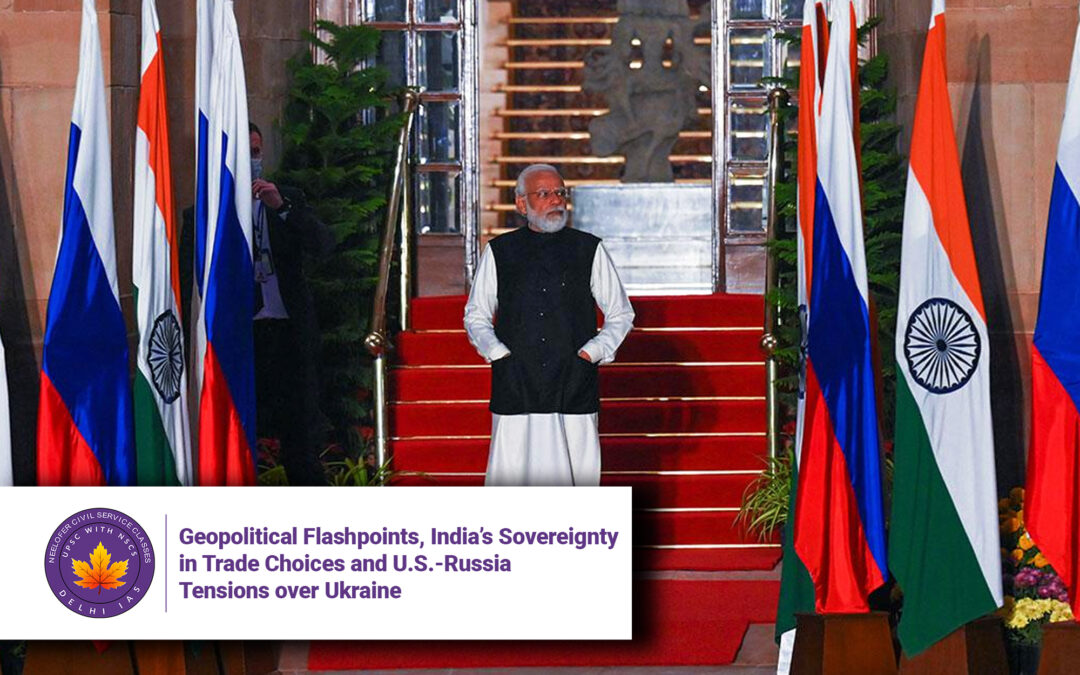
Geopolitical Flashpoints, India’s Sovereignty in Trade Choices and U.S.-Russia Tensions over Ukraine
Why in News?
Recent developments in global geopolitics have placed India and the United States at critical crossroads, both in terms of foreign policy and strategic alignment. On one hand, India has strongly pushed back against the U.S. and the European Union (EU) for targeting its continued oil trade with Russia, defending its sovereign right to determine its trade partners. On the other, former U.S. President Donald Trump’s aggressive rhetoric toward Russia, involving nuclear threats and secondary sanctions on countries like India and China, has added fresh tensions to the ongoing Ukraine conflict.
These twin developments are significant because they highlight the increasingly complex and contested terrain of international diplomacy, where national interest, economic security, and global pressure collide.
Introduction
In a bold diplomatic move, India’s Ministry of External Affairs (MEA) recently issued a sharp statement rejecting pressure from the U.S. and EU over its continued oil trade with Russia. This comes amid renewed tensions following the U.S. announcement of a 25% reciprocal tariff on Indian goods starting August 7 and the EU’s sanctions on Indian refiners.
Simultaneously, Donald Trump’s public threat to move nuclear submarines in response to Russia’s provocative statements, coupled with his 10–12-day ultimatum to President Vladimir Putin to end the Ukraine war or face U.S. tariffs, has raised alarm across the global strategic community.
Key Issues and Institutional Concerns
1. India’s Trade Sovereignty and the Russia Factor
India has made it unequivocally clear that no external power—including the United States or the European Union—can dictate its trade relationships. This firm assertion came after mounting pressure from the West due to India’s continued purchase and sale of Russian oil, seen as a crucial economic buffer amid rising global energy prices and the Russia-Ukraine war.
The MEA’s statement condemned the actions by both Washington and Brussels as “unjustified and unreasonable”, especially given that both countries continue their own trade with Russia for essential goods like LNG, critical minerals, and nuclear fuel.
It also pointed out the paradox: The U.S. itself had previously encouraged India to buy Russian oil to help stabilize global markets, a policy that the Biden administration had confirmed. The MEA emphasized that India’s Russian oil purchases were a “vital national compulsion” and essential for safeguarding India’s economic security.
2. EU’s Secondary Sanctions on Indian Refineries
The European Union recently imposed secondary sanctions on India’s Vadinar refinery, which has partial Russian ownership. These sanctions, aimed at curtailing India’s oil trade with Russia, are seen by New Delhi as an infringement of sovereignty.
The MEA’s strong statement is the first such clear and public stance since the Ukraine war began, signaling a shift from cautious diplomacy to assertive engagement.
3. Donald Trump’s Hardline Shift on Ukraine and Russia
Meanwhile, former President Donald Trump’s foreign policy posture has taken a more aggressive turn. In a stark announcement, Trump revealed he had ordered two U.S. nuclear submarines to be stationed in “appropriate regions” in response to provocative statements by Dmitry Medvedev, former Russian President and current Deputy Chair of Russia’s Security Council.
Medvedev had called Trump’s tariff threats against Russia a “step toward war.” Trump responded with thinly veiled nuclear signaling, though he did not clarify whether the submarines were armed with conventional or nuclear warheads.
Trump also shortened his original 50-day ultimatum to Putin to end the Ukraine war to just 10-12 days, threatening sanctions on countries that continued to trade with Russia—including India and China.
Challenges and the Way Forward
For India: Balancing Sovereignty with Global Expectations
India’s core challenge is balancing its national interest with the geopolitical expectations of Western allies. The country has long maintained a non-aligned posture in international relations. However, the Russia-Ukraine war has brought new scrutiny to India’s foreign partnerships.
India’s firm stance underscores its commitment to an independent foreign policy. However, the economic consequences of retaliatory tariffs and sanctions from Western nations could pose serious challenges. To navigate these waters, India must continue strategic dialogue with both the U.S. and the EU while exploring deeper trade ties with other BRICS nations and ASEAN partners.
For the U.S.: Recalibrating Diplomacy with Coercion
Trump’s increasing reliance on threats—nuclear posturing, tariff-based coercion, and criticism of trade partners—marks a deviation from traditional diplomacy. While pressure tactics can yield short-term results, they risk alienating key allies like India, who value sovereign decision-making.
Moreover, Trump’s mixed signals—offering peace while brandishing military threats—create confusion about America’s long-term strategic goals. A sustainable diplomatic route would involve constructive engagement with both Russia and Ukraine, emphasizing ceasefire, humanitarian relief, and confidence-building measures.
For the Global Community: Avoiding a Bipolar World Order
These developments are a reminder of the shifting fault lines in international diplomacy. As major powers clash over influence, trade, and security, countries like India are increasingly asserting their own paths. This shift indicates a potential move away from a U.S.-dominated unipolar world to a more complex, multipolar system.
Conclusion
India’s defiant stance and Donald Trump’s aggressive policies encapsulate the turbulent state of global diplomacy today. India has drawn a line in the sand, making it clear that its foreign policy is not up for external manipulation. On the other side, Trump’s confrontational tactics with Russia and secondary sanctions threaten to escalate an already volatile conflict.
For lasting peace and economic stability, all stakeholders—including the U.S., EU, India, and Russia—must return to the table with a renewed commitment to diplomacy, sovereignty, and mutual respect. The world cannot afford to let power politics override reasoned negotiation. It is only through collective dialogue, not coercion, that the Ukraine crisis can find a peaceful resolution—and that global trade systems can continue to function without fracturing under geopolitical pressure.
Q&A Section
Q1: Why did India issue a strong statement against the U.S. and EU?
A: India’s Ministry of External Affairs condemned the U.S. and EU for targeting its oil trade with Russia, calling the sanctions and tariffs “unjustified and unreasonable.” The statement emphasized India’s sovereign right to choose its trade partners and criticized Western hypocrisy, as both the U.S. and EU continue to import key goods from Russia themselves.
Q2: What are the implications of Trump’s threat to deploy nuclear submarines?
A: Trump’s decision to deploy two nuclear submarines near Russia signals a dangerous escalation in U.S.-Russia tensions. Though vague in intent, the move underscores the increasing use of military pressure in foreign policy and raises fears of a potential direct conflict between nuclear powers.
Q3: How does India justify its continued import of Russian oil?
A: India calls its Russian oil purchases a “vital national compulsion,” necessary due to rising global energy prices and to safeguard its national economic security. The government also pointed out that the U.S. had previously encouraged such purchases to help stabilize the global oil market.
Q4: What is the international concern with Trump’s secondary sanctions?
A: Trump’s threat of imposing secondary penalties on countries like India and China, who trade with Russia, could disrupt global trade networks and provoke backlash from key international partners. Such tactics risk isolating the U.S. diplomatically and may push allies away from cooperative agreements.
Q5: What does India’s response indicate about its future foreign policy direction?
A: India’s strong rebuke reflects a more assertive and sovereign foreign policy stance. It signals that India will not bow to external pressures and will prioritize its own national interests and economic security, even at the risk of straining ties with major Western powers.

