
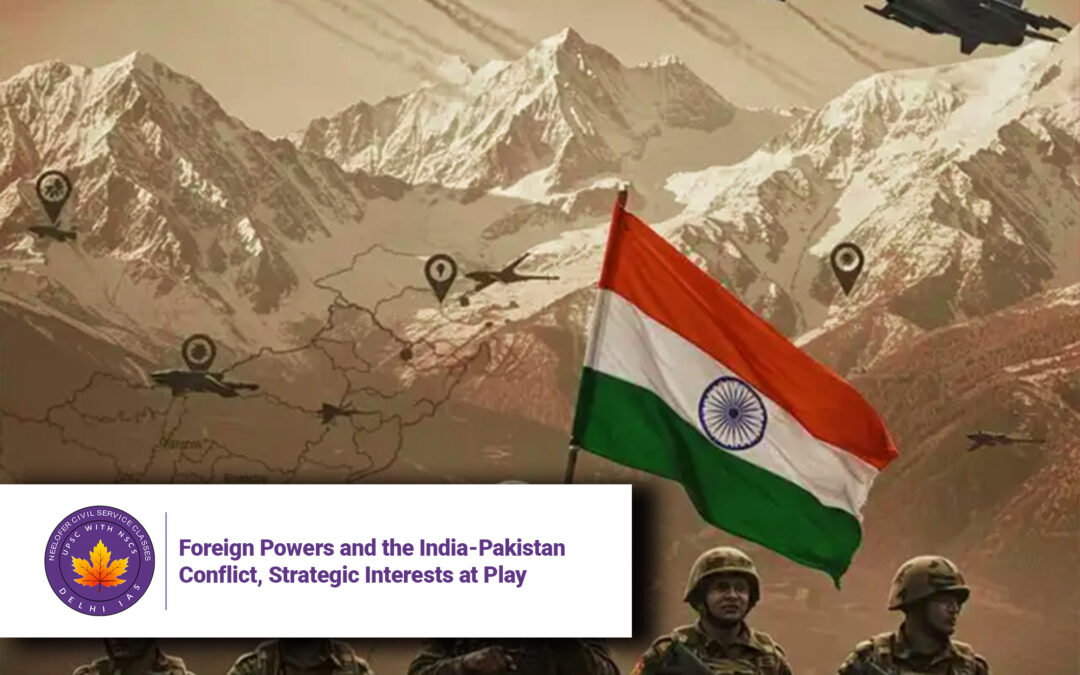
Foreign Powers and the India-Pakistan Conflict, Strategic Interests at Play
Why in News?
Following the Pulwama terror attack and the Balakot airstrikes in February 2019, tensions between India and Pakistan escalated rapidly. Beyond the bilateral dimension, this event also showcased how major global powers — including the U.S., China, Russia, and others — responded based on their national interests, highlighting the complexity of international diplomacy in South Asia. 
Introduction
While India and Pakistan remain the primary players in their long-standing rivalry, the reactions and interventions from global actors underline how geopolitical calculations play a crucial role in shaping the outcomes of regional conflicts. The Pulwama-Balakot episode not only tested diplomatic and military preparedness but also the strategic alignment of powerful nations.
Key Observations and Background
1. United States’ Dual Role
-
Initially, the Trump administration offered support to India by backing its right to self-defense.
-
However, as tensions escalated, Washington pushed for de-escalation, pressuring both sides to stand down.
-
The U.S. also relied on its deep intelligence network and contacts within both countries to monitor developments.
2. China’s Pro-Pakistan Tilt
-
China reaffirmed its status as Pakistan’s “all-weather” ally, diplomatically shielding Islamabad at global forums.
-
It resisted Indian narratives and backed Pakistan at the UN Security Council.
-
China also ensured that its strategic investments in Pakistan, especially under CPEC, were protected.
3. Russia’s Balanced Approach
-
Russia maintained ties with both India and Pakistan.
-
While expressing concern over terrorism, Moscow also encouraged diplomatic solutions, emphasizing stability in South Asia.
4. Middle Eastern Reactions
-
Countries like Saudi Arabia and the UAE, key allies of both nations, attempted to mediate quietly.
-
Their responses were guided more by economic ties than any direct strategic interest in the Kashmir conflict.
The Core of the Concern
The episode brought to light a core international reality — each country responds to military situations based on its self-interest, not moral posturing or alliance obligations. There is no permanent friend or enemy, only permanent interests.
Key Takeaways
-
The global reactions to India’s strike on Balakot and Pakistan’s response highlighted that diplomacy and military power go hand in hand.
-
China and the U.S. emerged as the two major players, but with contrasting agendas: one supporting India’s counterterrorism stance, the other promoting stability.
-
The episode exposed the limits of international mediation and showed how regional autonomy in decision-making is still very relevant.
Conclusion
The Pulwama-Balakot crisis marked a significant turning point in India-Pakistan relations, where both diplomacy and deterrence were tested. While India demonstrated its will to retaliate against terror, global powers acted according to their strategic compulsions, not shared values. This reaffirms that in international politics, national interest reigns supreme.
5 Questions and Answers
Q1. What global event triggered international reactions in this context?
A: The Pulwama terrorist attack and the subsequent Balakot airstrikes in 2019 triggered worldwide responses.
Q2. How did the U.S. respond to the India-Pakistan escalation?
A: The U.S. initially supported India’s right to self-defense but later pushed for de-escalation to avoid further conflict.
Q3. What was China’s position during the crisis?
A: China backed Pakistan diplomatically, blocking India’s attempts to name Masood Azhar a global terrorist and supporting Pakistan in the UN.
Q4. Did any country play a mediation role during the crisis?
A: Countries like Saudi Arabia and the UAE attempted quiet diplomacy but remained neutral due to economic interests in both nations.
Q5. What is the main lesson from the foreign response to the crisis?
A: The key takeaway is that every country acts based on its own national interests, and the global order is shaped by self-help rather than alliances.

