
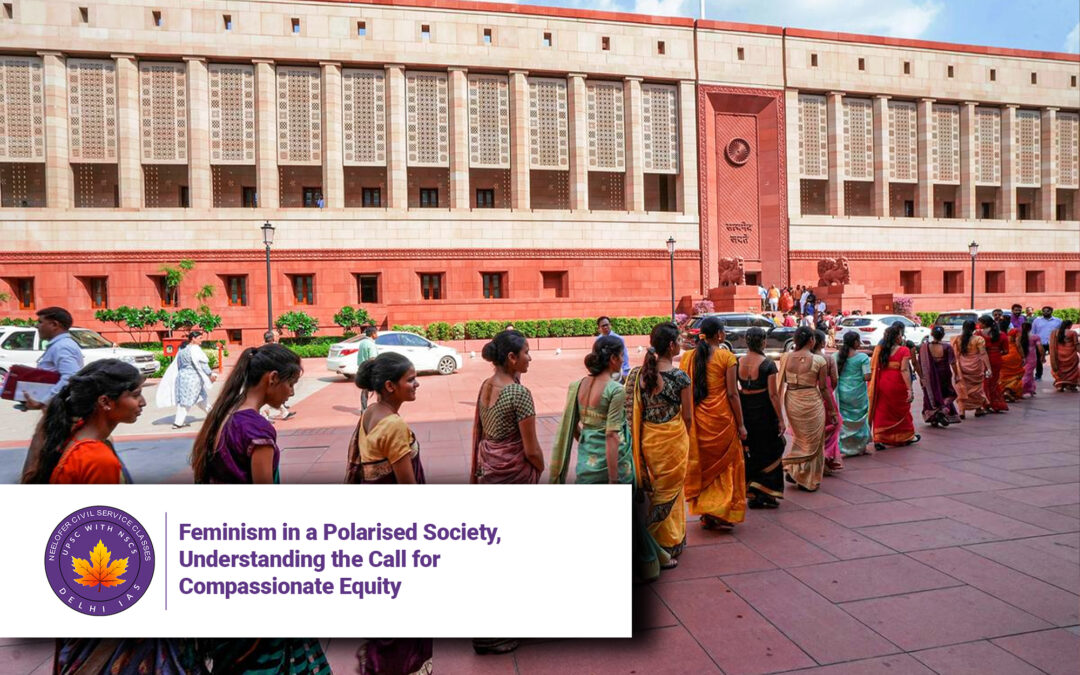
Feminism in a Polarised Society, Understanding the Call for Compassionate Equity
Why in News?
With the historic implementation of the Women’s Reservation Bill, 2023, gender equity has moved from the margins to the centre of political discourse. This shift demands a deeper, more inclusive feminist engagement that can respond to the complex intersections of structure, sentiment, and everyday interpersonal relationships. 
Introduction
The passage of the Women’s Reservation Bill in 2023 marked a watershed moment in India’s democratic evolution. It shifted gender equity from a peripheral debate to a central one. However, this mainstreaming has paradoxically made feminist discussions more complicated, especially for those navigating nuanced, daily realities in a deeply unequal and polarized society.
Key Issues and Background
1. Two Distinct Terrains of Feminist Debate
-
Structural Terrain: Focuses on institutional barriers that restrict women’s access to power and opportunities.
-
Interpersonal Terrain: Deals with everyday relationships and the subtle dynamics of power, care, and negotiation within them.
Overemphasis on structuralism risks flattening the personal and emotional struggles embedded in relationships, while overlooking institutional structures risks masking systemic oppression.
2. Complex Realities of Patriarchy
-
In India, many men face economic vulnerability and continue to work under difficult conditions, often in silence.
-
Such realities complicate the narrative of male privilege, especially when men earn less than their wives or feel undervalued at home.
-
Feminist movements must acknowledge this complexity to avoid backlash and foster genuine support.
The Core of the Concern
Need for a Compassionate Feminism
-
Feminist discourse must engender support instead of triggering resistance.
-
Today’s feminist messaging often feels alienating, especially when it seems to forcefully assign guilt.
-
A more context-sensitive approach is needed—one that recognizes economic pressures, cultural values, and emotional investments.
Key Observations
1. Blurring of Inequities
-
Conflating vastly different kinds of injustice—economic, emotional, or violent—can misdirect focus and alienate potential allies.
-
For example, a man who earns less than his wife and works in silence is often wrongly portrayed as a privileged oppressor.
2. Empowerment Requires Multiple Shifts
-
Legal rights, economic access, social networks, and cultural shifts must be addressed simultaneously.
-
Empowerment must begin from the grassroots level—e.g., giving recognition to a father who fights to educate his daughter.
Conclusion
What we need today is a feminism that accommodates contradiction without compromising on justice. It must allow room for compassion, contextuality, and emotional truths while addressing structural oppression. The feminist movement cannot afford to be polarising. Instead, it must be layered, inclusive, and capable of holding both structure and sentiment together in its vision for change.
Q&A Section
Q1. Why has the Women’s Reservation Bill, 2023 been seen as a historic move for feminism in India?
Ans: It shifted gender equity from the margins to the core of political discourse, ensuring institutional accountability towards women’s representation.
Q2. What are the two terrains in which feminist debates operate, according to the article?
Ans: The structural terrain (laws and systems keeping women at the margins) and the interpersonal terrain (daily relationship dynamics and emotional negotiations).
Q3. Why is a compassionate feminism necessary today?
Ans: To ensure that feminist discourse includes diverse lived experiences, avoids alienation, and invites solidarity instead of backlash.
Q4. How can empowerment be effectively achieved for women according to the article?
Ans: Through an interlocking strategy involving economic independence, legal protection, cultural shifts, and institutional capacity building.
Q5. What danger lies in blurring different forms of inequality in feminist discussions?
Ans: It can alienate those who feel misrepresented, overlook real suffering, and misdirect the movement’s focus from effective systemic change.

