
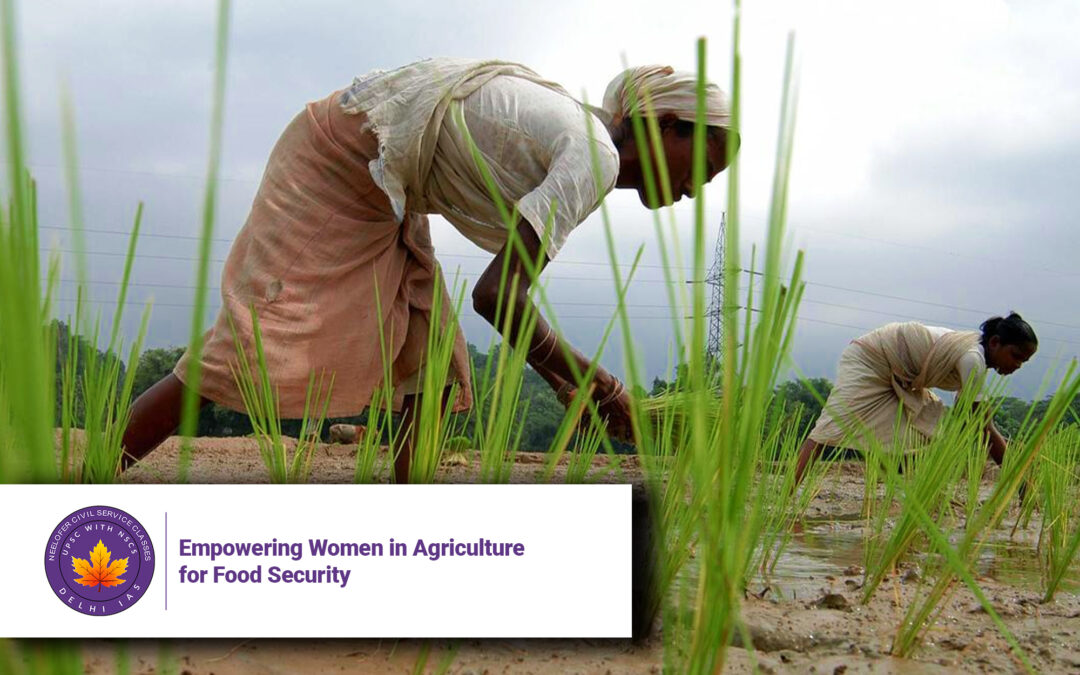
Empowering Women in Agriculture for Food Security
Why in News?
The United Nations General Assembly has declared 2026 as the International Year of the Woman Farmer, supported by over 100 co-sponsors.
The resolution celebrates the crucial role of women in global agriculture and seeks to raise awareness about the challenges they face, including issues of property rights and market access. 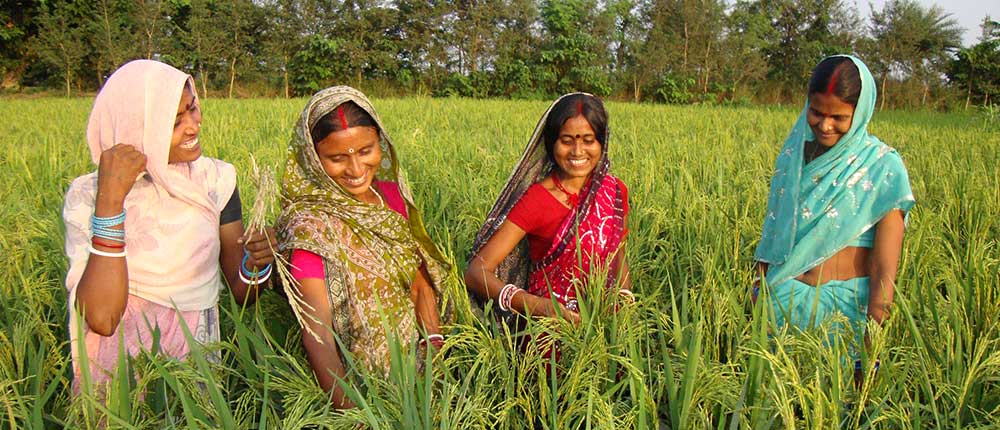
Introduction
Women play an essential role in global agriculture but continue to face deep-rooted gender inequalities in ownership, access to resources, and participation in decision-making.
This issue was highlighted during a symposium on women in agriculture organised by the Royal Norwegian Embassy and the UN World Food Programme (WFP) in India.
The event, attended by 200 participants from diverse fields, underscored the urgency of empowering women farmers to ensure food security and build resilient livelihoods.
Key Issues and Background
1. Ownership, Control and Access
-
Nearly 80% of food is grown by small and marginal farmers, but only 13.96% of agricultural land is owned by women.
-
Women’s rights to land and property remain severely restricted, limiting their access to credit, technologies, and market opportunities.
-
According to India’s National Family Health Survey, female land ownership is even lower, at just 8.3%.
2. Lack of Information and Resources
-
Many women farmers report a lack of awareness of their entitlements.
-
Limited access to financial instruments, technology, and agricultural advisory services hampers their productivity.
-
Government schemes often do not reach women effectively.
3. Government Support Measures
-
Government initiatives include:
-
Mahila Kisan Sashaktikaran Pariyojana for training and skill upgrades.
-
Subsidies for women on agriculture machinery and equipment.
-
30% of the National Food Security Mission budget earmarked for women farmers.
-
Specific Impacts or Effects
1. Empowering Women Builds Resilience
-
Studies show that empowering women in agriculture enhances family well-being, community resilience, and food security.
-
Programmes such as WFP’s School Feeding Initiatives demonstrate the potential of linking nutrition, gender equality, and climate resilience.
2. The Need for Technological Inclusion
-
Women’s digital literacy remains low.
-
Expanding access to mobile-based tools, agri-advisory services, and market platforms can boost productivity.
3. Ecosystem-based Approaches
-
Promoting climate-resilient farming techniques.
-
Enhancing participation of women in natural resource management.
-
Encouraging the cultivation of nutrient-rich local varieties and mitigating disaster risks like flooding and drought.
Challenges and the Way Forward
Challenges
-
Deep-rooted gender biases in land ownership and inheritance laws.
-
Limited financial inclusion of women farmers.
-
Gaps in extension services and technology access.
Way Forward
-
Leverage partnerships between state agencies, academic institutions, and NGOs.
-
Ensure that 30% of agricultural schemes benefit women.
-
Promote peer learning and women-led cooperatives.
-
Strengthen climate-resilient agriculture to support vulnerable rural women.
-
Facilitate women’s participation in policy dialogues and leadership roles in agriculture.
Conclusion
The 2026 International Year of the Woman Farmer offers a historic opportunity to champion women’s rights in agriculture.
Empowering women farmers is not just about gender equality — it is critical for ensuring food security, nutrition, and sustainable development.
A focused, collaborative approach is needed to translate this vision into tangible action.
5 Questions & Answers
Q1: Why was 2026 declared the International Year of the Woman Farmer?
A: To celebrate women’s critical role in agriculture and raise awareness of the gender-based challenges they face.
Q2: What percentage of agricultural land is owned by women in India?
A: Only about 13.96% of land is owned by women; according to the National Family Health Survey, this figure is even lower at 8.3%.
Q3: What are the key challenges faced by women farmers?
A: Limited land ownership, poor access to credit, lack of technological information, and insufficient participation in decision-making.
Q4: What government schemes support women in agriculture?
A: Programmes like Mahila Kisan Sashaktikaran Pariyojana, subsidies for farm machinery, and allocation of 30% of the National Food Security Mission budget for women farmers.
Q5: What are the recommended next steps?
A: Improve land rights for women, expand financial access, promote climate-resilient practices, increase technology adoption, and foster leadership opportunities for women in agriculture.

