
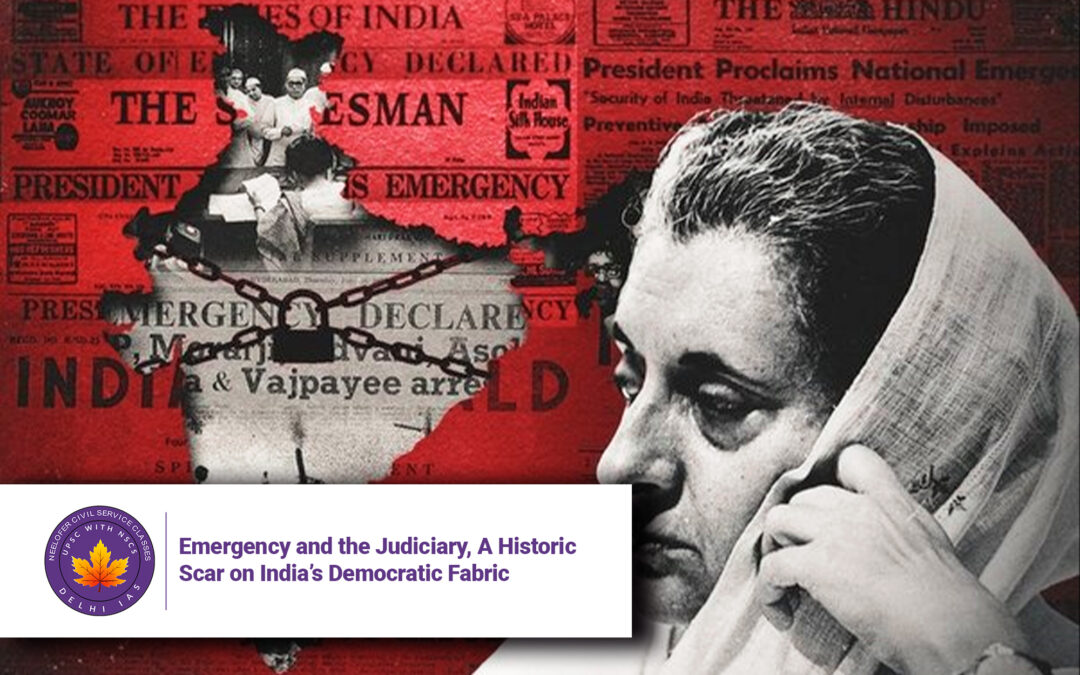
Emergency and the Judiciary, A Historic Scar on India’s Democratic Fabric
Why in News?
As India marks 50 years since the declaration of the Emergency in 1975, legal scholars and citizens reflect on how this period severely undermined the independence and credibility of the Indian judiciary, especially the Supreme Court, through decisions that weakened constitutional safeguards and eroded public trust. 
Introduction
The Emergency period (1975–77), declared by then Prime Minister Indira Gandhi, was one of the darkest phases in Indian democratic history. The judiciary, particularly the Supreme Court, faced immense criticism for failing to uphold constitutional values. The infamous ADM Jabalpur case (1976), in which the Supreme Court upheld the suspension of habeas corpus during the Emergency, has since become a symbol of judicial failure.
Key Issues
1. ADM Jabalpur Judgment
-
Often cited as the nadir of the Indian judiciary.
-
The Supreme Court ruled that during Emergency, citizens had no right to move courts for enforcement of Fundamental Rights, including the right to life.
-
Only Justice H.R. Khanna dissented, defending constitutional values and civil liberties.
2. Kesavananda Bharati Case (1973)
-
Just two years before the Emergency, this judgment upheld the Basic Structure Doctrine, limiting Parliament’s power to amend the Constitution.
-
Ironically, this foundational judgment was soon overshadowed during the Emergency when the judiciary caved to executive pressure.
3. Judicial Appointments and Transfers
-
The Emergency saw strategic use of judicial transfers and appointments to reward or punish judges based on loyalty to the government.
-
Judges who supported the government received promotions, while dissenters were sidelined.
Challenges and the Way Forward
-
Trust Deficit: The judiciary’s conduct during the Emergency weakened its institutional credibility.
-
Need for Accountability: There is a demand for judicial transparency, especially in politically sensitive cases.
-
Judicial Courage: The legacy of Justice Khanna remains a benchmark for constitutional integrity. The judiciary must protect its independence, particularly during politically volatile times.
Conclusion
The Emergency era is a reminder of how fragile democratic institutions can become under authoritarian impulses. The judiciary’s failure to stand firm during that time has had long-lasting implications for public trust. As India continues to evolve as a constitutional democracy, protecting judicial independence is not just a legal necessity but a democratic imperative.
5 Questions & Answers
1. What was the ADM Jabalpur case about?
It was a Supreme Court judgment during the Emergency that ruled citizens could not seek court intervention to enforce Fundamental Rights, including the right to life, if those rights were suspended.
2. Which judge famously dissented in the ADM Jabalpur case?
Justice H.R. Khanna. His dissent defended the inviolability of the right to life and liberty even during Emergency.
3. How did the Emergency affect judicial independence?
The government rewarded compliant judges and punished those who dissented through transfers and denial of promotions, undermining the judiciary’s autonomy.
4. What is the significance of the Kesavananda Bharati case?
It established the Basic Structure Doctrine, limiting Parliament’s power to alter the core principles of the Constitution. It became a cornerstone for judicial review in India.
5. Why is revisiting the judiciary’s role during the Emergency important today?
It serves as a cautionary tale to uphold democratic values and judicial independence, especially during political crises or threats to civil liberties.

