
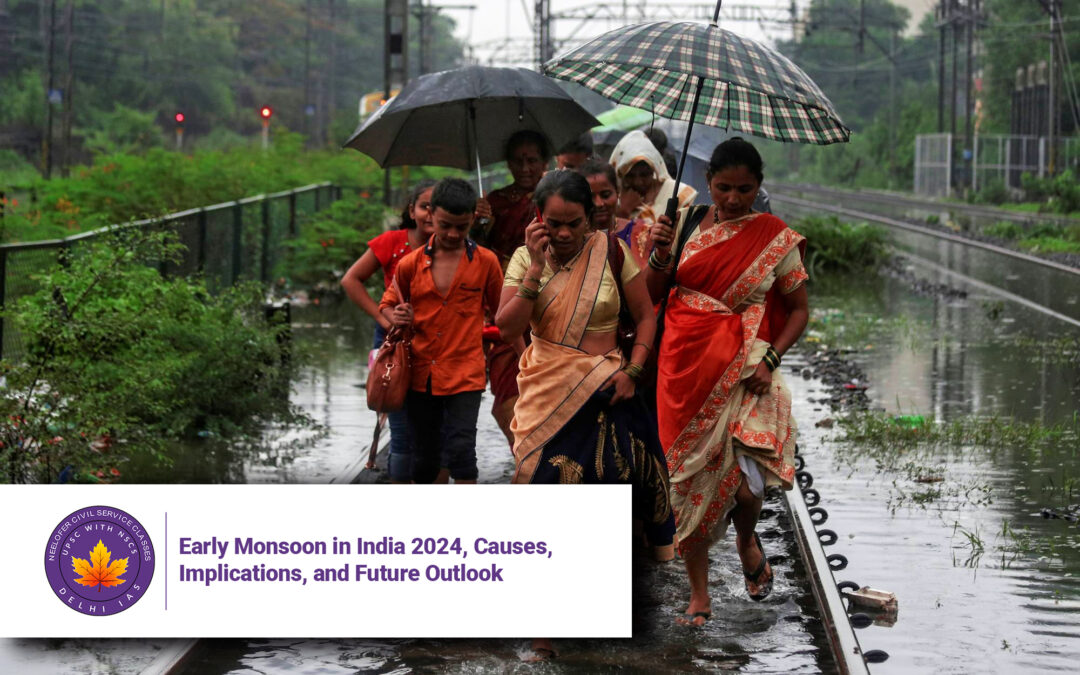
Early Monsoon in India 2024, Causes, Implications, and Future Outlook
Why in News?
The Indian Meteorological Department (IMD) announced that the southwest monsoon arrived in Kerala on May 24, 2024, making it a week earlier than the normal onset date of June 1. This marks the earliest monsoon arrival in the past 13 years, with the last comparable early onset occurring on May 23, 2010. This early onset raises questions about the scientific reasons behind such deviations, the impact of climate change, and what it means for agriculture, water resources, and overall weather patterns in India. 
Introduction
The monsoon is a climatic lifeline for India, playing a critical role in determining the health of its agriculture, economy, and water security. Any deviation from the normal monsoon schedule—either early or late—triggers widespread speculation and concern.
This year’s early arrival in Kerala has once again brought the phenomenon under scrutiny. While it may offer hope of abundant rainfall, experts caution against drawing conclusions without considering the broader climatological context. The early arrival could be a statistical blip or an indication of shifting weather dynamics, potentially influenced by global warming and complex oceanic patterns like El Niño and La Niña.
What is the Science Behind the Monsoon’s Early Onset?
Several factors affect the timing of monsoon onset, particularly in Kerala, the gateway for the southwest monsoon into mainland India.
1. Oceanic Temperatures
One of the most important influences is the sea surface temperature over the Bay of Bengal and Arabian Sea. In 2024, warmer-than-usual ocean waters were observed, especially in the eastern Indian Ocean, which helped energize the monsoon winds.
2. Wind Patterns and the Madden-Julian Oscillation (MJO)
Wind circulation patterns from the southwest Indian Ocean to the northwest Pacific Ocean play a crucial role in transporting moisture. This year, favorable westerlies and a supportive Madden-Julian Oscillation helped accelerate the movement of the monsoon trough toward the Indian subcontinent.
3. Absence of El Niño Conditions
While 2024 started with weak El Niño-like conditions, they have not intensified. Historically, El Niño is associated with delayed monsoon or deficient rainfall. The absence of strong El Niño signals possibly enabled an early and relatively strong onset.
Historical Context and Comparison
This early arrival brings comparisons to other years with unusual monsoon behavior:
-
2009 also witnessed an early onset (May 23), but was followed by one of the worst droughts in Indian history.
-
2020 and 2021 had relatively normal onset dates, but varying monsoon performances.
-
Since 1975, the IMD has tracked monsoon arrivals and found only a few cases where it arrived more than a week early.
Thus, an early onset does not guarantee abundant rainfall and may not correlate with a strong or weak monsoon season overall.
Key Issues and Concerns
1. Rainfall Distribution, Not Just Arrival
Experts caution that the onset date is less important than the spatial and temporal distribution of rainfall across the country. Even if the monsoon begins early, it may not sustain momentum uniformly across regions like Maharashtra, Gujarat, or Punjab.
2. Agricultural Planning
Farmers, especially in rain-fed states, rely heavily on the monsoon for sowing crops. An early onset might encourage premature sowing, risking crop failure if there is a dry spell afterward.
3. Water Resource Management
Reservoirs, dams, and groundwater recharge systems are designed around monsoon predictions. Unusual patterns could strain water management policies.
4. Predictive Challenges
Although meteorological tools have improved, forecasting monsoon onset remains difficult. Multiple variables—sea temperature, wind shear, polar conditions, etc.—interact in unpredictable ways.
Impact of Climate Change
Climate scientists argue that global warming is making monsoon patterns more erratic and difficult to predict. Here are some changes observed:
-
Increased frequency of extreme weather (heavy rainfall events, sudden droughts).
-
Shifting monsoon zones, affecting traditionally rain-fed areas.
-
Delayed withdrawal of monsoon, leading to flooding in October-November.
Moreover, the Arctic warming and polar jet stream changes are also believed to influence tropical weather, including the Indian monsoon.
2024: What Can Be Expected Going Forward?
While it is too early to draw firm conclusions, the IMD and other weather models predict that 2024 may have a “normal monsoon” in terms of total volume. However, the distribution of rain remains uncertain.
Weather watchers will closely monitor:
-
Whether the monsoon sustains momentum through central and northern India.
-
If the early rains taper off, causing a mid-season dry spell.
-
Impact on Kharif crop sowing across states like Karnataka, Andhra Pradesh, and Bihar.
Conclusion
The early monsoon in 2024 is a weather event that must be interpreted with caution. While it offers hope for a good agricultural season, it also raises critical concerns about the changing climate system, predictive challenges, and policy preparedness.
India must invest more in weather modeling, climate resilience, and farmer education to mitigate risks. The event reaffirms the need to decouple our dependency on monsoon arrival and instead focus on building robust, adaptive systems for a future of uncertain climates.
Q&A Section
1. When did the 2024 monsoon begin in Kerala?
The southwest monsoon began in Kerala on May 24, 2024—one week ahead of schedule.
2. Why is an early monsoon onset significant?
It signals a shift in seasonal patterns and has important implications for agriculture, water supply, and disaster preparedness.
3. What role does El Niño play in monsoon timing?
El Niño usually causes a delay or weakening of the monsoon. In 2024, El Niño conditions have not intensified, which may have allowed an early onset.
4. Does early arrival mean better rainfall?
Not necessarily. Past early arrivals (e.g., 2009) have been followed by droughts. Distribution and intensity of rainfall matter more.
5. How often does the monsoon arrive early?
Only a few times since 1975 has the monsoon arrived this early. It is a rare occurrence.

