
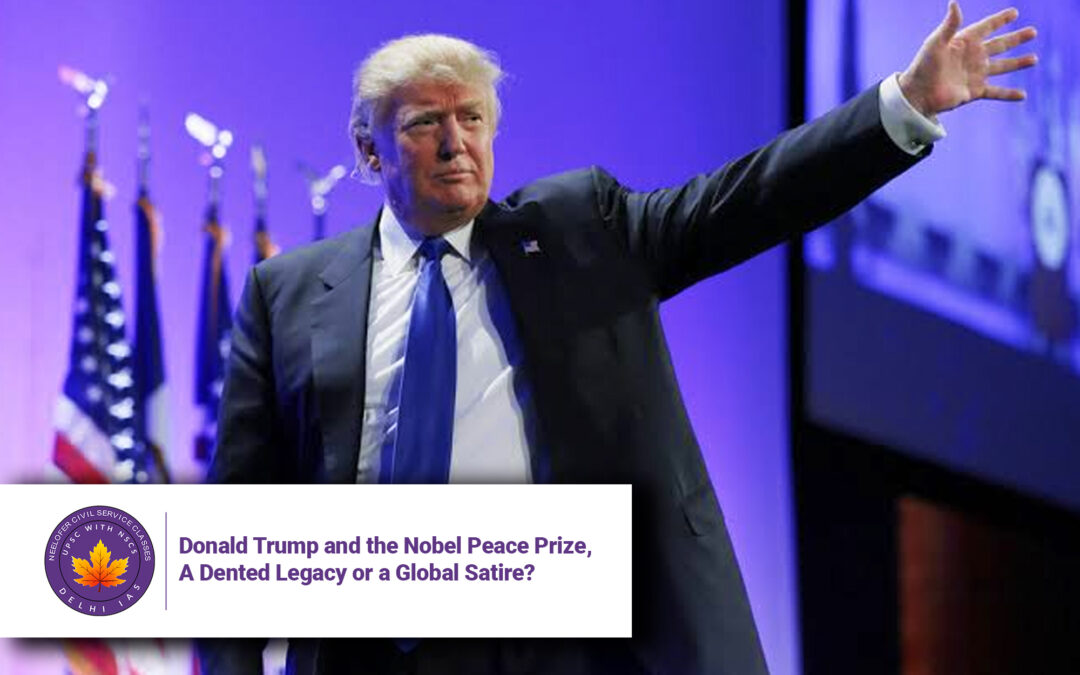
Donald Trump and the Nobel Peace Prize, A Dented Legacy or a Global Satire?
Why in News?
Donald Trump’s recurring obsession with winning the Nobel Peace Prize has once again sparked international debate. Despite his controversial foreign policy decisions and military interventions, there are multiple nominations in his favor, raising questions over the credibility of the Nobel Peace Prize itself. 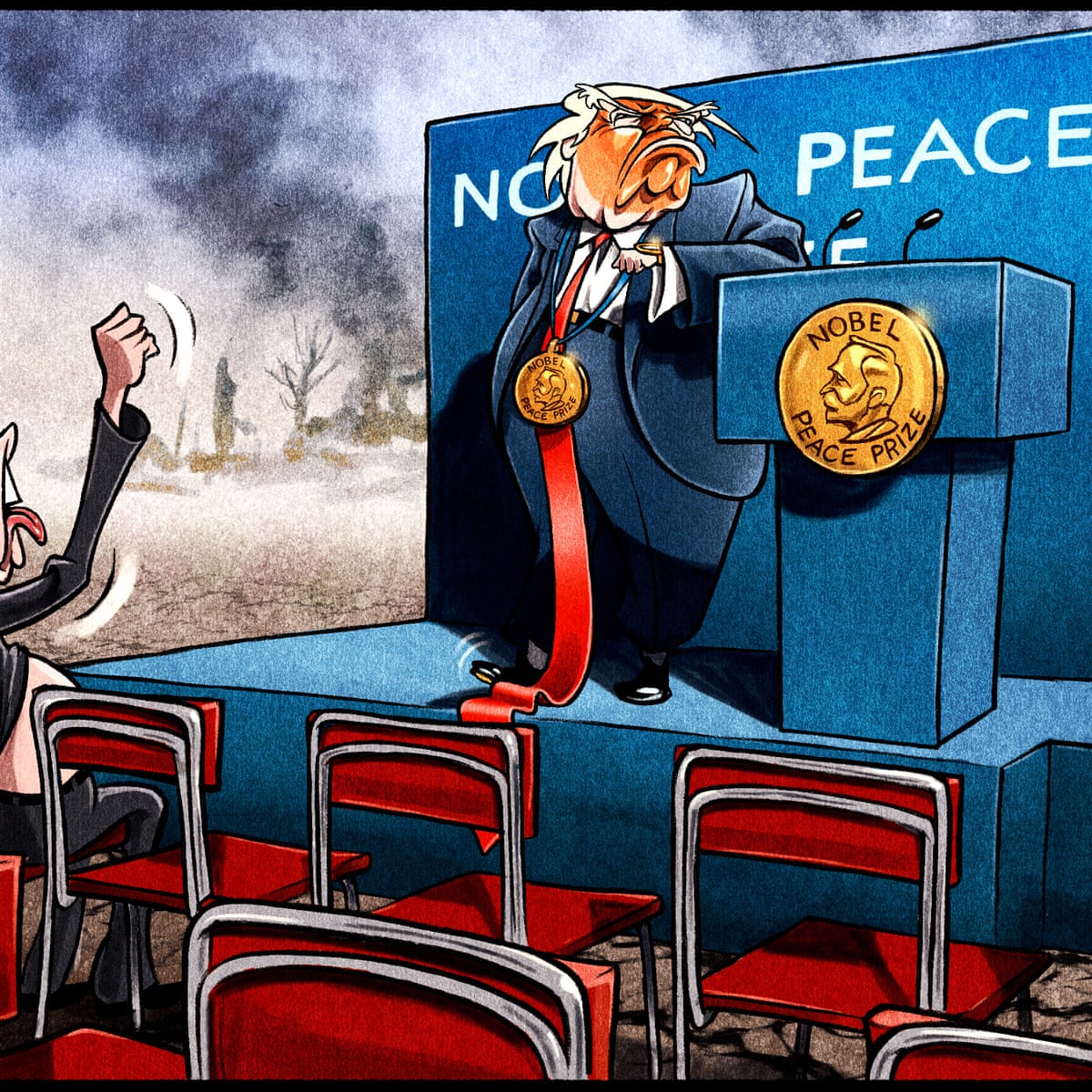
Introduction
The Nobel Peace Prize, once considered the highest honor for promoting global peace and diplomacy, has seemingly become a subject of ridicule and politicization. At the heart of this controversy is Donald Trump—the former President of the United States—whose desire to win the Nobel has become more of a spectacle than a matter of merit. With multiple countries and leaders nominating him, despite his polarizing record on peace, war, and diplomacy, observers are questioning: Has the Nobel Peace Prize lost its meaning?
Key Issues and Background
-
Trump’s Obsession with the Nobel Peace Prize
During his term, Trump repeatedly mentioned that he deserved the Nobel Peace Prize. From his speeches to social media posts, he would often lament that others, including President Barack Obama, had received the award without merit. He famously said, “They should give me the Nobel Prize for a lot of things.” -
Obama vs. Trump: The Comparison
Barack Obama was awarded the Nobel Peace Prize in 2009, early in his first term, for his efforts to strengthen international diplomacy. While the award was debated, Obama did not actively seek it. In contrast, Trump’s pursuit of the award was aggressive and public. He claimed he deserved it for his actions in Serbia, Kosovo, Congo, Rwanda, Iraq, and Afghanistan—even though many of these were controversial military interventions or coercive strategies. -
Trump’s Foreign Policy Approach: Peace or Pressure?
Trump’s foreign policy included imposing sanctions on adversaries like Russia, ordering airstrikes in Syria and Yemen, and withdrawing from international agreements like the Iran nuclear deal. He also encouraged normalization between Israel and Arab states. While his administration claimed these moves promoted peace, critics saw them as destabilizing. -
The Pakistan Factor and Regional Politics
Trump was nominated for the Nobel by individuals who praised his decision to cut military aid to Pakistan and publicly call out Pakistan’s role in harboring terrorists. For Indian audiences, this was a major point in his favor. However, the same Trump also pushed for American withdrawal from Afghanistan, leading to a Taliban takeover—an outcome that raised eyebrows globally. -
Trump and Israel: A Controversial Alliance
Israeli Prime Minister Benjamin Netanyahu has openly praised Trump and nominated him for the Nobel. Netanyahu thanked him for recognizing Jerusalem as Israel’s capital, cutting aid to Palestinians, and giving Israel “everything it needs to finish the job in Gaza.” However, Trump’s support came at the cost of civilian bombings in Gaza and Yemen. Meanwhile, Netanyahu himself is under scrutiny from the International Criminal Court (ICC) for alleged war crimes.
Five Key Observations
-
Nobel as a Political Tool
The Nobel Peace Prize has increasingly become a tool of political messaging rather than a recognition of true peacebuilding. The nomination of a polarizing figure like Trump reinforces this shift. -
Moral Complexity vs. Merit
Many of Trump’s actions, such as sanctions, military operations, and withdrawal from peace accords, contradict the ideals of peace. Yet these are being interpreted by his supporters as peace-promoting actions. -
The Role of Allies in Image Management
Leaders like Netanyahu have been instrumental in pushing Trump’s Nobel narrative. This creates a scenario where international alliances are being used to influence reputational gain rather than genuine peace efforts. -
The Declining Credibility of the Nobel Committee
With over 388 candidates for the prize this year (285 individuals and 94 organizations), the Nobel committee faces increasing pressure to ensure legitimacy. Trump’s repeated nomination exposes how easily the process can be gamed by political allies. -
Media and Spectacle Culture
Trump’s consistent public display of craving the Nobel—through speeches, memes, and news appearances—highlights a broader cultural shift where awards are pursued like social trophies, not solemn honors.
Challenges and the Way Forward
The major challenge before the Nobel Committee now is regaining credibility. With powerful political figures using the Peace Prize as a PR strategy, the essence of the award—honoring those who actively reduce conflict and promote harmony—is at risk. If people who contribute to bombings, military escalations, and divisive rhetoric are celebrated, it sends a dangerous message globally.
The Nobel Committee must enforce stricter criteria and vet nominations more rigorously. Public perception of the award hinges on moral clarity and consistency. Recognizing individuals solely for temporary political gains dilutes the legacy of past recipients like Martin Luther King Jr., Mother Teresa, and Nelson Mandela.
There’s also a need to establish clearer guidelines on what constitutes “peace” in today’s global landscape. In a world where sanctions and strategic coercion are marketed as diplomacy, the line between war and peace has blurred dangerously.
Conclusion
Donald Trump’s fascination with the Nobel Peace Prize, and the repeated nominations he receives, underline a larger crisis in how the world views and rewards peace. Instead of serving as a symbol of hope, the prize now risks becoming a political badge handed out for strategic favors and media clout.
Trump may never win the award, or he might—because in today’s geopolitical theater, symbolism often trumps substance. But if he does, it would mark a turning point for the Nobel Peace Prize—when satire and seriousness collide. The world would then be forced to ask: Has the Peace Prize become a parody?
Q&A Section
Q1: Why does Donald Trump want the Nobel Peace Prize so badly?
A: Trump views the Nobel Peace Prize as a symbol of global prestige. He feels he deserves it for actions like fostering ties between Israel and Arab nations and reducing aid to Pakistan. More importantly, he sees it as something Obama received unfairly, and thus wants it to prove his own superiority.
Q2: What foreign policy actions does Trump claim make him deserving of the prize?
A: Trump cites his administration’s involvement in Afghanistan, Iraq, Syria, Serbia, Kosovo, and Congo. He also points to his pressure tactics on Pakistan and his support for Israel in their operations against Gaza.
Q3: Who has nominated Trump for the Nobel Peace Prize?
A: Notably, Benjamin Netanyahu and some Pakistani figures have nominated Trump, praising his tough stance on Pakistan and his unwavering support for Israel. These nominations are political and strategic rather than humanitarian.
Q4: Has Trump’s foreign policy actually promoted peace?
A: This is heavily contested. While his administration made moves like brokering deals between Israel and Arab nations, it also oversaw bombings in Yemen and Gaza, escalated tensions with Iran, and withdrew from peace accords. His peace claims are seen by many as selective and self-serving.
Q5: What does this situation mean for the Nobel Peace Prize itself?
A: It risks being devalued. If political figures known for aggressive policies are repeatedly nominated, the Peace Prize may lose its moral credibility. Critics argue the prize must reflect genuine efforts toward reducing violence and fostering global harmony.

