
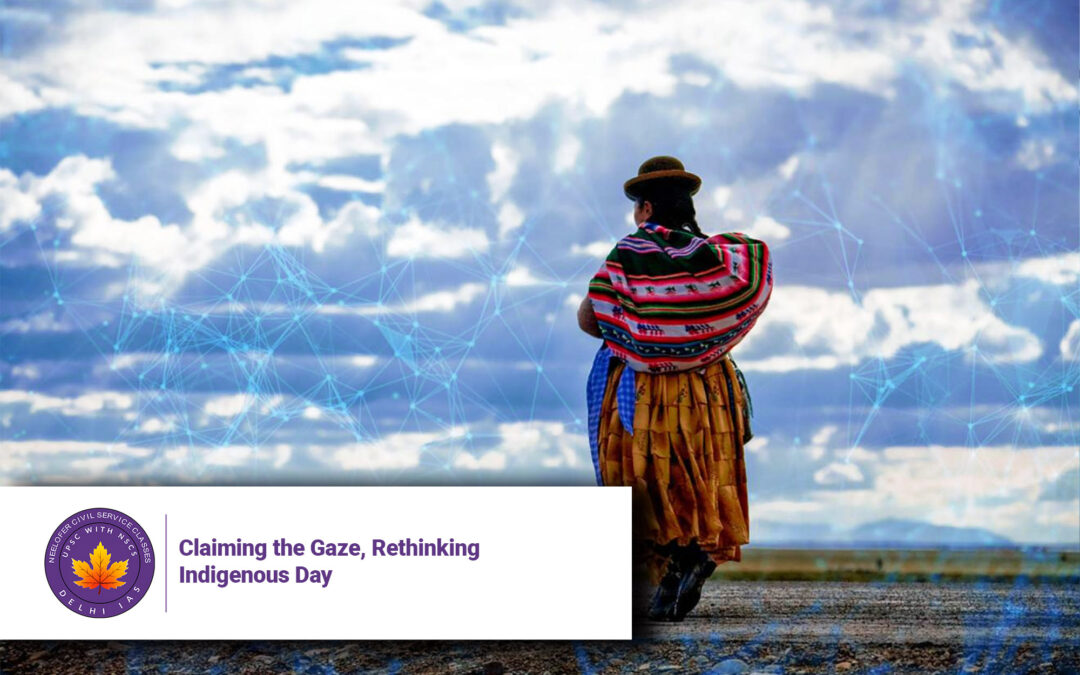
Claiming the Gaze, Rethinking Indigenous Day
Every year on August 9th, the world is called upon by the United Nations to observe the International Day of the World’s Indigenous Peoples. The intention behind this day is noble — to highlight the struggles, rights, and contributions of Indigenous peoples across the globe. It is marked by panels, policy discussions, cultural showcases, and a flurry of social media campaigns. Yet, as the day approaches, one question lingers for India’s tribal communities: What does this “international” observance truly mean for them?
Does it resonate with the lived experiences of India’s Indigenous peoples, or does it impose an imported framework shaped largely by Western historical narratives? In a world where globalization increasingly shapes our cultural memory, the act of remembering itself risks becoming a globalized exercise, stripped of local context and nuance.
The Indian Context
India is home to over 700 recognized Scheduled Tribes, spanning the length and breadth of the country. From the Gonds of Central India to the Dimasa Kacharis of Assam, from the Santhals of Jharkhand to the Apatanis of Arunachal Pradesh, these communities embody a rich archive of Indigenous knowledge, ecological wisdom, and cultural continuity.
Historically, Indian tribal societies were not fully displaced from their lands in the same way as many Indigenous communities elsewhere (though colonialism did dispossess many). Rather, in India, the imposition of external governance structures and economic systems altered tribal life while often leaving their territories intact.
To understand what Indigenous identity means in India, we must go beyond simply importing the global narrative of Indigenous victimhood. Here, the meaning is layered — it is about safeguarding cultural memory, resisting homogenizing forces, and reclaiming ways of knowing that have been sidelined by modernity.
Tribal Contributions to Civilisational Ethos
The contributions of tribal communities to India’s civilisational ethos cannot be reduced to folkloric curiosities or cultural “color” for tourist brochures. They have provided foundational knowledge systems:
-
Ecological wisdom rooted in sustainable resource use.
-
Cosmological insights shaping spiritual and ethical frameworks.
-
Agricultural techniques suited to varied geographies.
-
Medicinal knowledge that predates modern pharmacology.
-
Rich linguistic diversity that has influenced regional languages.
Festivals, rituals, and spiritual worldviews of tribal societies have been woven into India’s cultural fabric for centuries. This is not heritage locked in the past — it is a living tradition that informs sustainable futures.
Festivals as Living Memory
In Indigenous contexts, festivals are not just annual events; they are repositories of historical memory. For many tribal communities in India, they serve as acts of resistance, cultural reclamation, and ecological reaffirmation.
Take the Dimasa Bushu Dima festival, a harvest celebration that ties agricultural cycles to communal wellbeing. Or the Santhals’ Baha festival, which honors nature spirits and ancestral bonds. Festivals like the Oraon Sarhul, marking the blooming of the sal tree, weave together ecology, spirituality, and community cohesion.
These are not spectacles for outsiders. They are immersive, participatory experiences through which communities reaffirm their identity, transmit values to younger generations, and sustain an unbroken chain of memory.
The Colonial Legacy of the Gaze
Colonialism did not just seize land; it also seized the right to define and categorize knowledge. Indigenous peoples were recast as “subjects” — to be studied, governed, and displayed. Their knowledge systems were deemed “primitive” or “pre-modern” in academic and policy discourses.
This legacy of objectification persists. Even today, Indigenous contributions are often framed as secondary to “mainstream” culture, and their perspectives are filtered through outsiders’ interpretations.
As a result, International Day observances risk becoming symbolic acts that mimic global formats instead of fostering an authentically local engagement with tribal realities.
Towards Rooted Celebrations
If August 9th is to hold real meaning for India’s Indigenous peoples, it must be more than a ceremonial gesture. It should be a moment to decolonize the very act of remembrance.
Instead of asking how to fit tribal identity into global narratives, we should be asking:
-
How do tribal communities in India remember themselves?
-
What are their modes of archiving history, culture, and resistance?
-
How can these modes shape our collective national memory?
Consider Janajati Gaurav Diwas, commemorated annually on November 15th to honor Birsa Munda. This is more than a date on the calendar — it is a day rooted in the memory of resistance, spirituality, and Indigenous pride. Observances like this demonstrate that commemoration can be firmly grounded in local histories while still resonating with universal themes of justice and dignity.
Rethinking Representation
Representation matters — not only who is represented, but how. Too often, Indigenous peoples are represented visually through a narrow set of images: colorful costumes, dances, and exoticized rituals. While these are valuable cultural expressions, they are only fragments of a much larger picture.
True representation would center Indigenous voices as historians of their own communities, as philosophers articulating their worldviews, and as leaders shaping sustainable futures. It would also mean engaging with the difficult realities — displacement, erosion of land rights, and cultural marginalization — alongside the celebration of achievements.
Why This Matters Now
In a world facing ecological crisis, the knowledge systems of Indigenous peoples offer pathways to sustainability. Their emphasis on balance, reciprocity, and respect for the natural world stands in sharp contrast to extractive models of development.
Reclaiming Indigenous narratives is not simply about justice for marginalized communities; it is also about rethinking the future of our planet.
As August 9th approaches, let us remember: The most powerful commemorations are not those that echo global scripts but those that emerge from the heartbeat of the communities themselves.
Conclusion
The International Day of the World’s Indigenous Peoples offers an opportunity — but only if approached thoughtfully. For India, this means grounding observance in local contexts, amplifying Indigenous perspectives, and recognizing that the act of remembering is itself a form of resistance.
Instead of a day for others to look at tribal communities, it should be a day for those communities to claim the gaze — to look back, speak back, and define themselves on their own terms.
5 Q&A on the Topic
Q1: Why is the International Day of the World’s Indigenous Peoples important for India?
A1: It provides a platform to highlight the struggles, rights, and contributions of India’s 700+ tribal communities. However, its true impact depends on grounding the observance in local contexts rather than merely mimicking global narratives.
Q2: How have India’s tribal communities contributed to the nation’s cultural fabric?
A2: They have enriched India with ecological knowledge, agricultural innovations, linguistic diversity, medicinal practices, spiritual philosophies, and sustainable living models that predate and often surpass modern methods.
Q3: What risks arise from globalized forms of commemoration?
A3: Globalized formats can impose external frameworks that may overlook or distort local histories and perspectives, reducing Indigenous identity to symbolic acts rather than living realities.
Q4: How can festivals serve as acts of cultural resistance?
A4: Festivals like the Dimasa Bushu Dima, Oraon Sarhul, and Santhal Baha preserve ecological wisdom, honor ancestors, and strengthen community bonds. They are acts of memory and resistance against cultural erasure.
Q5: What is meant by “claiming the gaze”?
A5: It means shifting from being objects of observation to active subjects of representation. Indigenous communities define themselves, tell their own stories, and assert their perspectives, resisting outsider-imposed narratives.

