
Chinese Government Actions Against Apple and Foxconn Will Not Deliver
Why in News?
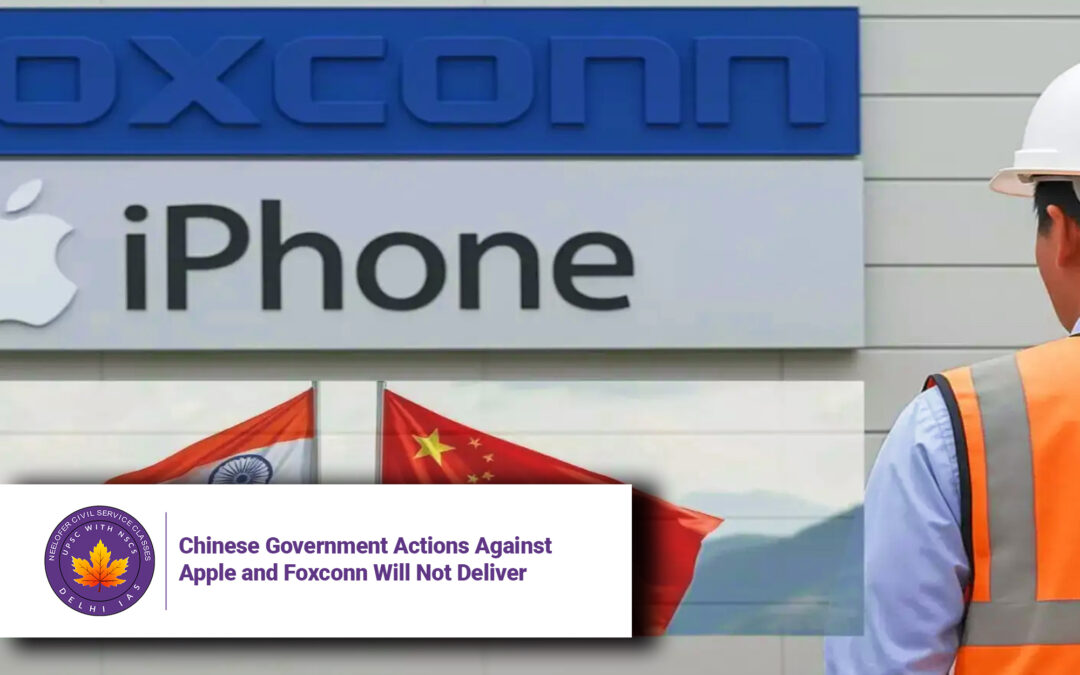
Recently, the Chinese government has taken regulatory and political actions against Taiwanese manufacturing giant Foxconn, and global tech leader Apple, both of which have been pivotal players in China’s export-driven industrial economy. These actions come at a time when both companies are actively exploring alternatives to reduce their overdependence on China, with India emerging as a prime candidate in their “China+1” strategy. The move by China reflects deeper anxieties regarding its slipping grip over global supply chains and intellectual superiority. 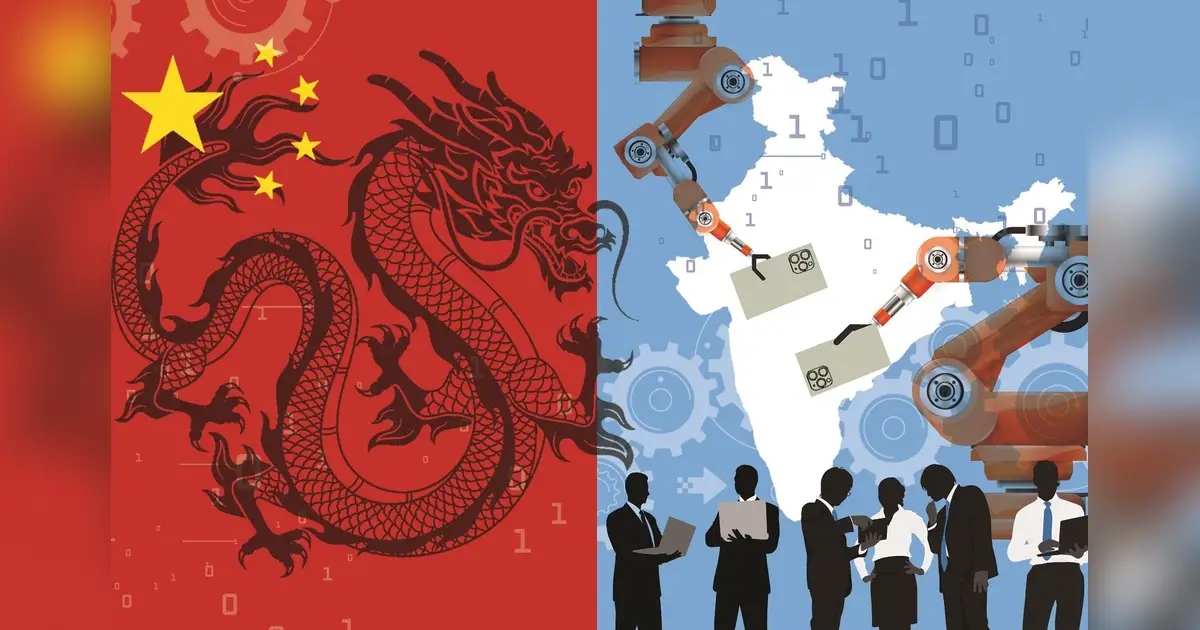
Introduction
The term “China+1” represents a strategy adopted by multinational corporations to diversify their manufacturing bases beyond China, prompted by rising labor costs, geopolitical risks, and supply chain disruptions. Over the past few years, India has stood out as a viable destination due to its vast labor force, improving ease of doing business, and government incentives. This trend is being accelerated by U.S.-China tensions, especially in the field of high-tech manufacturing, such as semiconductors, smartphones, and defense technologies.
However, instead of adapting to this global shift by making its business environment more appealing, China has chosen a confrontational path. By targeting firms like Foxconn and Apple — both of which are instrumental in the China+1 strategy — China aims to signal its intolerance for global power shifts. But in doing so, it may unintentionally accelerate its own isolation, as businesses continue to look for more stable, democratic, and rules-based markets.
Key Issues
1. Targeting Foxconn and Apple: A Tactical Mistake?
At a tactical level, China’s actions may delay the full transition of high-skill activities from China to India. Investigations and regulatory crackdowns create uncertainty, and companies may temporarily slow down their shift to avoid punitive measures. But at a strategic level, this increases the incentives for these companies — and others watching — to reduce dependence on China.
Foxconn is a critical player in the global tech supply chain. A Taiwanese company, it has been integral to Apple’s assembly line, employing millions in China. However, China’s rising authoritarianism, coupled with deteriorating U.S.-China relations, has pushed companies to rethink their long-term strategies.
The Chinese government’s recent crackdown on Foxconn reflects an authoritarian system’s typical impulse to respond to threats with brute force rather than reform. Unfortunately for Beijing, such measures only increase the risks for foreign firms, making India a safer bet in the long run.
2. Supply Chain Shifts to India
The shift of global supply chains to India is not a new phenomenon. India’s manufacturing appeal lies in:
-
A large, young labor force.
-
Lower operational costs.
-
Rapid digital infrastructure growth.
-
Friendly tax and investment reforms.
-
Strategic alignment with the U.S. and other democracies.
India’s PLI (Production Linked Incentive) schemes have already attracted major investments in electronics, pharmaceuticals, and semiconductors. From 2009 to 2018, China accounted for nearly 80% of Apple’s production base. That number has begun to drop sharply. For example, Apple now assembles around 7% of its iPhones in India, with plans to increase it to 25% by 2026.
3. China’s Superiority Complex
There is a historical and psychological layer to China’s response. The Chinese elite have long harbored a sense of superiority over India, a belief rooted in economic size, political stability (until recently), and educational output.
But times have changed. China under Xi Jinping has become more inward-looking and authoritarian. Nationalistic policies, control of private businesses, and suppression of dissent have created political turmoil. This has made China far less attractive to global firms who prioritize stability, transparency, and consistency.
Alternative Approaches: What Could China Have Done Instead?
Instead of suppressing foreign firms and doubling down on state control, China could have adopted a reform-oriented approach. Key alternatives include:
-
Relaxing Foreign Investment Rules: By opening up more sectors to foreign direct investment, China could have created incentives for firms to stay.
-
Enhancing Rule of Law: Transparent enforcement of laws and protection of intellectual property would help build global trust.
-
Collaboration Over Coercion: Partnering with global firms on research, talent exchange, and joint ventures would strengthen China’s long-term technological base.
-
Boosting Intellectual Freedom: Innovation flourishes where ideas are free. Encouraging academic and research freedoms would help China retain and attract talent.
However, none of these have been pursued seriously. Instead, China continues to rely on fear, control, and nationalism, which only pushes businesses away faster.
Challenges and the Way Forward
1. Intellectual Leadership Vacuum
One of the core problems China faces is the lack of intellectual leadership. While China excels in scale and speed, it lags behind in knowledge-centric innovation. For example:
-
EUV lithography machines, essential for high-end semiconductors, are dominated by the Dutch company ASML, which has cut off exports to China.
-
China’s attempts to replicate the F-35 Lightning II stealth fighter have been unsuccessful due to limited access to top-end military tech.
-
Much of China’s computational power depends on foreign chipmakers, especially from the U.S. and Taiwan.
The real chokehold on China is not from Foxconn or Apple pulling out — it’s from being excluded from the global knowledge economy. This is an area where India, with its vast English-speaking talent pool, democratic institutions, and openness to global collaborations, has a strategic advantage.
2. Economic Nationalism vs. Globalism
Xi Jinping’s China has leaned into economic nationalism, aiming to make the country self-sufficient. While this may boost morale domestically, it isolates China from global innovation networks.
In contrast, India is building alliances. The Quad alliance, strategic ties with the U.S., Australia, and Japan, and a new wave of FTAs are opening India to a wide variety of markets and technologies.
India’s policies respect property rights, legal independence, and foreign participation. It is these fundamentals, not just cost arbitrage, that will decide the next manufacturing giant.
3. The China+1 Opportunity for India
India must be strategic and swift in seizing the China+1 opportunity. While the momentum is in India’s favor, it faces its own challenges:
-
Regulatory bottlenecks.
-
Infrastructure gaps.
-
Logistics delays.
-
Labor skill mismatches.
Yet, reform efforts are underway. Digital India, GST, labor law reforms, and FDI liberalization all signal India’s intent to modernize. If India continues on this path, China’s loss could be India’s big gain.
Conclusion
China’s recent actions against Apple and Foxconn may provide short-term nationalistic satisfaction, but they are strategic missteps. Rather than deterring companies from shifting to India, these actions reinforce their decision.
As global firms watch China with increasing caution, India must prepare itself to become the next manufacturing and innovation hub. The road is long, but the direction is right. The China+1 era is not just a trade reshuffle — it’s a shift in global power.
In choosing coercion over cooperation, China may have unwittingly accelerated its own marginalization from the global economy.
Five Key Questions and Answers
1. Why is China targeting companies like Foxconn and Apple?
China is pressuring these companies to slow down their shift to India under the China+1 strategy, which threatens China’s dominance in global manufacturing.
2. What is the China+1 strategy?
It is a global business strategy to reduce dependence on China by investing in alternative countries like India for manufacturing and supply chains.
3. How does India benefit from this shift?
India offers a large labor force, political stability, improving infrastructure, and favorable government policies, making it a top alternative to China.
4. What risks does China face with its current approach?
By using coercion and control, China may push foreign companies to leave faster and isolate itself from global innovation and trade networks.
5. What should India do to maximize this opportunity?
India must continue reforming its infrastructure, laws, logistics, and labor markets while maintaining an open and collaborative economic environment.

