
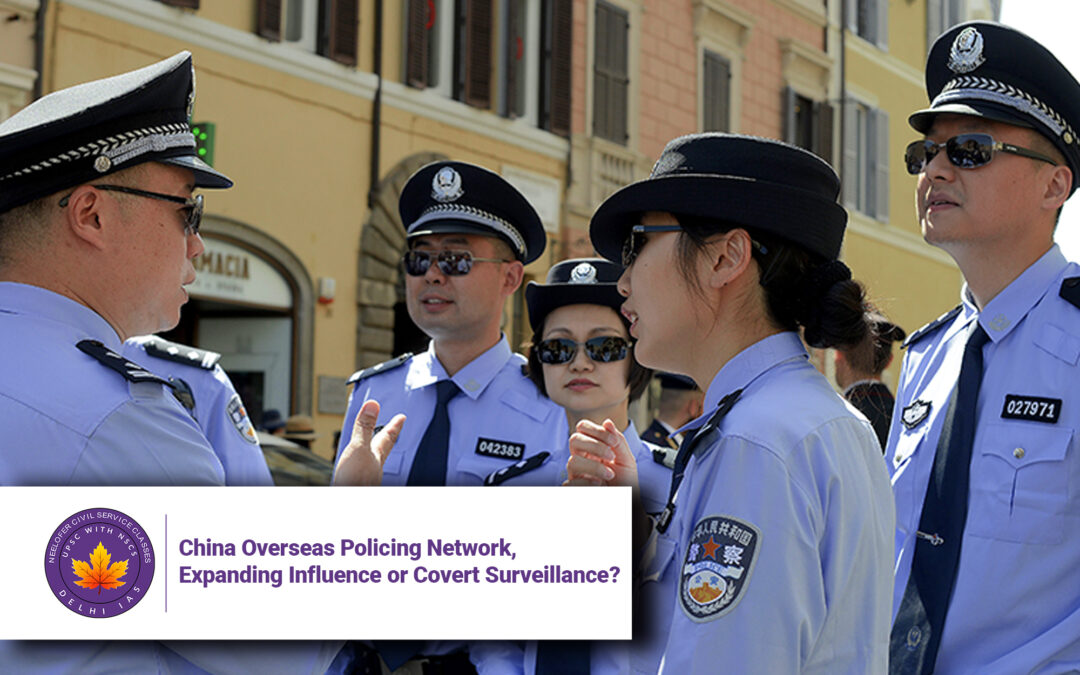
China Overseas Policing Network, Expanding Influence or Covert Surveillance?
Introduction
In a world shaped by increasing geopolitical complexity, China’s growing international presence has sparked both admiration and alarm. While its Belt and Road Initiative (BRI), economic diplomacy, and technological influence have received significant attention, a quieter, more controversial expansion is underway—China’s overseas policing operations.
On July 16, the Chinese Ministry of Public Security (MPS) deployed an eight-member police team to Croatia as part of a joint patrol. Though presented as a tourist safety initiative, this marks the sixth such joint mission since the 2017 China-Croatia Agreement on Police Cooperation. This growing pattern of joint policing and covert “service centers” in various countries suggests a broader and more ambitious aim: projecting China’s domestic security architecture onto the global stage.
This article delves into the evolution, intent, methods, and international response to China’s overseas policing missions, focusing especially on Europe and North America.
What Are the Joint Patrols?
Under the 2017 China-Croatia Agreement on Police Cooperation, officers from China and Croatia have jointly patrolled Croatian cities like Zagreb, Dubrovnik, and Zadar. Initially launched to safeguard Chinese tourists, the patrols reflect China’s concern for its citizens abroad, especially given that 2.5 lakh Chinese tourists visited Croatia in 2024, a 41% rise from the previous year.
The Chinese Ambassador to Croatia, Qi Qianjin, stated that the patrols address not just safety concerns for tourists, but also for Chinese nationals and diaspora communities in Croatia.
Though such patrols are not unprecedented, they do raise concerns—particularly when viewed alongside China’s broader international policing efforts.
Not Just Croatia: China’s Broader Policing Footprint in Europe
The Croatian initiative is just one part of a larger global policing network China is establishing. This began with Operation Fox Hunt (2014) and its umbrella programme, Sky Net (2015), aimed at pursuing fugitive economic offenders and political dissidents abroad.
Since then, China has signed joint policing agreements or operated covertly in several countries:
-
Serbia: Joint patrols began in 2019 and continued through 2023 and 2024.
-
Hungary: China’s Qingtiang County Public Security Bureau reportedly helped establish “police service centres” within Hungary.
-
Italy: After public outcry over covert Chinese policing infrastructure, Italy suspended joint patrols.
These initiatives are often framed as mutual security cooperation, but several international watchdogs warn they might facilitate surveillance of dissidents and Chinese nationals, even in sovereign foreign states.
Covert “Service Centres” and Global Backlash
While joint patrols are public-facing, China’s more controversial covert activities involve the creation of “service centres” abroad—some of which have allegedly been used for surveillance or intimidation.
In 2023, it was discovered that China had operated two such service stations in Amsterdam and Rotterdam (Netherlands). While the Chinese Foreign Ministry claimed these were mere consular outposts offering passport renewals and document services, media investigations suggested clandestine operations against overseas Chinese communities, including activists, journalists, and dissidents.
In the United States, the matter escalated into criminal prosecution. In April 2023, the FBI arrested two individuals in Manhattan’s Chinatown, linked to a “service centre” affiliated with China’s MPS. The U.S. Department of Justice charged them with:
-
Acting as agents of a foreign government without notification
-
Conspiracy to obstruct justice
-
Destroying communications with MPS officials
This incident sparked wider concerns about China’s extraterritorial law enforcement tactics, particularly in democratic societies with strong norms of civil liberties.
What Is China Really Aiming For?
China’s justification rests on two pillars:
-
Protecting Chinese nationals abroad: With growing outbound tourism and overseas Chinese communities, the Chinese government claims to have a legitimate interest in ensuring their safety.
-
Controlling political dissent: Critics argue that these “service centres” and patrols are part of a broader global surveillance apparatus, enabling extraterritorial law enforcement, especially against dissidents, defectors, and critics of the Chinese Communist Party (CCP).
China’s ability to deploy police or operate covertly abroad speaks to two troubling outcomes:
-
Establishing global reach: China is not just protecting its interests; it is attempting to create a web of quasi-policing infrastructure that can operate without oversight from the host country.
-
Exporting its governance model: These actions could normalize state surveillance and censorship beyond Chinese borders.
How Are Countries Responding?
Responses have varied based on bilateral relations with China, public awareness, and the host country’s legal framework:
United States
-
With deteriorating relations and growing concern about espionage, the U.S. has taken decisive action, including FBI arrests and investigations.
-
Chinese students, scholars, and tourists face increased scrutiny, and diplomatic exchanges have become strained.
Netherlands
-
Following revelations about secret Chinese “service stations,” the Dutch government launched investigations and is likely to revise foreign consulate and NGO regulations.
Italy
-
Amid rising media reports and civil society pressure, Italy suspended joint patrols, reflecting a proactive stance to uphold sovereignty.
Hungary and Serbia
-
Both countries have stronger economic ties with Beijing and appear less inclined to restrict cooperation.
-
No public investigations have taken place, and joint patrols continue without scrutiny.
Mongolia
-
Similar to Hungary and Serbia, Mongolia has seen no official inquiry, possibly due to China’s economic leverage and infrastructure investments in the region.
Implications for National Sovereignty and Human Rights
China’s overseas policing—whether through joint patrols or covert centres—raises significant questions about sovereignty, civil rights, and international law.
1. Extraterritorial Enforcement
-
Allowing a foreign country to operate law enforcement structures within one’s borders, even under cooperation, potentially compromises national sovereignty.
2. Surveillance of Diaspora Communities
-
These operations create fear among overseas Chinese communities, particularly those involved in activism or critical reporting on China.
3. Legal Grey Zones
-
Many of these “service centres” are not registered consulates, and their activities often evade host country regulation.
4. Diplomatic Fallout
-
Countries like the U.S. have seen a rise in diplomatic tensions, while others may be drawn into balancing national security with trade interests.
What Can the International Community Do?
1. Legal Reform
-
Countries must establish clear legal frameworks for the registration and regulation of foreign consulates and associated organizations.
2. Intelligence Sharing
-
Multilateral platforms like Interpol, Europol, and the Five Eyes alliance can play a vital role in monitoring and responding to such covert operations.
3. Protecting Diaspora Communities
-
Host governments should guarantee protections for political refugees, asylum seekers, and activists from foreign surveillance and harassment.
4. Public Awareness and Transparency
-
Civil society organizations, journalists, and human rights defenders must remain vigilant and vocal, ensuring transparency in international policing cooperation.
Conclusion
China’s growing overseas policing network represents a new frontier in global statecraft. As Beijing extends its law enforcement reach through joint patrols and covert stations, the world must confront a difficult question: how much foreign policing is too much?
While safeguarding tourists and nationals is a legitimate goal, these efforts risk becoming instruments of transnational repression, challenging the legal and ethical boundaries of sovereignty. Democracies, in particular, must respond decisively—lest the norms of surveillance, censorship, and state control seep silently across their borders.
The next few years will determine whether international norms and institutions can evolve fast enough to manage this new model of global policing—one that operates not just with boots on the ground, but with deep roots in digital, diplomatic, and diasporic channels.
Five Key Questions and Answers
1. What is the stated purpose of China’s overseas joint police patrols?
Answer:
According to the Chinese Ministry of Public Security, the joint patrols aim to address the “safety concerns” of Chinese tourists and nationals abroad. These include providing assistance, helping with documentation, and maintaining peace in areas with a large Chinese presence.
2. Why are these joint patrols considered controversial?
Answer:
They blur the line between legal cooperation and extraterritorial law enforcement. Critics argue that they serve as covert surveillance platforms, potentially targeting dissidents, activists, and defectors. The lack of oversight and transparency heightens the risk of abuse and human rights violations.
3. What are the “service centres” and why are they alarming?
Answer:
These are unofficial offices set up in foreign cities (e.g., Amsterdam, Manhattan) allegedly for consular support like renewing licenses. Investigations suggest they have been used for monitoring, pressuring, and harassing Chinese nationals critical of the CCP. The FBI arrests in April 2023 highlight the threat these pose to host nation sovereignty.
4. How have European and American nations responded?
Answer:
-
The U.S. has initiated criminal action, with FBI arrests.
-
The Netherlands and Italy have taken investigative or corrective measures.
-
Countries like Serbia, Hungary, and Mongolia have not acted publicly, possibly due to economic or political ties with China.
5. What broader geopolitical concerns does this trend raise?
Answer:
This is part of China’s larger strategy to extend its authoritarian model globally, using economic partnerships to justify policing presence. It challenges the rules-based international order, erodes democratic values, and forces a recalibration of international law enforcement cooperation.

