
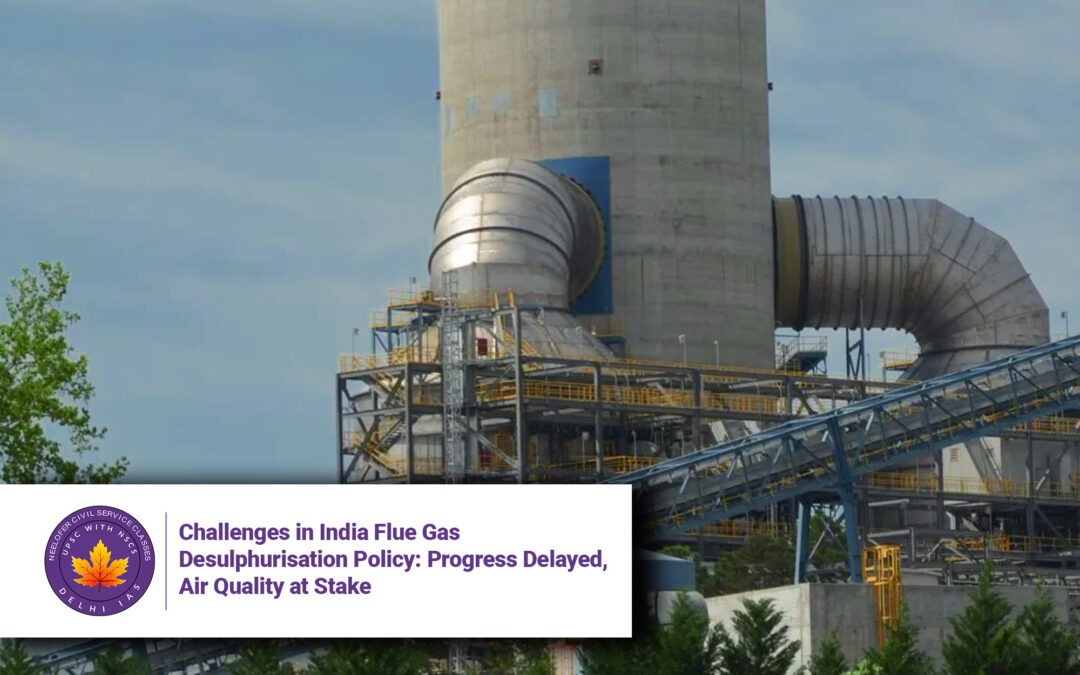
Challenges in India Flue Gas Desulphurisation Policy: Progress Delayed, Air Quality at Stake
Why in News? 
The Indian government’s efforts to control sulphur dioxide (SO₂) emissions from coal-based thermal power plants through the installation of Flue Gas Desulphurisation (FGD) units have been met with delays, loopholes, and policy confusion. A commentary by energy expert Somit Dasgupta critically assesses how a promising environmental measure has turned into a policy setback.
Introduction
The Ministry of Environment, Forest and Climate Change (MoEFCC) initiated new emission norms in 2015, mandating coal-based thermal plants to install FGDs to reduce SO₂—a harmful pollutant contributing to respiratory illnesses and environmental damage. However, nearly a decade later, India is still struggling to implement these reforms effectively.
Key Issues and Institutional Concerns
1. Misplaced Focus on SO₂ Instead of Carbon
FGDs aim to remove SO₂—not carbon dioxide. Yet SO₂ is not classified as a greenhouse gas (GHG). Despite its severe health effects, particularly as a component of PM 2.5, it was not the central concern of climate policies, creating confusion over priorities.
2. Delayed Implementation and Policy U-turns
Though power stations were supposed to install FGDs by 2017, progress stalled due to:
-
Lack of standardised FGD costs
-
Increased operating expenses
-
Unclear implementation timelines
-
Weak policy enforcement
By 2021, the government divided power plants into three categories (A, B, C) based on proximity to polluted areas and adjusted deadlines accordingly. However, repeated extensions now push deadlines up to 2030, delaying meaningful pollution control.
3. Market Disruption and Manufacturer Crisis
Several companies that had invested in FGD production, expecting a demand boom, have now suffered massive losses. The market for FGDs, once poised for growth, has collapsed. Companies laid off staff and exited the market due to lack of orders.
4. Economic Trade-offs and Power Costs
Adding FGDs was expected to increase electricity generation costs by ₹0.70 per unit and fixed tariffs by up to 8 paise per unit. The increased operating costs discouraged plants from voluntarily adopting the technology.
5. Minimal Environmental Gains
Ironically, studies suggest FGDs may not significantly reduce net carbon dioxide emissions and their impact on PM 2.5 is minimal. Moreover, around 78% of India’s installed coal capacity lies in Category C, which no longer needs to install FGDs.
Challenges and the Way Forward
-
Stronger Regulation: Clear, consistent, and mandatory policies must replace voluntary adoption and rolling deadlines.
-
Environmental vs Economic Balance: Government must transparently assess the health costs of air pollution against short-term economic burdens.
-
Support for Indian Industry: Businesses that invested in FGD tech should receive support or compensation for policy reversals.
-
Public Awareness and Accountability: The public must be informed of the health risks involved in such policy delays to build pressure on regulators.
Conclusion
India’s experience with FGD implementation reflects a larger issue in environmental governance: policy inconsistency, poor execution, and misplaced priorities. Without real change, India may continue to lose both public health and investor confidence, making “A step forward, two steps back” an all-too-real idiom for its environmental policies.
Q&A Section
1. Q: What are Flue Gas Desulphurisation (FGD) units designed to reduce?
A: FGDs are meant to reduce sulphur dioxide (SO₂) emissions from coal-based power plants.
2. Q: Why has the implementation of FGDs in India been delayed?
A: Due to cost concerns, lack of standardised pricing, multiple deadline extensions, and categorisation of power plants that exempt many from installation.
3. Q: How many categories of power plants were created by the government in 2021?
A: Three—Category A (within 10 km of National Capital/1 million+ cities), B (within 10 km of polluted/non-attainment cities), and C (others).
4. Q: What has been the impact on manufacturers of FGD equipment?
A: Many manufacturers faced massive financial losses, layoffs, and market collapse due to cancelled or delayed FGD orders.
5. Q: What is the article’s main concern regarding the FGD policy?
A: That despite well-intentioned goals, the policy has failed in execution, offering little real benefit to air quality while harming industry and public trust.

