
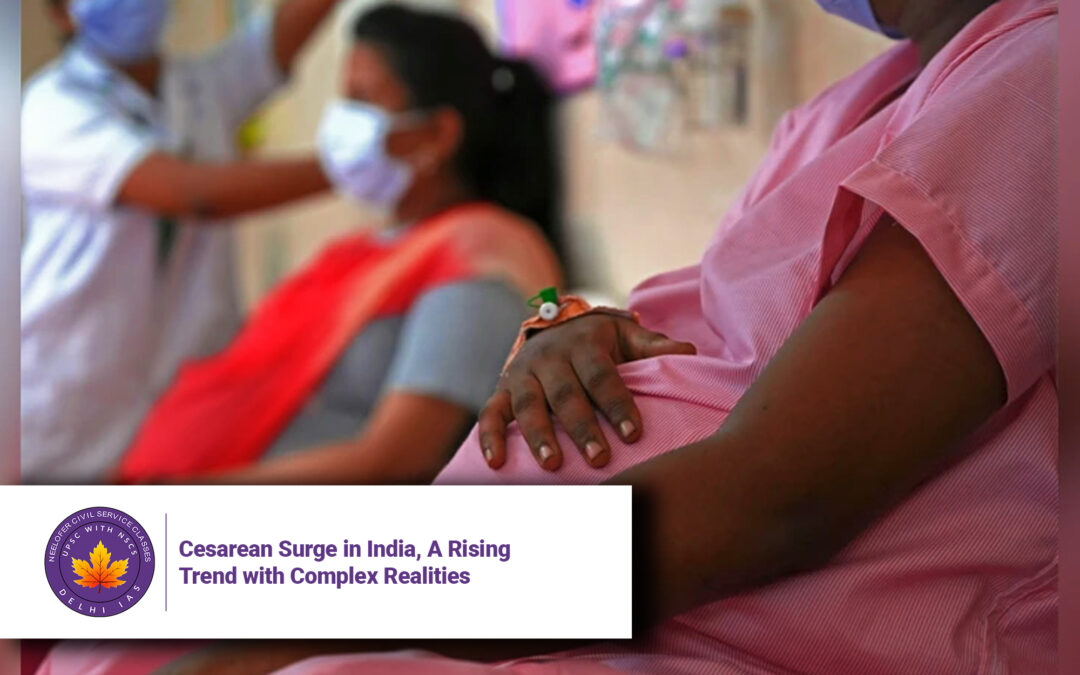
Cesarean Surge in India, A Rising Trend with Complex Realities
Why in News?
India is witnessing a sharp increase in cesarean deliveries, particularly elective (non-medically indicated) C-sections, raising concern among healthcare professionals, policymakers, and women’s rights advocates. While C-sections are essential in life-threatening conditions, their overuse may compromise maternal and neonatal health outcomes. Manorama Bakshi, a senior health policy expert, sheds light on this critical issue in her recent editorial, blending personal experience with national data.
Introduction:
The cesarean section (C-section), once regarded strictly as a medical intervention to save lives, is increasingly becoming a norm in modern childbirth — not out of necessity but convenience and preference. In India, this trend has become particularly visible in urban areas and private healthcare facilities. According to the National Family Health Survey-5 (NFHS-5), conducted between 2019 and 2021, 21.5% of births were by C-section, up from 17.2% in the previous survey. In some states, this rate crosses the World Health Organization’s (WHO) recommended safe threshold of 10-15%, reaching alarming levels of over 70% in institutional deliveries in places like Kerala.
This current affair attempts to understand this phenomenon not only through cold statistics but also through lived experience, medical research, and policy frameworks.
A Personal Lens into a National Reality:
Manorama Bakshi’s account of her two cesarean deliveries — one possibly due to questionable medical advice and the other almost pre-scheduled — reflects a growing pattern. Women, especially first-time mothers, are often steered toward C-sections by their doctors with explanations that blend medical caution with convenience. This interplay of vulnerability, authority, and information asymmetry makes consent complicated.
Her experience, once thought personal, aligns with the broader data: an increasing number of women are being directed toward cesarean births without a clear medical necessity. It reflects a subtle yet profound shift in how childbirth is perceived and managed in India — a move away from physiological processes and towards surgical intervention.
The Surge in Numbers:
The data from NFHS-5 is striking:
-
National Average C-section Rate: 21.5% (2019–21)
-
Previously (NFHS-4): 17.2% (2015–16)
-
States Exceeding WHO Safe Limits (10-15%): 28 of 36
-
States with Lower Rates: Nagaland (5.2%), Meghalaya (8%), Bihar (9.7%)
-
Kerala (Private Facilities): Over 70% of institutional births are cesarean
In private hospitals, the rate of cesarean births is significantly higher than in public ones — 47.4% compared to just 14.3%. This stark disparity raises questions about the motivation behind surgical intervention and the accessibility of vaginal birth support systems.
Socio-demographic Factors Driving the Trend:
-
Age: Older maternal age correlates with higher C-section rates.
-
Location: Urban areas show significantly higher rates due to better access and more interventions.
-
Education and Income: Educated and wealthier women are more likely to opt for or be advised a cesarean.
-
Institutional Setting: Birth in a private facility increases the odds of a C-section nearly fourfold.
-
State-wise Contrast: In Bihar’s wealthiest quintile, C-section rates are 13 times higher than the poorest; Tamil Nadu shows a similar disparity with a threefold difference.
The Convenience Factor and Scheduled Surgeries:
A major concern is the rise in planned cesareans, where the surgery is scheduled before labor begins. Often, these are unrelated to any urgent medical condition. This trend is particularly common in affluent urban areas. In Kerala, 70–73% of low-risk cesarean cases are elective. A German study links such pre-labor C-sections to:
-
A 21% higher risk of acute lymphoblastic leukemia
-
A 29% greater risk for asthma
-
Increased chances of type 1 diabetes, allergies, and obesity
The overuse of C-sections bypasses the natural exposure to microbiota and hormones during vaginal delivery, which has implications for the child’s immune development.
The Biological and Emotional Significance of Labour:
The article references a metaphor — The Butterfly and the Cocoon — to explain the physiological and psychological importance of natural labor. Just as a butterfly strengthens through the struggle to emerge from a cocoon, childbirth too is a transformative experience. Labor pain is not just a physical ordeal but a preparation for motherhood — triggering hormones and emotions that are essential for bonding and resilience.
Vaginal seeding, an experimental technique where C-section newborns are swabbed with maternal vaginal fluids, is an attempt to restore some of this biological exposure. Though promising, it remains controversial and is not yet recommended by major bodies like the American College of Obstetricians and Gynaecologists due to infection risks.
Medical Guidelines and WHO Recommendations:
C-sections, while life-saving, must be medically justified. According to WHO and the Indian government:
-
C-sections should be performed only when medically necessary (e.g., breech position, fetal distress, placenta previa).
-
Institutions should audit C-section rates to monitor overuse.
-
Promotion of midwife-led care for low-risk pregnancies is essential.
-
Consideration of VBAC (Vaginal Birth After Cesarean) and birth centers led by trained professionals should be increased.
Unfortunately, implementation of these guidelines is inconsistent, especially in private setups where profitability and scheduling ease may trump medical ethics.
Policy Recommendations and the Path Forward:
To curb the over-medicalization of childbirth, a multi-pronged approach is required:
-
Transparent Communication: Doctors must clearly explain the medical indications of C-section vs. vaginal delivery.
-
Midwifery and Birth Centers: Government should invest in midwifery programs and woman-centered maternity care.
-
Public Awareness Campaigns: Educate women and families on the risks and benefits of different birth methods.
-
Audit Systems: Enforce institutional review mechanisms to assess and report unnecessary C-sections.
-
Equitable Healthcare Access: Address socio-economic disparities that push women into high-intervention systems due to lack of informed choices.
Conclusion:
Cesarean sections are not inherently problematic — they are critical interventions that save lives. However, the normalization of non-indicated C-sections, particularly in India’s private healthcare system, presents a troubling narrative. It’s not just about numbers; it’s about ethics, informed consent, and the sanctity of childbirth.
As Manorama Bakshi writes, “We give wings not only to babies, but to the women who bring them forth.” This powerful sentiment must anchor future policy — where women are not passive recipients of surgical convenience but empowered participants in one of life’s most profound experiences.
5 Important Questions and Answers:
Q1: Why are cesarean deliveries increasing in India?
A: The rise is due to multiple factors: urbanization, wealthier demographics choosing private hospitals, fear of labor pain, and scheduling convenience. Private hospitals perform more C-sections (47.4%) than public ones (14.3%), often without clear medical necessity.
Q2: What are the health risks associated with non-indicated C-sections?
A: Unnecessary C-sections can increase the risk of asthma, obesity, diabetes, and weakened immunity in children. They also prevent the newborn from exposure to beneficial maternal microbes and hormones crucial for immune development.
Q3: Are C-sections always bad or unnecessary?
A: No. C-sections are life-saving when medically required (e.g., fetal distress, breech position, placenta complications). The issue is with planned or elective surgeries done without urgent medical indications.
Q4: What solutions are recommended to tackle this issue?
A: Promoting midwifery care, enforcing audit systems in hospitals, raising public awareness, supporting vaginal births after cesareans (VBAC), and ensuring women receive unbiased, informed advice during pregnancy.
Q5: What role do policies and international bodies play in managing C-section rates?
A: WHO, UNICEF, and India’s health ministry advocate institutional tracking, midwife-led care, and evidence-based practices. However, implementation remains inconsistent, especially in private sectors driven by convenience and profitability.

