
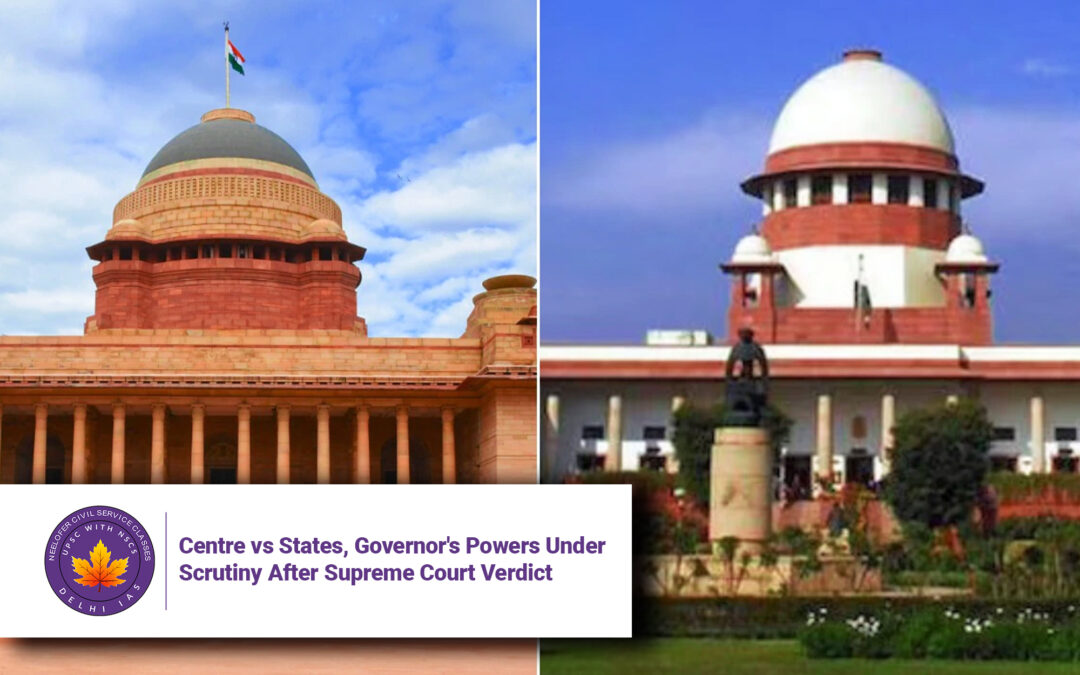
Centre vs States, Governor’s Powers Under Scrutiny After Supreme Court Verdict
Why in News?
On April 8, 2025, the Supreme Court delivered a significant judgment declaring Tamil Nadu Governor R.N. Ravi’s act of withholding assent to 10 Bills passed by the State Assembly as “illegal and erroneous.” However, instead of accepting the ruling, the Central government has now sought a Presidential Reference under Article 143, reopening questions the Court had already settled. 
Introduction
In recent years, growing tension between State governments and Governors has raised questions about the balance of power between the Centre and States. The latest move by the Union government to seek the President’s opinion on already resolved matters through Article 143 has reignited debates on federalism, democratic functioning, and the limits of gubernatorial authority.
Key Issues and Background
1. Supreme Court Verdict of April 8, 2025
-
A Division Bench of Justices J.B. Pardiwala and R. Maheshwari ruled that withholding assent without justification violates constitutional principles.
-
The Court clarified that while the Constitution does not set a time limit for assent, it does not permit indefinite inaction.
-
The verdict declared that Governors and the President cannot arbitrarily block laws passed by elected State Assemblies.
2. Presidential Reference under Article 143
-
The Union government has now approached the Supreme Court seeking its ‘opinion’ on the same issues already ruled upon.
-
Article 143 allows the President to seek the Court’s opinion, but it does not override a court judgment.
-
Legal scholars see this as an attempt to delay or dilute the effect of the earlier ruling.
The Core of the Concern
Centralisation vs Federal Autonomy
-
The misuse of gubernatorial powers by unelected appointees is seen as undermining the mandate of democratically elected State governments.
-
This strategy threatens the constitutional balance, where both the Centre and States are expected to work autonomously under a cooperative federal model.
Key Observations
-
The Centre could have ended the controversy by implementing the Supreme Court ruling and initiating amendments if needed.
-
Instead, by raising already settled matters through a Presidential Reference, it appears to be resisting judicial discipline.
-
The real fear is that Governors may continue to act as political agents, stalling legislative processes in opposition-ruled States.
Conclusion
The April 2025 Supreme Court judgment was a watershed moment for restoring State legislative sovereignty. By attempting to revisit this issue via a Presidential Reference, the Centre risks undermining constitutional clarity and weakening democratic norms. A consensus on the role of the Governor, aligned with federal principles and judicial guidance, is urgently needed to ensure smooth governance and constitutional propriety.
5 Questions and Answers
Q1. What was the Supreme Court’s verdict on April 8, 2025?
A: The Court ruled that Tamil Nadu Governor R.N. Ravi’s act of withholding assent to 10 Bills was “illegal and erroneous,” affirming that neither the Governor nor the President has arbitrary powers to indefinitely block state legislation.
Q2. What is Article 143 of the Indian Constitution?
A: Article 143 allows the President to seek the Supreme Court’s opinion on legal or constitutional matters. However, it cannot be used to override settled judicial rulings.
Q3. Why is the Centre’s use of a Presidential Reference controversial?
A: Legal experts argue that the move reopens already settled issues, signaling the Centre’s reluctance to accept the Supreme Court’s authority and potentially undermining State autonomy.
Q4. How does the Court’s ruling strengthen Indian federalism?
A: By limiting the Governor’s powers and reaffirming the primacy of elected State Assemblies, the judgment strengthens the federal balance and democratic accountability.
Q5. What is the way forward to resolve such conflicts?
A: The Centre should respect judicial rulings and, if needed, seek broad political consensus through forums involving Chief Ministers and MPs to clearly define the Governor’s role, rather than undermining federal principles via Presidential References.

